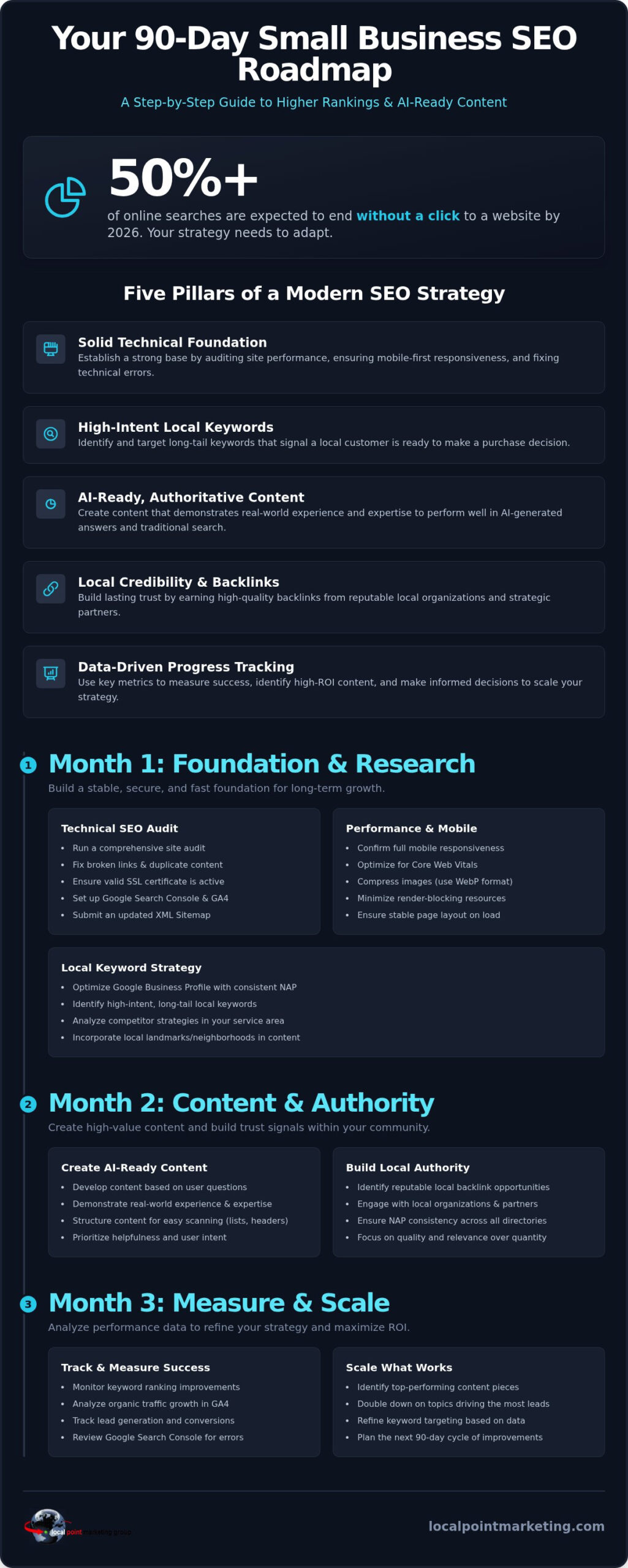

Did you know that traditional search engine volume is projected to drop by 25% this year? As we move through 2026, the era of the “ten blue links” is quickly fading into the background. It’s natural to feel concerned when AI-generated summaries provide immediate answers, often bypassing the need for a click to your website. You likely feel the pressure to keep up with complex jargon like Generative Engine Optimization while managing your daily operations. It’s a significant shift, but it doesn’t have to be a setback for your local growth.
Many owners are now turning to specialized AI SEO services for small business to bridge this technical gap and ensure their brand isn’t left behind. We’ve designed this report to help you reclaim your visibility and move forward with confidence. You’ll discover how to position your brand as a preferred source for AI agents so your expertise is the one being cited. We will break down the 2026 search landscape and provide a clear roadmap to ensure your business remains a trusted authority in an AI-first world. By the end of this guide, you’ll have actionable steps to turn these technological shifts into your competitive advantage.
Key Takeaways
- Understand the shift from traditional search engines to answer engines and how being cited by AI models defines modern digital visibility.
- Discover why existing SEO foundations require new content formats to remain effective in a zero-click search environment.
- Learn how to optimize your presence in South Florida so AI agents recommend your business to customers in Miami and Fort Lauderdale.
- Identify how managed AI SEO services for small business provide the technical expertise needed to stay ahead without overwhelming your team.
- Gain a clear roadmap for transitioning your brand from a simple list of links to a trusted, AI-cited authority.
What is Generative AI Search Visibility in 2026?
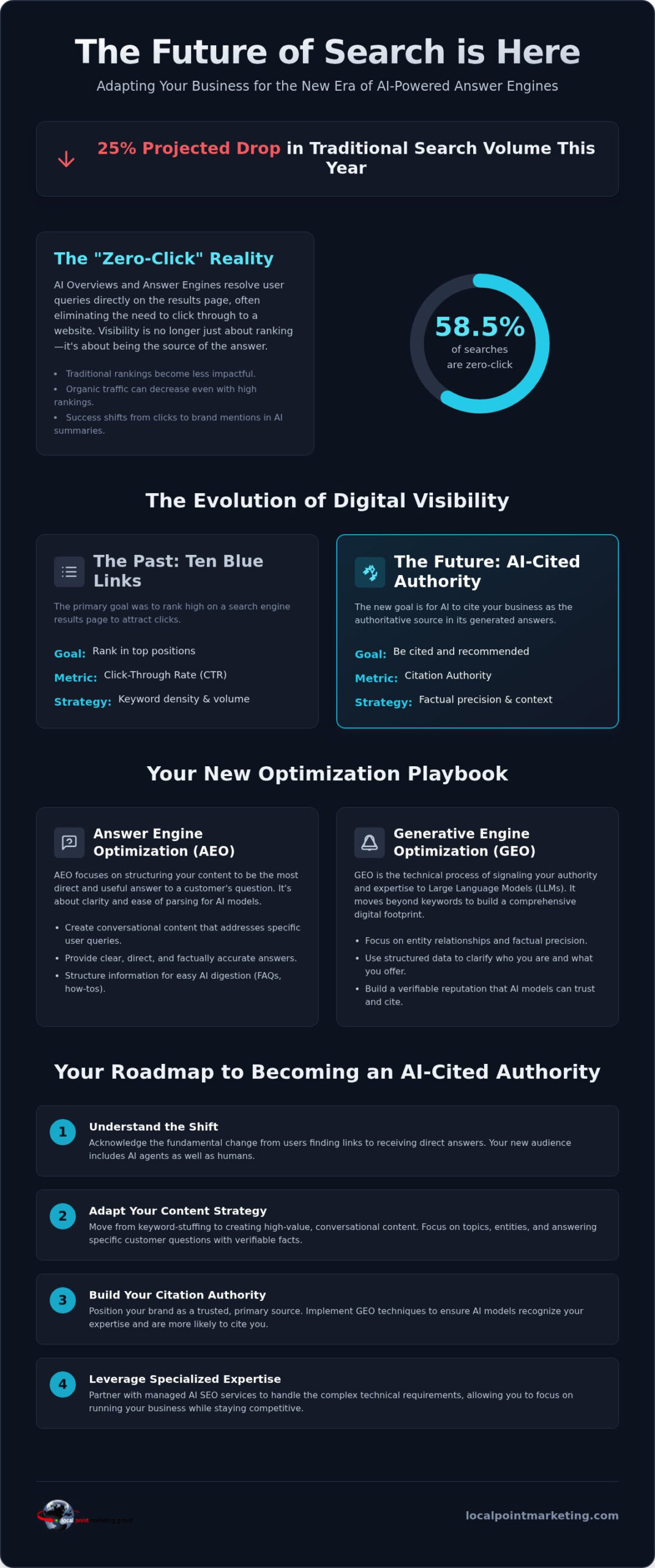
The digital landscape of 2026 has shifted from finding a website to receiving a direct answer. Generative AI search visibility refers to the ability of your brand to be cited and recommended by AI models rather than just appearing in a list of links. We have moved past the era where search engines were simple directories. Today, platforms like Google Search Generative Experience (SGE), Perplexity, and ChatGPT act as answer engines. They synthesize information from across the web to provide users with immediate solutions. For small businesses, this means that visibility is now measured by how often an AI model uses your content as a primary source.
Traditional metrics like click-through rates are no longer the only way to measure success. In this new environment, citation authority has become the gold standard. When an AI summarizes your services, it often provides a citation link to your site as proof of its answer. This transition is driven by Large Language Models (LLMs) that prioritize factual accuracy and authoritative voices. Consumer discovery happens within these conversational interfaces, making it vital to secure a place within the AI’s response. Utilizing specialized AI SEO services for small business ensures your brand is formatted correctly for these models to digest and display.
The Rise of Answer Engine Optimization (AEO)
AI engines work by summarizing high-quality web content to resolve direct user queries. This shift has given rise to Answer Engine Optimization (AEO). In 2026, being the source for an AI-generated answer is the equivalent of ranking in the top spot on Page 1. To achieve this, content must be structured conversationally. You should focus on providing clear, direct answers to the specific questions your customers are asking. When your content is easy for an AI to parse and repeat, your likelihood of being the cited authority increases significantly. This strategy helps you capture the attention of users who want immediate information without scrolling through multiple results.
Generative Engine Optimization (GEO) Explained
Generative Engine Optimization (GEO) is the process of optimizing content for citation by LLMs. Unlike traditional SEO, which often relied on keyword density, GEO focuses on entity relationships and factual precision. It’s about demonstrating your business’s role within your local industry and community. By providing structured data and verifiable facts, you help AI models understand exactly who you are and what you offer. This approach moves away from keyword stuffing and toward building a comprehensive digital footprint. Integrating Generative Engine Optimization (GEO) into your marketing strategy allows your business to remain relevant as search technology continues to evolve. Professional AI SEO services for small business focus on these technical nuances to keep your brand visible and trusted by the systems consumers use every day.
Why Traditional SEO Isn’t Enough for Small Businesses Anymore
The search experience has undergone a fundamental transformation. For years, the primary goal was to rank in the top ten blue links. Today, those links often appear below a massive AI Overview that satisfies the user’s intent instantly. This has created a zero-click reality. Research indicates that over 58.5% of Google searches now conclude without a single click to an external website. For a local business, this means your traditional rankings might still be high, but your organic traffic could be disappearing as AI answers the query on the results page.
Basic keyword targeting no longer captures how users interact with modern search engines. Users now input complex, conversational queries that require more than a simple phrase match. AI models don’t look for exact word repetitions; they look for the most authoritative answer. This shift requires a move from volume-based metrics to “brand mentions” within AI responses. If an AI summary doesn’t mention your name as a source, you are effectively invisible to the user. Seeking out AI SEO services for small business helps you navigate this shift by focusing on how AI perceives your brand’s relevance and authority.
The Death of the Keyword-Only Strategy
AI now understands context better than any previous algorithm. It looks at the intent behind a search rather than just the specific phrases used. This means your strategy must move from “keywords” to “topics and entities.” AI systems are designed to filter out low-value, repetitive content that doesn’t add new information to the conversation. As highlighted in a recent OECD report on AI and SMEs, the adoption of these technologies is a critical step for smaller firms to maintain their competitive edge. Relying on old-school keyword stuffing will likely lead to being ignored by modern answer engines that value depth and clarity.
Building Entity Authority
To stay visible, your business must become a recognized entity in your local market. This involves more than just having a website. It requires a cohesive digital footprint that Google’s Knowledge Graph can verify. When generative AI looks for a source, it seeks out entities it trusts. Your customer reviews, social signals, and consistent business information all feed into this trust. Building this authority ensures that when a customer asks for a recommendation in South Florida, the AI has the confidence to cite your business as the expert solution. Managed services can provide the steady guidance needed to build this digital reputation without taking time away from your daily operations.
AI Visibility vs. Traditional SEO: A 2026 Comparison
Understanding the distinction between traditional search rankings and AI visibility is essential for sustained growth. While traditional SEO focuses on optimizing for specific keywords to secure a spot in the top results, AI search optimization leverages this foundation to achieve a different objective. Instead of simply appearing in a list of links, your goal is to be the primary source an AI model uses to construct its narrative answer. This shift requires a change in content formatting because AI models prioritize narrative depth and structured context over simple, repetitive lists.
The technical requirements have also evolved significantly. Schema markup remains a vital tool for communicating with search engines, but we are moving toward a world of LLM-readable API data that allows AI models to pull real-time information about your business. Measuring success in 2026 looks different than it did just a few years ago. Rank tracking is being supplemented by sentiment and citation tracking to see how often your brand is recommended. Utilizing AI SEO services for small business ensures that these technical nuances are managed correctly to maintain your competitive edge.
The Complementary Nature of Modern Search
You still need a strong technical SEO base to feed the AI models. Without a crawlable site structure, AI agents cannot find the information they need to recommend your brand to users. Your local SEO strategy provides the geographic data these systems use to answer location-based questions. A recent paper on Generative AI’s impact on small business processes highlights that businesses successfully blending human-centric content with machine-readable structures see the highest engagement levels. It’s about balancing the warmth of your brand voice with the precision that modern algorithms require.
New Metrics for a New Era
Success is no longer just about where you sit on a results page. We now track “Share of Model,” which measures how frequently AI platforms mention your brand compared to your competitors. Brand sentiment has also become a critical factor in AI training data. If the digital conversation around your business is positive and consistent, AI models are much more likely to trust and cite you as an authority. Brand Salience has emerged as the primary metric for 2026 because it measures how prominent your brand is in the “mind” of the AI. Investing in AI visibility marketing ensures that these new metrics are tracked and optimized to secure your long-term visibility.
Winning the Local AI Search Battle in South Florida
AI handles local intent with a level of precision that traditional search could never match. It identifies proximity and verified presence in cities like Miami and Fort Lauderdale by triangulating data from multiple sources. Your Google Business Profile has become the primary source of truth for these generative results. AI models pull your operating hours, specific service offerings, and physical location directly from this profile to answer user questions without a single click. Ensuring this information is consistent across the web is the first step toward securing an AI recommendation.
Local reviews are now the most significant trust signal for AI. These systems don’t just count your stars; they perform sentiment analysis on the actual text of your customer feedback. If a user asks for a reliable contractor in Fort Lauderdale, the AI scans your reviews for phrases like “on time” or “fair pricing” to validate its answer. Professional AI SEO services for small business help you manage these reputation signals to ensure you remain the top choice. High-quality strategy also focuses on creating hyper-local content that bridges the gap between a general city search and a neighborhood-specific recommendation.
Geographic Signals for AI Citations
Optimizing for “near me” queries in 2026 requires more than just a zip code. AI uses local landmarks and neighborhood names to verify your proximity and relevance to a specific area. This is why targeting neighborhoods from Boca Raton to Jupiter with specific content is so effective. Miami businesses can anchor their AI visibility by referencing hyper-local landmarks like the Vizcaya Museum or the Wynwood Walls within their service descriptions. This provides the necessary context for the AI to confirm your business is a true fixture in the local community.
The Importance of Local Structured Data
Schema.org allows you to communicate directly with AI models in a language they understand. By using local structured data, you tell the AI exactly where you are and what services you provide in areas like Palm Beach or Stuart. This technical layer ensures your business is connected to the right local service entities. Effective AI search optimization relies on this verified data to build authority with Large Language Models. When your technical data is clean and accurate, AI models can cite your business as the definitive local option. To secure your brand’s future in the South Florida market, you can partner with Local Point Marketing to handle these complex technical requirements through specialized AI SEO services for small business.
Managed AI SEO Services: The Small Business Solution
Many small business owners attempt a DIY approach by subscribing to the latest AI software suites. While these tools are powerful, they often carry a hidden cost in the form of your most valuable resource: time. Managing a complex array of AI tools can easily consume 20 hours or more each week. A software subscription is not a marketing strategy; it is simply a utility that requires expert handling to produce results. Investing in professional AI SEO services for small business allows you to reclaim your schedule while ensuring your digital strategy is managed by specialists.
The return on investment for professional AI integration far exceeds the value of a standalone tool. Managed services focus on high-level lead generation and brand authority rather than just technical maintenance. By partnering with a dedicated agency, you gain access to a team that monitors citation rates and AI sentiment in real time. Local Point Marketing prioritizes measurable visibility growth, moving your business beyond simple rankings and into the realm of trusted AI recommendations. This methodical approach provides the steady growth your business needs to thrive in a competitive market.
Bridging the Technical Gap
The shift from traditional SEO to Generative Engine Optimization (GEO) is happening faster than many expected. Letting experts handle this transition ensures your business doesn’t fall behind as search engines evolve into answer engines. Managed retainers are designed to adapt to the rapidly changing AI landscape, providing a level of agility that DIY methods cannot match. You gain the peace of mind that comes with a data-driven partner who values evidence over hype. This collaboration allows your brand to maintain a consistent presence across all major AI models without requiring you to master new technical skills every month.
Starting Your AI Visibility Journey
The transition from being invisible to becoming a cited authority typically takes place over the first 90 days of a managed campaign. During this time, your digital footprint is audited and reorganized to meet the specific requirements of Large Language Models. It is also important to consider how AI search impacts PPC campaigns, as your paid and organic efforts must work in harmony to dominate the results page. Aligning these strategies ensures that your business is visible whether a user is looking for a quick answer or a sponsored solution. To begin this transformation, you can schedule your 2026 AI Visibility Audit with Local Point Marketing and secure your place as a leader in your industry. Our AI SEO services for small business are built to provide the technical expertise and reliable partnership you need for long-term success.
Securing Your Place in the Future of Search
The transition to 2026 search requires moving beyond traditional ranking lists to focus on citation authority and entity trust. Your visibility now depends on being the primary source that AI models rely on to answer direct customer questions. By optimizing for specific local intent and technical schema, you ensure your South Florida brand remains at the forefront of this digital shift. It is no longer about just showing up; it is about being the trusted recommendation that answer engines provide to your future customers.
Navigating this landscape alone can be overwhelming, but you don’t have to manage it by yourself. Utilizing professional AI SEO services for small business provides the strategic framework needed to stay ahead without sacrificing your valuable time. Local Point Marketing offers ten years of search marketing experience and specialized AI integration to help South Florida SMBs achieve measurable results focused on lead generation. We invite you to secure your business’s future with managed AI SEO services from Local Point Marketing. The path to growth is clear, and we are ready to help you lead the way in this new era of search.
Frequently Asked Questions
What is the difference between SEO and Generative AI search visibility?
Traditional SEO focuses on optimizing your website for a list of blue links, whereas AI search visibility targets being the specific source cited by an answer engine. While SEO builds your foundation, AI visibility ensures your brand is synthesized into the narrative responses generated by models like ChatGPT or Google SGE. It moves the goal from simply getting a click to becoming the trusted answer.
Will AI search kill traditional organic traffic for my small business?
AI search doesn’t kill traffic, but it fundamentally changes how users discover your business. While zero-click searches are increasing, the traffic that does reach your site is often higher in intent because the user has already vetted your brand through an AI summary. Businesses that adapt see their traffic shift from broad, informational visits to qualified leads who are ready to engage with a cited authority.
How does Google’s Search Generative Experience (SGE) pick which businesses to cite?
Google SGE selects businesses based on entity authority, factual accuracy, and the quality of structured data on your website. The system looks for clear, verified information that directly answers a user query with high confidence. By maintaining consistent business information and positive customer sentiment across the web, you increase the likelihood that Google’s Large Language Models will choose your brand as a primary citation.
Do I need special software to rank in AI search results?
You don’t necessarily need special software to rank, but you do need a specialized strategy that includes technical schema and conversational content. While many tools exist to analyze AI results, the real work involves restructuring your digital footprint to be machine-readable. Most small businesses find that managed AI SEO services for small business are more effective than software because they provide the expert analysis that automated tools miss.
How much do AI SEO services for small businesses typically cost?
Pricing for professional services is typically structured as a monthly retainer that scales with your specific business goals. This model allows for the ongoing monitoring and technical adjustments required to keep up with rapid AI updates. By focusing on a data-driven approach, you ensure that your marketing budget is directed toward measurable visibility and lead generation rather than just paying for software tool subscriptions.
Can I still rank locally in Miami if I don’t use AI SEO?
You may still appear in traditional local results for a time, but your visibility will likely decrease as more users shift to AI-driven discovery. In a competitive market like Miami or Fort Lauderdale, answer engines are becoming the primary way consumers find service providers. Without a strategy focused on AI visibility marketing for South Florida businesses, your business risks being bypassed by competitors who are actively being cited as the top local experts.
How long does it take to see results from AI search optimization?
Most small businesses begin to see measurable shifts in their AI citation rates within the first 90 days of an optimized campaign. This initial period is used to audit your digital footprint and implement the structured data necessary for AI models to trust your information. Because AI models are constantly retraining on new data, your visibility typically grows as your brand sentiment and authority strengthen over several months.
Is AI SEO just another word for Answer Engine Optimization?
Answer Engine Optimization (AEO) is a key component of AI SEO, but the two are not identical. AI SEO is a broader strategy that includes Generative Engine Optimization (GEO) and the management of your brand presence across multiple Large Language Models. A comprehensive approach using AI SEO services for small business ensures your brand is also cited, recommended, and trusted in various conversational contexts beyond just direct answers.