
What if the customers you’re trying to reach are already searching for your business online, but finding your competitors instead? For many South Florida businesses, that’s exactly what’s happening. Local SEO is the practice of optimizing your online presence so that nearby customers can find you first, and in a market as competitive as South Florida, it’s not something you can afford to overlook.
If you’ve ever wondered why your business doesn’t show up in local search results, or felt unsure about how to make the most of your Google Business Profile, you’re not alone. Most business owners understand that visibility online matters; they just don’t know where to start.
This guide is designed to change that. You’ll learn the core principles of local SEO, discover practical strategies to improve your rankings in local searches, and understand how to attract more customers from the communities you serve. From optimizing your online listings to building a stronger local presence, every section is built to give you clear, actionable steps forward.
Key Takeaways
- Local SEO is essential for South Florida businesses that want nearby customers to find them first – before the competition does.
- Optimizing your Google Business Profile is one of the most impactful steps you can take to improve your visibility in local search results.
- A combination of on-page SEO strategies and consistent online listings builds the foundation for stronger local rankings over time.
- Tracking your performance with the right tools helps you make data-driven decisions and refine your local SEO efforts as your market evolves.
- By the end of this guide, you’ll have a clear, actionable roadmap to attract more customers from the South Florida communities you serve.
What is Local SEO and Why is it Important for South Florida Businesses?
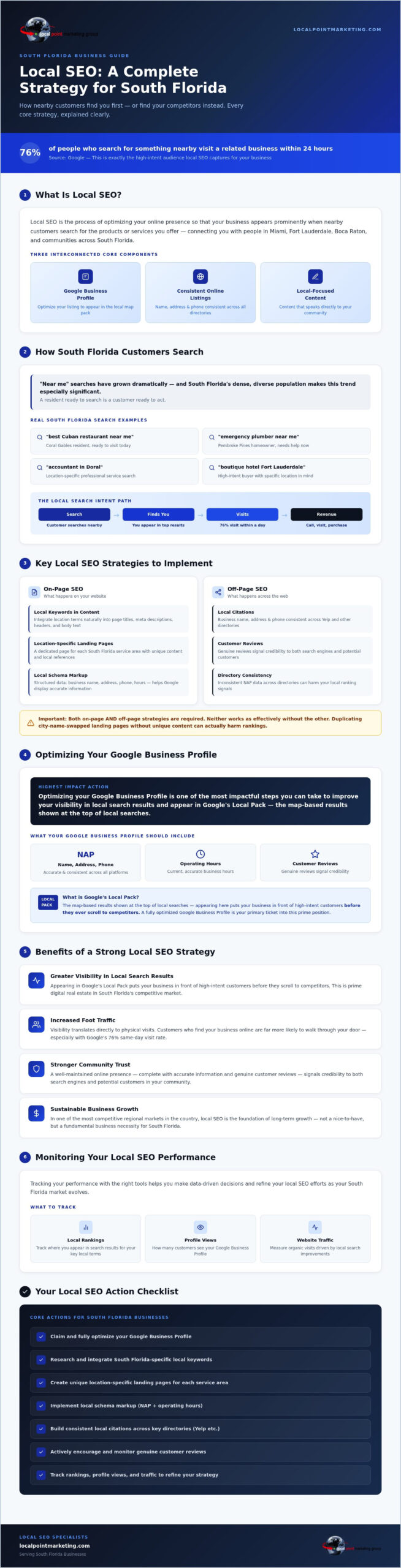
Local SEO is the process of optimizing your online presence so that your business appears prominently when nearby customers search for the products or services you offer. Unlike broader SEO efforts that target national or global audiences, local SEO focuses on connecting you with people in your specific geographic area, whether that’s Miami, Fort Lauderdale, Boca Raton, or any of the communities across South Florida.
At its core, local SEO involves three interconnected components: optimizing your Google Business Profile, building consistent business listings across the web, and creating content that speaks directly to your local audience. Together, these elements signal to search engines that your business is relevant, trustworthy, and worth showing to nearby searchers.
Understanding Local Search Behavior
South Florida customers search differently than a general online audience. They’re looking for immediate solutions close to home. According to Google, 76% of people who search for something nearby on their smartphone visit a related business within a day. That kind of intent is powerful, and it’s exactly the audience local SEO is designed to capture.
“Near me” searches have grown dramatically over the past several years, and South Florida’s dense, diverse population makes this trend especially significant here. A resident in Coral Gables searching for “best Cuban restaurant near me” or a homeowner in Pembroke Pines looking for “emergency plumber near me” is ready to act. The businesses that appear first in those results earn the call, the visit, and the revenue.
Identifying the right local keywords for your business means thinking like your customers. Consider terms that combine your service with a neighborhood, city, or regional identifier. Phrases like “accountant in Doral” or “boutique hotel Fort Lauderdale” reflect how real South Florida customers search, and targeting them strategically puts your business directly in their path.
Benefits of Local SEO for Your Business
The advantages of a strong local SEO strategy extend well beyond search rankings. Here’s what consistent local optimization delivers:
- Greater visibility in local search results: Appearing in Google’s local pack, the map-based results shown at the top of local searches, puts your business in front of high-intent customers before they ever scroll to competitors.
- Increased foot traffic: Visibility translates directly to physical visits. Customers who find you online are far more likely to walk through your door.
- Stronger community trust: A well-maintained online presence, complete with accurate information and genuine customer reviews, signals credibility to both search engines and potential customers.
For South Florida businesses operating in one of the most competitive regional markets in the country, local SEO isn’t a nice-to-have. It’s the foundation of sustainable growth.
How Local SEO Works: Key Strategies to Implement
Understanding why local SEO matters is only the first step. The real work lies in knowing exactly what to do about it. A strong local SEO strategy operates on two fronts: what happens on your website and what happens across the broader web. Both matter, and neither works as well without the other.
On-Page SEO for Local Optimization
Your website needs to communicate your location clearly and consistently to search engines. That starts with integrating local keywords naturally into your page titles, meta descriptions, headers, and body content. A law firm in Fort Lauderdale, for example, benefits from pages that specifically reference the communities it serves rather than using generic language that could apply anywhere.
Location-specific landing pages take this further. If your business serves multiple South Florida communities, a dedicated page for each service area helps search engines match your content to the right local queries. Each page should include unique content, local references, and relevant service details rather than duplicating the same text with a different city name swapped in.
Local schema markup is another layer worth implementing. This structured data tells search engines precisely what your business is, where it’s located, and what it offers. Adding schema for your business name, address, phone number, and operating hours makes it easier for Google to display accurate information about your business in search results. If you want to go deeper on the technical and content fundamentals that drive search visibility, this comprehensive guide on how to rank higher on Google covers the full spectrum of strategies that support stronger rankings.
Off-Page SEO Techniques
Off-page signals carry significant weight in local rankings. Local citations, which are mentions of your business name, address, and phone number across directories like Yelp, the Better Business Bureau, and local Chamber of Commerce listings, help establish credibility and consistency in the eyes of search engines. Inconsistent information across these sources can quietly undermine your rankings, so accuracy is non-negotiable.
Backlinks from locally relevant, authoritative sources strengthen your domain’s trustworthiness. Earning links from South Florida news outlets, local business associations, or community organizations sends a clear signal that your business is a legitimate, established presence in the region. Focus on building genuine relationships rather than chasing volume.
Social media plays a supporting role that’s easy to underestimate. Active engagement on platforms like Facebook and Instagram, particularly with South Florida community groups and local events, reinforces your geographic relevance and drives traffic back to your website. Consistent posting that references your service areas and local community keeps your brand visible between searches. If you want to turn that social presence into a structured lead-generation engine, a dedicated social media marketing strategy for local business can help you move beyond basic posting toward measurable growth.
- Audit your citations regularly to ensure your business information is accurate across all directories.
- Prioritize quality over quantity when pursuing backlinks; one link from a respected local publication outweighs dozens from low-authority sources.
- Engage authentically on social media by participating in local conversations, not just broadcasting promotional content.
Putting these strategies into practice consistently is what separates businesses that rank from those that don’t. If you’d like expert guidance on building a local SEO foundation tailored to the South Florida market, explore how Local Point Marketing approaches local search optimization.
Optimizing Your Google Business Profile for Local SEO
Your Google Business Profile is often the first thing a potential customer sees when they search for your business. It appears in Google Maps, the local pack, and knowledge panels, making it one of the most visible assets you control. Getting it right isn’t complicated, but it does require attention to detail and consistent maintenance.
Setting Up Your Google Business Profile
Start by claiming your listing at Google Business Profile Manager. If your business already exists in Google’s database, you’ll need to verify ownership, typically through a postcard mailed to your business address, a phone call, or email verification. Once verified, you have full control over how your business appears in search results.
Choosing the right primary category is one of the most consequential decisions you’ll make during setup. Google uses your category to determine which searches trigger your listing. Be specific: a business in Coral Gables offering family dental care should select “Dentist” rather than “Health Care Provider.” You can add secondary categories to capture related searches, but your primary category should reflect your core offering as precisely as possible.
Fill out every available field completely. That means your business name, address, phone number, website URL, service areas, hours of operation, and a thorough business description. Consistency with the information on your website and across other directories reinforces the credibility signals that search engines rely on.
Maximizing Your Profile’s Potential
Customer reviews carry real weight in local rankings and in the trust decisions of prospective customers. The most effective way to earn reviews is simply to ask. After a positive interaction, invite your customers to share their experience on Google. A direct link to your review page removes friction and increases follow-through. When reviews come in, respond to every one of them. Thank customers for positive feedback and address concerns professionally in negative ones. Thoughtful responses signal to both Google and future customers that your business is engaged and accountable.
Photos and videos give your profile substance. Businesses with strong visual content consistently attract more clicks and direction requests than those without. Upload high-quality images of your storefront, team, products, and services. Refresh your photo library regularly so the profile feels current.
Google Posts let you share updates, promotions, and announcements directly on your profile. Use them to highlight seasonal offers, community involvement, or new services. Posts expire after seven days, so a consistent posting cadence keeps your profile active and signals ongoing relevance to Google.
- Review your profile insights monthly to understand how customers are finding you and what actions they’re taking.
- Track search queries that surface your profile to identify new keyword opportunities for your broader local SEO strategy.
- Monitor your photo views to gauge which visual content resonates most with your audience.
A fully optimized, actively maintained Google Business Profile doesn’t just improve your rankings. It builds the kind of first impression that converts a search into a customer.
Tools and Resources for Monitoring Local SEO Performance
Implementing a local SEO strategy is only half the equation. Knowing whether it’s working, and where to adjust, is what separates businesses that improve steadily from those that stall. The right tools give you visibility into your performance, your customers’ behavior, and the competitive landscape around you.
Essential Local SEO Tools
Google Search Console is the logical starting point. It shows you exactly which search queries are driving impressions and clicks to your website, how your pages rank for specific terms, and whether Google is encountering any technical issues that could suppress your visibility. For local SEO, pay close attention to queries that include city names, neighborhood references, or “near me” language. These tell you which local searches are already connecting customers to your site and which opportunities you haven’t yet captured.
For rank tracking across specific geographic areas, tools like Moz Local and Ahrefs provide more granular data than Search Console alone. Moz Local is particularly useful for managing citation consistency across directories, alerting you when your business information appears incorrectly somewhere online. Ahrefs helps you analyze your backlink profile and benchmark your domain authority against local competitors. Used together, they give you a clear picture of both your content performance and your off-page credibility.
Review management deserves its own dedicated attention. Platforms like BirdEye aggregate your reviews from Google, Yelp, and other sources into a single dashboard, making it easier to monitor sentiment, respond promptly, and identify patterns in customer feedback. Yelp’s own business tools also offer useful analytics on profile views and customer actions, particularly for businesses in South Florida’s hospitality and service sectors.
Analyzing Performance and Making Adjustments
Raw data only creates value when you interpret it correctly. Google Analytics, connected to your Search Console account, reveals how local visitors behave after they reach your site: which pages they visit, how long they stay, and whether they convert into leads or customers. A high volume of local traffic paired with low engagement often signals a mismatch between what searchers expect and what your pages deliver.
Set a regular review cadence, monthly at minimum, to assess your key metrics and identify trends. Declining impressions for a specific service area might indicate a competitor has strengthened their presence there. A drop in review volume might mean your request process needs attention. These signals are actionable when you catch them early.
- Track ranking changes by location to understand how your visibility shifts across different South Florida communities.
- Monitor your Google Business Profile insights separately from website analytics; they measure different customer touchpoints.
- Review citation accuracy quarterly using Moz Local or a similar tool to catch inconsistencies before they affect rankings.
Staying current with local SEO trends matters too. Google updates its local search algorithms regularly, and what works today may need refinement tomorrow. As AI-generated results now appear at the top of more than half of all Google searches, understanding AI search optimization and how it affects your business visibility in 2026 is becoming just as important as traditional ranking tactics. Following sources like Google’s Search Central Blog and reputable industry publications keeps your strategy grounded in current best practices rather than outdated assumptions.
If interpreting this data feels overwhelming or time-consuming, working with an experienced partner makes the process more efficient. Learn how Local Point Marketing uses data-driven strategies to monitor and improve local SEO performance for businesses across South Florida.
Conclusion: Taking Your South Florida Business to the Next Level with Local SEO
The path to stronger local visibility is clearer than most business owners realize. Throughout this guide, you’ve seen how local SEO operates across multiple layers: your website, your Google Business Profile, your citation footprint, and the data tools that help you measure progress. Each layer reinforces the others, and together they build the kind of online presence that consistently puts your business in front of the right customers at the right moment.
South Florida is a market that rewards businesses willing to invest in their local presence. The competition is real, but so is the opportunity. Customers across Miami, Fort Lauderdale, Boca Raton, and every community in between are actively searching for the services you offer. The businesses that appear first in those results aren’t there by accident. They’ve made deliberate, consistent efforts to earn that visibility, and you can do the same.
The strategies covered here are actionable starting points, not abstract theory. Optimizing your on-page content for local keywords, maintaining accurate citations, building your Google Business Profile, and tracking your performance with the right tools are all steps you can begin taking today. Progress compounds over time. Small, consistent improvements lead to meaningful ranking gains, and those gains translate directly into more calls, more visits, and more revenue.
That said, managing a comprehensive local SEO strategy alongside running a business is a significant undertaking. Knowing what to do and having the bandwidth to do it consistently are two different things.
That’s where Local Point Marketing comes in. With a decade of experience helping South Florida businesses grow their digital presence, Local Point Marketing brings data-driven SEO strategies and genuine local market expertise to every client relationship. The approach is built around your outcomes, not generic templates. Whether you’re starting from scratch or looking to strengthen an existing foundation, the team works alongside you as a reliable partner focused on measurable results.
- SEO strategies tailored to your specific South Florida market and the communities you serve.
- Content creation and social media marketing that reinforces your local presence across channels.
- Ongoing performance monitoring to ensure your strategy evolves as your market does.
Taking the next step doesn’t require a complete overhaul overnight. It starts with a conversation. Reach out to Local Point Marketing today to discuss how a focused local SEO strategy can help your South Florida business grow.
Start Growing Your Local Presence Today
Local SEO isn’t a one-time fix; it’s an ongoing investment that builds momentum over time. The strategies covered in this guide, from optimizing your Google Business Profile to tracking performance with the right tools, give you a proven framework for attracting more customers across South Florida’s competitive market.
Three things matter most as you move forward: consistency, accuracy, and patience. Businesses that commit to these principles don’t just rank higher; they build lasting credibility with the communities they serve.
If you’re ready to put these strategies into practice but want an experienced partner alongside you, Local Point Marketing brings over 10 years of digital marketing expertise and a data-driven approach tailored to local businesses like yours. The focus is always on your outcomes, not generic solutions.
Your next customer is already searching. Make sure they find you first. Contact Local Point Marketing today to boost your local SEO and take a confident step toward sustainable growth.
Frequently Asked Questions About Local SEO
What is local SEO and how does it differ from traditional SEO?
Local SEO focuses specifically on improving your visibility for searches tied to a geographic area, such as “plumber in Miami” or “dentist near me.” Traditional SEO targets broader audiences without a location component, aiming to rank for terms that could apply anywhere. The strategies overlap in some areas, but local SEO adds layers like Google Business Profile optimization, citation building, and location-specific content that general SEO doesn’t prioritize.
For South Florida businesses serving customers in specific cities or neighborhoods, local SEO is the more relevant discipline. It connects you with people who are nearby, searching with immediate intent, and ready to make a decision.
How can I improve my Google Business Profile for better visibility?
Complete every field in your profile accurately, starting with your business name, address, phone number, hours, and primary category. Choose your category carefully; it directly influences which searches trigger your listing. Add high-quality photos, respond to every review, and use Google Posts to share updates regularly. Profiles that are fully filled out and actively maintained consistently outperform neglected ones in local search results.
Review your profile insights monthly to understand how customers are finding you and which actions they’re taking. That data tells you where to focus your attention next.
What are the key components of a successful local SEO strategy?
A successful local SEO strategy rests on four pillars: on-page optimization with location-specific keywords and content, a fully maintained Google Business Profile, consistent business citations across directories, and a steady stream of genuine customer reviews. Each element supports the others. Strong on-page content without accurate citations, for example, sends mixed signals to search engines that can suppress your rankings.
Consistency is what ties everything together. Businesses that apply these components regularly and accurately build cumulative authority in their local market over time.
How do online reviews affect my local SEO rankings?
Reviews influence local rankings in two direct ways: the volume of reviews signals to Google that your business is active and trusted, while the content of those reviews introduces natural keyword language that reinforces your relevance. A dental practice in Boca Raton that consistently receives reviews mentioning specific services will strengthen its visibility for those related searches over time.
Beyond rankings, reviews shape the trust decisions of potential customers before they ever contact you. Responding to every review, positive or negative, demonstrates accountability and signals that your business is engaged with the community it serves.
What tools can I use to monitor my local SEO performance?
Google Search Console is the essential starting point, showing you which queries drive traffic to your site and flagging technical issues. Moz Local helps you manage citation consistency across directories, while Ahrefs provides backlink analysis and competitive benchmarking. For review monitoring, platforms like BirdEye aggregate feedback from multiple sources into one dashboard, making it easier to track sentiment and respond promptly.
Use Google Analytics alongside Search Console to understand how local visitors behave once they reach your site. Together, these tools give you a complete picture of your performance across search, citations, and customer engagement.
What are the common mistakes to avoid in local SEO?
The most damaging mistakes are inconsistent business information across directories, neglecting your Google Business Profile after the initial setup, and targeting keywords that are too broad to attract local intent. Duplicate listings on Google Maps are another common issue; they split your authority and confuse search engines about which listing to surface. Thin or duplicated location pages that swap a city name without adding unique, relevant content also undermine rankings rather than supporting them.
Ignoring reviews entirely is a costly oversight. Businesses that don’t actively request or respond to reviews miss one of the most accessible opportunities to build trust and improve their local search visibility simultaneously.
How long does it take to see results from local SEO efforts?
Most businesses begin to see measurable improvements in local rankings within three to six months of consistent effort, though this varies based on your market’s competitiveness, your starting point, and how comprehensively you implement each strategy. Quick wins like completing your Google Business Profile or correcting citation errors can produce visible changes faster. Building domain authority through backlinks and content takes longer but delivers more durable results.
Patience is part of the process. Local SEO compounds over time; the businesses that commit to it consistently are the ones that hold strong rankings and attract steady customer growth across their South Florida communities. If your business isn’t appearing in search results at all, understanding why your business is not showing on Google is an important first step before investing further in optimization.
19 thoughts on “Local SEO Guide for South Florida Businesses: Boost Your Online Presence”