

Over 58% of Google search results now feature AI-generated content at the top of the page, fundamentally changing how customers find your business. This shift makes AI search optimization the most critical factor for maintaining your visibility in 2026. It’s understandable to feel unsettled as traditional organic click-through rates decline and the old rules of keywords seem to vanish. You’ve likely noticed that a simple blue link is no longer enough to capture attention in a zero-click environment where answers are delivered instantly.
This guide provides a clear path to master the transition from chasing keywords to becoming a trusted entity that AI models prioritize. You’ll learn how to adapt your content for generative engines, the growing importance of E-E-A-T, and how to measure success when clicks are no longer the only metric. We’ll show you how to secure your search dominance and find the right partner to manage this evolution with confidence. By focusing on data-rich, authoritative content, your business can thrive as a leader in this new era of digital discovery.
Key Takeaways
- Understand the shift from traditional keyword lists to conversational AI answers and what it means for your brand’s visibility.
- Gain insight into how Retrieval-Augmented Generation (RAG) allows AI models to process and rank your business information in real-time.
- Master the transition to AI search optimization by tracking new performance indicators like inclusion rates and sentiment scores.
- Implement actionable strategies to audit your brand’s “Entity” status and create content that AI engines prioritize as the definitive answer.
- Learn how a managed approach to AI integration ensures your business remains a steady and authoritative leader in the evolving search landscape.
What is AI Search Optimization and Why Does it Matter in 2026?
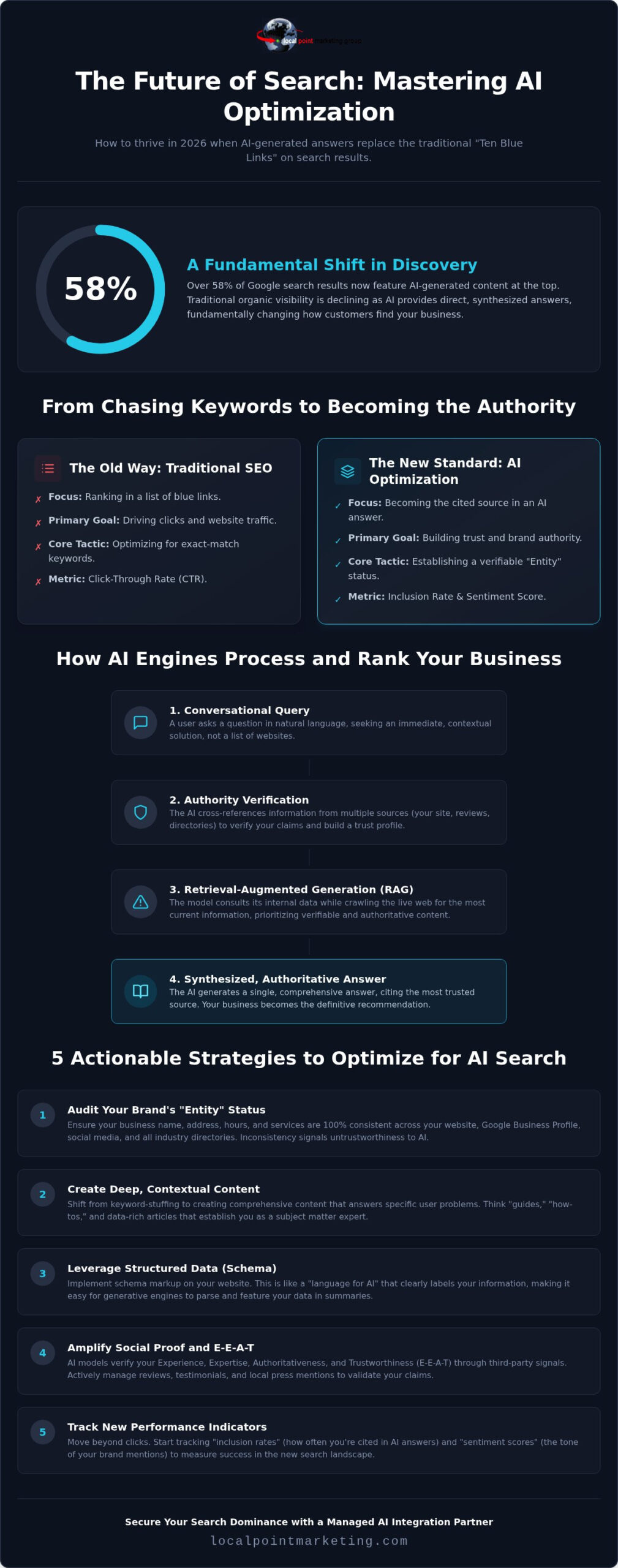
The digital landscape has reached a decisive turning point. As of August 2026, the era of the “Ten Blue Links” has evolved into a conversational ecosystem where answers are delivered instantly. AI search optimization is the strategic process of ensuring your business is the primary source these generative engines use to provide those answers. Unlike Traditional SEO, which focuses on ranking in a list of results, this new discipline ensures your brand is synthesized into a single, authoritative response. With over 58% of Google search results now featuring AI-generated content at the top, the window to secure your spot in these summaries is closing.
Consumer behavior has shifted rapidly. In January 2026, data showed that 37% of consumers began their online searches using AI tools rather than standard search bars. This trend has only accelerated. If your business isn’t optimized for these models, you risk being filtered out entirely by digital assistants that prioritize clear, structured, and factual data. Staying ahead of this curve isn’t just about growth; it’s about remaining discoverable in a world where AI assistants act as the new gatekeepers of information. Our Generative AI Search Visibility 2026 Trend Report for Small Businesses provides a deeper look at how these shifts are affecting local brands and what specialized AI SEO services for small business can do to close the gap.
From Keywords to Contextual Intent
Modern AI models no longer just look for matching words. They seek to understand the “why” behind a query to provide a relevant solution. This shift has led to a decline in the importance of exact-match keywords. Instead, semantic relevance has become the new gold standard for visibility. AI search engines now identify your business as an “entity” within a broader knowledge graph. To succeed, your content must provide deep, contextual value that answers specific user problems. When your brand consistently provides the most helpful information, AI models recognize you as a reliable authority in your field.
The Rise of Generative Engines: SGE, Perplexity, and Beyond
The search market is more diverse than ever before. While Google maintains approximately 80% of the global search share through Gemini and Search Generative Experience (SGE), new players have gained significant ground. ChatGPT now holds a 10-15% share, while Perplexity processes an estimated 50 million weekly queries. These platforms aggregate data differently than traditional crawlers, often prioritizing “extractable” content that fits neatly into a summary. This has led to an increase in zero-click searches, where users find everything they need without ever leaving the search interface. Success in this environment means being the cited source that the AI trusts to represent the facts.
How AI Search Engines Process and Rank Your Business Information
AI search engines operate differently than the index-based systems of the past. They utilize a process called Retrieval-Augmented Generation (RAG). This allows the model to consult its massive internal training sets while simultaneously crawling the live web for the most current information. This dual approach makes AI search optimization a continuous effort. It isn’t enough to have been relevant three years ago; your brand must remain active and verifiable in real-time. By combining stored knowledge with fresh data, AI models provide answers that are both deep and timely.
Research into Generative Engine Optimization (GEO) shows that AI models prioritize content that is authoritative and easily verifiable. Your digital footprint matters more than ever. AI assistants don’t just look at your homepage. They scan third-party reviews, social media profiles, and industry directories to build a complete profile of your business as an entity. This holistic view helps the AI determine if your business is the best recommendation for a user’s specific intent. Every mention of your brand across the web contributes to your overall authority score.
The Authority Gap: How AI Verifies Your Claims
AI engines are designed to reduce inaccuracies by cross-referencing information across multiple sources. If your business hours or service descriptions vary between your website and your Google Business Profile, the AI may view your brand as less reliable. Consistent information across all platforms builds the necessary trust for AI to recommend you. Social proof, such as customer testimonials and local press mentions, serves as validation for the claims you make on your own site. When multiple reputable sources agree on your expertise, the AI is more likely to feature your business in its generated answers.
Structured Data and Schema: The Language of AI
While human readers focus on your prose, AI bots focus on your code. Structured data, or Schema markup, acts as a translator. It tells the AI exactly what your data represents. In 2026, using Schema is no longer optional for businesses that want to stay visible. For example, a professional service firm in Miami or a retail business in Vero Beach should use LocalBusiness schema to define its specific service area and operating hours. This precision ensures that when a user asks an AI assistant for a local recommendation, your business is presented with complete accuracy. If you want to ensure your technical foundation is ready for these changes, exploring our AI integration and visibility services can provide the steady guidance your brand needs.
AI Search Optimization vs. Traditional SEO: Key Differences
Search has historically functioned as a “pull” mechanism. A user entered a query, scanned a list of results, and pulled the information they found most relevant. In 2026, the model has shifted toward a “push” mechanism. AI engines now push a single, synthesized recommendation directly to the user. This fundamental change requires a new set of success metrics. We no longer focus solely on ranking in the top three positions. Instead, we prioritize the “Inclusion Rate,” which measures how frequently AI models cite your brand as a primary source. We also track “Sentiment Score” to ensure the AI describes your business with the appropriate level of authority and trust.
The user journey has evolved from a linear search into a multi-turn conversation. Users now ask follow-up questions and refine their needs through dialogue with an AI assistant. This makes a hybrid approach essential for businesses in transition. You must maintain the technical foundations of a high-quality website while simultaneously optimizing for the conversational models that now act as the primary interface for many consumers. Understanding these nuances is the core of effective AI search optimization. It ensures your brand isn’t just present, but is actively recommended during these digital interactions.
Keyword Volume vs. Answer Relevancy
High-volume keywords are no longer the reliable traffic drivers they once were. AI models prioritize answer relevancy over simple keyword matching. This means that a page optimized for a broad, high-traffic term might be ignored if it doesn’t provide a direct, extractable solution to a specific user problem. Modern optimization focuses on long-tail, conversational queries. The objective is to move beyond “ranking #1” and become the “primary citation.” When an AI engine uses your content to build its answer, it provides a level of third-party validation that a traditional search result cannot match.
The Death of the Ten Blue Links
The Search Engine Results Page (SERP) of 2026 is a visual and interactive experience. The classic list of links has been replaced by AI-generated summaries, product carousels, and suggested follow-up questions. Capturing real estate in the AI “snapshot” box is now the highest priority for local visibility. While the interface has changed, traditional SEO foundations still provide the necessary data for these AI summaries. Our Local SEO Guide for South Florida Businesses demonstrates how established local signals support your broader AI visibility goals. By building a strong local presence, you provide the “entities” and “facts” that AI models need to feature your business in their snapshots.
5 Actionable Strategies to Optimize for AI Search
Transitioning to AI search optimization requires moving from passive observation to active participation in how your brand is perceived by large language models. AI engines don’t just read your website; they digest your entire digital presence to determine if you are a credible recommendation. To stay visible, you must provide clear, factual, and authoritative data points that these models can easily extract and summarize.
- Audit your brand’s “Entity” status. AI models view your business as an entity within a knowledge graph. Ensure your core facts, such as your founding date, key executives, and primary services, are consistent across the web.
- Create “Answer-First” content. Structure your blog posts and service pages so the direct answer to a user’s question appears in the first paragraph. This modular approach makes your content highly extractable for AI summaries. Professional blog content creation services can help you consistently produce this type of precision-structured content that AI engines prioritize as a definitive source.
- Enhance your local digital footprint. For businesses operating from Miami to Jupiter, local relevance is a major competitive advantage. AI models prioritize geographically relevant data when answering localized queries.
- Secure high-quality niche citations. Being mentioned in industry-specific publications or South Florida business journals provides the third-party validation AI engines use to verify your authority.
- Monitor online sentiment. AI models are trained on public data, including customer feedback. Maintaining a high volume of positive reviews across multiple platforms builds the trust necessary for AI to recommend your business.
Optimizing for Conversational Queries
Modern search is no longer about typing fragmented keywords into a bar. It’s about natural dialogue. You should structure your content in a Q&A format to match the way customers speak to AI assistants. Using natural language that reflects your actual customers’ speech patterns helps models identify your content as the best match for voice and conversational searches. Creating comprehensive guides that address potential follow-up questions ensures the AI views your brand as the definitive source for that topic.
Reputation as a Ranking Factor
AI search engines evaluate your broader reputation to decide if you are a reliable recommendation. They analyze customer reviews and social mentions to gauge the sentiment surrounding your brand. Negative sentiment in training data can lead an AI assistant to overlook your business in favor of a competitor with a stronger “Trust Moat.” Consistently gathering positive feedback and responding to customer interactions professionally is essential for long-term visibility. Pairing this with a well-executed social media marketing strategy for local business amplifies your brand signals and strengthens the trust indicators that AI engines rely on. If you are ready to secure your brand’s future in this new era, our team can help you implement these strategies through our managed AI integration and visibility services.
Partnering with Local Point Marketing for AI Visibility
Local Point Marketing acts as the steady partner your business needs to navigate the complexities of digital discovery. We integrate AI search optimization directly into our managed SEO retainers, ensuring that your visibility evolves alongside the technology. Our team doesn’t rely on guesswork. We use a methodical, data-driven approach to track how frequently your brand appears in generative engines and the specific sentiment associated with those mentions. This focus on measurable results allows South Florida SMBs to maintain their market position while the search landscape undergoes its most significant change in decades. We provide the reassurance that your digital presence is being managed by experts who value evidence over hype.
Our Methodical Approach to Growth
Our process is built on ten years of experience in digital marketing. We start with a comprehensive audit of your brand’s current “entity” status to identify gaps in how AI models perceive your authority. From there, we move into continuous optimization, refining your content to be more extractable and authoritative. Our local expertise in the Miami and Palm Beach markets is a critical asset. We understand the specific nuances of the South Florida business environment, from the vibrant markets of Miami to the professional hubs in Vero Beach. This allows us to create customized strategies that resonate with both AI models and your local customers. We provide regular, transparent reporting that connects technical metrics to your actual business growth.
Ready to Secure Your Future in Search?
The window for early-mover advantage is narrowing. Businesses that adopt these strategies now will secure their place as the primary citations in AI summaries before the market becomes oversaturated. Waiting to adapt carries the risk of being filtered out by the very tools your customers use to make buying decisions. We invite you to a consultation to assess your current readiness for these shifts. Our goal is to empower your business with the tools and strategies needed for long-term success. We provide a clear roadmap to ensure your brand remains a leader in your industry. We handle the technical evolution so you can focus on running your business with confidence. Let’s work together to make your business the most trusted entity in your market.
Securing Your Brand’s Authority in the Era of AI
The transition to a generative search environment represents a fundamental shift in how your customers interact with the digital world. By prioritizing entity-based authority and clear, structured data, you ensure that your business remains the primary citation for AI assistants. Mastering AI search optimization allows you to move beyond the traditional list of links and become the definitive answer your customers receive. This proactive approach turns technological change into a significant competitive advantage for your brand.
With over 10 years of digital marketing excellence, Local Point Marketing provides the steady guidance needed to navigate these changes. We offer specialized AI Integration and Visibility services designed specifically for the unique needs of South Florida businesses. From Miami to Vero Beach, our dedicated local support ensures your brand’s growth remains measurable and consistent. We handle the technical complexities so you can focus on the long-term success of your business.
Secure your business visibility with a data-driven AI strategy from Local Point Marketing. The future of search is conversational, and your brand is ready to lead the way.
Frequently Asked Questions
What is the difference between SEO and AI search optimization?
AI search optimization focuses on becoming the primary citation in a generative summary rather than just a link in a list. Traditional SEO targets the “Ten Blue Links,” while this new approach targets the conversational response. It’s about being the source of the answer rather than one of many options. This shift requires a focus on structured data and entity authority to ensure AI models trust your information.
Will AI search completely replace traditional Google search?
Traditional search hasn’t disappeared, but it has evolved into a hybrid model. As of 2026, over 58% of Google results include AI-generated content. Users still use standard search for quick navigation, but they rely on AI for complex decision making. Your strategy must address both the classic search engine results and the new generative snapshots to maintain full market coverage.
How can a local business in Miami appear in AI search results?
Local businesses must prioritize geographic relevance and data consistency. If you’re a Miami-based firm, your brand should be cited in local directories and South Florida business journals. AI engines cross-reference these sources to verify your location and services. Using specific LocalBusiness Schema helps these models accurately present your business to users searching within the Miami or Palm Beach areas.
Do I need to change my current content strategy for AI?
Your strategy should evolve to prioritize “extractable” information. This involves using a Q&A format and placing direct answers at the beginning of your content. AI models prefer modular data that they can easily pull into a summary. While quality remains paramount, the structure of your content now plays a much larger role in whether you are featured as a primary source.
How does AI search impact my website traffic and leads?
You might see a decline in raw click-through rates due to zero-click searches, but lead quality often improves. When an AI assistant recommends your business, it has already filtered the information for the user. This means the traffic reaching your site is more qualified and closer to a conversion. The focus shifts from total volume to the measurable impact of authoritative citations.
Is AI search optimization more expensive than traditional SEO?
The cost is comparable to a standard SEO strategy, as the core activities overlap. The difference lies in the allocation of resources toward technical markup and reputation management. At Local Point Marketing, we integrate these advanced AI search optimization techniques into our existing managed retainers. This ensures your business stays visible without requiring a separate, high-cost investment for every technological shift. For a broader view of how these trends are reshaping the market, our 2026 Generative AI Search Visibility Trend Report for Small Businesses outlines the key data points and AI SEO services for small business that are driving results this year.
How do I track my business performance in AI search engines?
Tracking now requires looking at inclusion rates and brand sentiment. You need to monitor how often AI models include your business in their generated answers for specific industry queries. Specialized reporting tools now allow us to see the “Share of Voice” your brand holds within AI responses. These metrics provide a clearer picture of your authority than traditional keyword rankings alone.
What role does social media play in AI search visibility?
Social platforms provide the real-time validation AI models seek. Active social media profiles and positive customer interactions signal that your business is a current, relevant entity. AI engines use these public signals to gauge your authority and trustworthiness. Maintaining a consistent, positive social presence helps build the “Trust Moat” that encourages AI search engines to recommend you. A focused social media marketing strategy for local business ensures your profiles actively contribute to your AI visibility rather than functioning as static digital brochures. If you rely on paid advertising alongside your organic efforts, understanding how AI search impacts PPC campaigns is equally critical to protecting your overall lead volume and ROI in 2026.
17 thoughts on “AI Search Optimization: The Business Guide to Visibility in 2026”