
AI Content for SEO in 2026: Scaling Quality Without Losing Your Voice

The most successful brands in 2026 aren’t the ones racing to automate every word; they’re the ones using technology to amplify their unique local expertise. It’s natural to feel overwhelmed by the speed of digital change or to fear that your content might sound robotic. You’ve likely noticed that generic, AI-generated spam is failing to capture the organic reach it once did. Using AI content for SEO effectively requires a balance between efficiency and the human touch that builds trust with your audience.

At Local Point Marketing, we believe your growth should be driven by measurable results and steady progress. This guide provides a clear workflow to scale your content safely without compromising on quality. You’ll discover how to maintain high E-E-A-T standards and improve your visibility in both Google and emerging AI search engines. We’ll show you how to secure more leads and reclaim your time through a methodical, data-driven approach to modern search strategy.

Key Takeaways

  • Learn how to optimize your brand for both traditional Google rankings and the rising influence of AI search engines.
  • Discover a sustainable method to leverage AI content for SEO that protects your unique voice and local authority.
  • Identify the specific gaps where human experience is essential to meet the high E-E-A-T standards required in 2026.
  • Master a structured workflow that integrates generative tools without sacrificing the quality your clients expect.
  • Move beyond simple automation toward a data-driven visibility strategy that delivers measurable lead generation and long-term success.

Understanding AI Content for SEO and AEO in 2026

By 2026, the definition of AI content for SEO has shifted from simple automation to a sophisticated collaboration between human expertise and Large Language Models (LLMs). This approach uses AI to assist in deep research, initial drafting, and technical optimization while maintaining your brand’s unique perspective. For businesses in Miami and Fort Lauderdale, this isn’t just a trend; it’s a necessary evolution to stay visible in a crowded digital market. The Search Revolution has introduced Search Generative Experience (SGE), which fundamentally changes how users interact with information.

South Florida businesses must adapt to several key shifts to remain competitive:

  • Direct Answers: SGE often provides the full answer within the search results page, reducing traditional click-through rates.
  • Source Attribution: Visibility now depends on being one of the few sources the AI chooses to cite as an authority.
  • Conversational Queries: Users are asking complex, multi-layered questions rather than typing short, fragmented keywords.

Adapting to these changes allows local service providers to compete with larger national brands by highlighting their specific regional knowledge and reliability.

The Evolution of Google’s Stance on AI

Google’s relationship with AI has matured significantly over the last few years. Between 2023 and 2026, the focus moved away from the source of the writing and toward the quality of the result. Early algorithms focused on detecting any machine-generated text, but modern systems are far more nuanced. They distinguish between low-effort, mass-produced automation and high-value, AI-assisted content that genuinely helps the reader. Google rewards content that provides original value and satisfies user intent, regardless of whether AI assisted in its creation. This shift empowers you to use technology to scale your production while ensuring every piece of content reinforces your position as a trusted expert in your field.

AEO vs. SEO: Why You Need Both

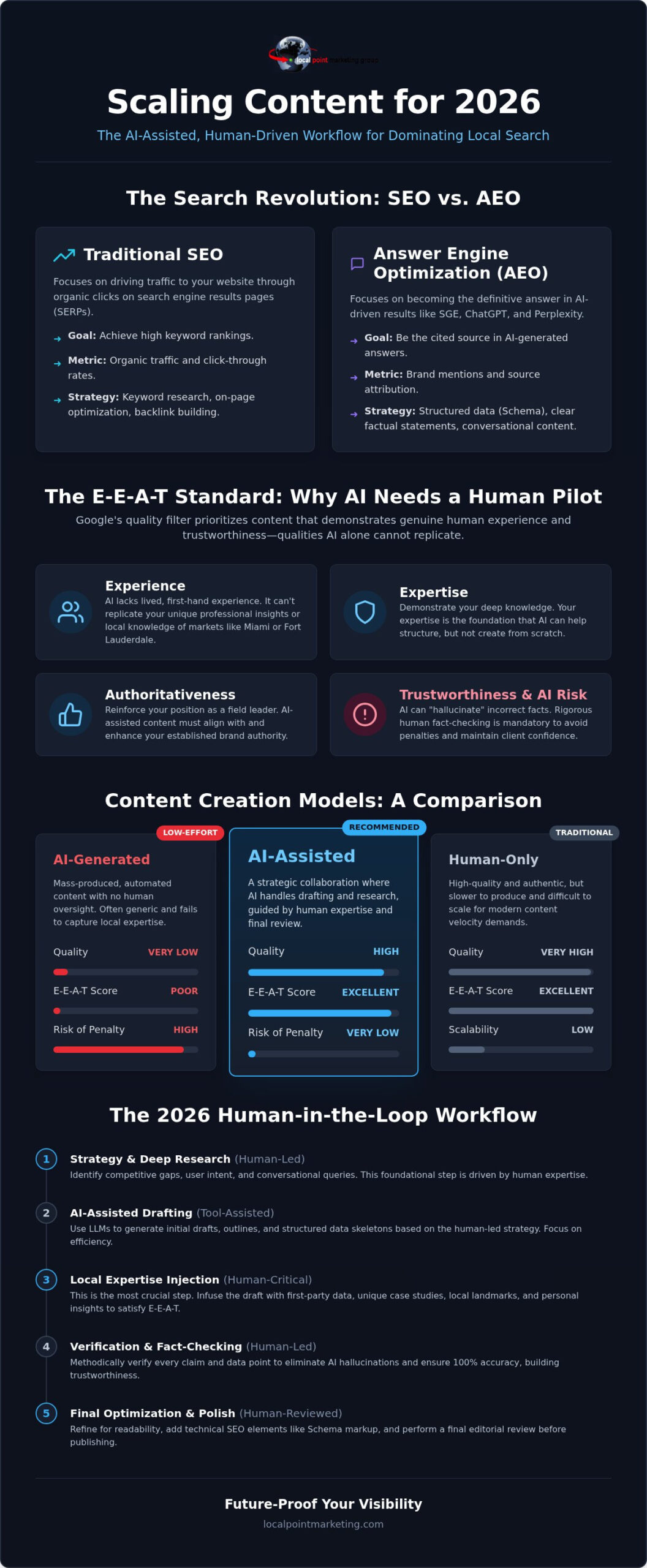
Traditional Search engine optimization (SEO) remains essential for driving traffic to your website through organic clicks. However, Answer Engine Optimization (AEO) is now equally vital for appearing as a cited source in platforms like ChatGPT and Perplexity. While SEO focuses on keyword rankings, AEO aims to make your business the definitive answer to a user’s query. This shift requires a focus on structured data and clear, declarative statements that AI agents can easily parse and verify. Using Schema markup helps AI agents understand the relationship between your services and your location in the Palm Beaches. Balancing both strategies ensures your brand remains a leader in both the traditional search results and the new generation of AI-driven answer engines.

The E-E-A-T Standard: Why AI Needs a Human Pilot

Google’s E-E-A-T guidelines act as the primary filter for ranking quality in 2026. While Large Language Models can summarize general topics, they cannot replicate lived experience. An AI hasn’t managed a logistics project in the Port of Miami or understood the seasonal business shifts in Fort Lauderdale. This lack of “Experience” is why AI content for SEO requires a human pilot to guide the narrative. Your personal insights and professional history provide the depth that search engines prioritize.

Building trust with your audience requires transparency and a commitment to accuracy. While you don’t always need to disclose every tool used, you must ensure your editorial process is visible and rigorous. At Local Point Marketing, we use data-driven verification to ensure every piece of content reinforces your reputation as a steady, capable leader. This human-centric approach guarantees that your digital presence remains authentic and authoritative.

Injecting Local Expertise into AI Drafts

Injecting local expertise is what separates high-performing content from generic automation. A standard AI draft on marketing basics won’t help you rank for competitive terms like “Miami SEO agency” because it lacks regional context. To ground these drafts, you should include mentions of local landmarks, specific neighborhood challenges, and unique case studies from your own files. Using first-party data is one of the most effective ways to outrank generic competitors. It provides search engines with evidence that your content is rooted in actual results rather than synthesized text.

The Risk of AI Hallucinations in SEO

Fact-checking has become a foundational part of search strategy. AI models can generate “hallucinations” where they present incorrect data as absolute truth. Publishing these errors can trigger a “Trustworthiness” penalty that damages your organic reach and client confidence. To avoid this, you need a methodical workflow for verifying every factual claim before it goes live. Our agency serves as a reliable expert partner to help you implement these safeguards. This balanced approach allows you to scale your production while maintaining the high standards your clients expect.

Comparison: AI-Generated vs. AI-Assisted vs. Human-Only Content

Choosing the right production method is a strategic decision that directly impacts your search visibility. Using AI content for SEO effectively requires a shift from simple automation to a more nuanced, human-led approach. Relying on “set and forget” automation is a recipe for SEO disaster in 2026. Without human oversight, these pieces often become repetitive or factually thin. This approach risks your hard-earned authority and can lead to a steady decline in organic reach. It’s a gamble that few growing businesses can afford to take.

Human-only writing remains the gold standard for deep thought leadership and opinion pieces. When you need to take a bold stand on an industry trend or share a complex personal philosophy, your own voice is irreplaceable. However, human-only production is difficult to scale effectively. This is where AI-assisted content provides a valuable middle ground. By using LLMs to handle research and initial outlines, you can scale your service pages and blog posts while maintaining a high level of quality. It’s about using the tool to enhance your work, not replace it.

Performance Metrics: What the Data Shows

Modern search engines now calculate “Information Gain” to determine if a page adds something new to the web. Purely robotic text often scores low because it simply rehashes existing data. Human-edited AI content consistently sees higher engagement rates because it includes the specific details that local leads value. In South Florida, where competition is high, providing unique insights can significantly improve your conversion rates. Readers respond to content that feels authentic and addresses their specific needs in Miami or Palm Beach. Data shows that users spend more time on pages that offer a unique perspective rather than generic summaries.

Cost vs. Quality: Finding the Balance

The true cost of “free” AI content often includes hours of heavy editing and the potential for search penalties. Achieving ROI-driven digital marketing requires a balanced approach to resource allocation. Small businesses in Jupiter must decide where their time is best spent. Investing in high-quality AI content for SEO allows you to maintain a consistent publishing schedule without burning out your internal team. We focus on helping you find this balance to ensure every piece of content contributes to your bottom line. Success comes from being methodical and focusing on measurable outcomes rather than just volume.
AI Content for SEO in 2026: Scaling Quality Without Losing Your Voice

The 2026 Workflow: A Human-in-the-Loop Strategy for Local SEO

Success in modern digital marketing requires a structured process that places human intuition at the center of every campaign. AI content for SEO provides a strong foundation, but your team’s expertise provides the necessary structural integrity. This human-in-the-loop strategy allows you to scale your production without sacrificing the authority that ranks. We’ve developed a steady, four-step workflow to help you achieve these results.

  • Step 1: Strategic Research. Identify the emerging market trends and specific customer pain points that haven’t yet appeared in AI training sets.
  • Step 2: AI Prompting. Move beyond generic commands by providing the model with specific buyer personas, the desired emotional tone, and the primary goal of the piece.
  • Step 3: Human Infusion. Add your unique brand voice and the specific local context that builds trust with your audience.
  • Step 4: Technical Optimization. Ensure every piece meets current E-E-A-T and AI search optimization standards for maximum visibility.

Localizing Content for South Florida Markets

Effective prompt engineering must focus on the specific nuances of your service area. A campaign targeting Boca Raton requires a different tone and set of references than one aimed at Stuart. It’s vital to ensure your tools don’t confuse the Treasure Coast with the Gold Coast, as geographic errors immediately signal a lack of local authority to your readers. Use our Local SEO Guide for South Florida Businesses to identify the key landmarks and neighborhood descriptors that will ground your content in reality. This methodical approach ensures your brand remains a trusted local partner.

The Editing Checklist for AI Content

A rigorous review process is non-negotiable when managing AI content for SEO. Start by looking for repetitive sentence structures or an overly formal, detached tone that feels robotic. Adding the “Human Touch” involves inserting specific quotes from your team, personal anecdotes, or unique perspectives on current industry challenges. Finally, conduct a comprehensive audit to verify keyword density and ensure internal linking is logical. Confirm the page is fully mobile-friendly to accommodate the majority of your local traffic. If you’re ready to modernize your marketing, we can help you integrate AI visibility strategies into your business today.

Future-Proofing Your Visibility with Local Point Marketing

Local Point Marketing serves as your dedicated guide through the complexities of the modern search environment. With 10 years of experience in digital marketing, we understand that technology works best when it supports a clear, data-driven strategy. We help you implement AI content for SEO in a way that respects your brand’s unique voice and ensures long-term growth. Our agency has evolved from providing traditional managed SEO to offering comprehensive AI visibility marketing. This shift ensures your business remains prominent not only in Google searches but also in the AI-driven answer engines your customers use every day. Our methodical use of AI content for SEO ensures that every piece of writing serves a specific purpose in your broader marketing funnel.

A software-only solution often lacks the strategic oversight needed to navigate rapid industry changes. We offer a partnership approach that prioritizes your specific goals and delivers measurable results. This collaborative model allows us to adjust your strategy in real-time based on actual performance metrics. We focus entirely on your outcomes, ensuring that every technological integration leads to higher lead generation and a stronger ROI. Our team acts as a steady extension of your business, providing the reassurance that your marketing is in capable hands.

Our AI Integration and Visibility Services

We create customized AI strategies that protect your brand integrity while maximizing efficiency. Our team provides continuous monitoring of AI search engine citations to ensure your business is accurately represented as a trusted source. By scaling your blog content creation services, we help you maintain a consistent presence without sacrificing the quality your audience expects. This methodical approach allows you to grow your reach across Miami and Fort Lauderdale while we handle the technical complexities. We focus on data and evidence to ensure your content remains impactful and relevant.

Ready to Lead the South Florida Market?

Early adoption of these advanced tools provides a significant competitive advantage for businesses in Miami, Fort Lauderdale, and the Palm Beaches. The transition from being invisible to becoming a cited authority requires a steady hand and a commitment to excellence. We work alongside you to transform your digital presence into a lead-generating engine that works around the clock. Your future success depends on how you adapt to the Search Revolution today. Take the first step toward securing your market position and schedule your AI Search Audit with Local Point Marketing today. Together, we can build a more successful and measurable future for your brand.

Securing Your Brand’s Future in the AI Era

Integrating AI content for SEO successfully requires a shift from simple automation to strategic collaboration. By prioritizing human experience and local context, you ensure your brand remains a trusted authority in an increasingly crowded digital landscape. Maintaining high E-E-A-T standards isn’t just about following guidelines; it’s about building lasting relationships with your audience in South Florida. You now have a clear workflow to scale production while protecting the unique voice that defines your business.

Local Point Marketing brings over 10 years of local SEO expertise to every client relationship. As data-driven AI integration specialists, we provide the steady guidance needed to navigate the Search Revolution across Miami, Fort Lauderdale, and the Palm Beaches. Our focus remains on your long-term success and measurable ROI. Elevate your visibility with ROI-driven AI SEO strategies from Local Point Marketing. Your brand’s potential for growth is stronger than ever with a reliable expert partner by your side.

Frequently Asked Questions

Is AI-generated content bad for SEO in 2026?

AI content for SEO isn’t inherently bad if it satisfies user intent and provides original value. Google’s algorithms have evolved to prioritize helpfulness over the specific method of production. Low-effort automation that lacks human oversight will likely face penalties for being unoriginal or repetitive. Successful brands use these tools to assist their experts rather than replace them. This balanced approach ensures your content remains competitive in both traditional and AI-driven search results.

How does Google detect AI content?

Google’s systems look for patterns that indicate low-effort automation and a lack of original insight. They use sophisticated models to determine if a page provides “Information Gain” or simply repeats existing data. Content that lacks real-world experience or specific local details often triggers quality flags. By focusing on high E-E-A-T standards, you can avoid these issues. Your content should always include unique perspectives that a machine cannot replicate on its own.

What is the difference between SEO and AEO?

Search Engine Optimization focuses on ranking your website in traditional search results to drive clicks. Answer Engine Optimization (AEO) targets being the cited authority within AI-generated responses from platforms like ChatGPT. While SEO relies on keywords and backlinks, AEO emphasizes structured data and clear, direct answers. Both strategies are essential for maintaining visibility in 2026. A comprehensive digital marketing plan integrates these approaches to capture traffic from every possible source.

Can AI help with local SEO in South Florida?

AI tools are excellent for scaling location-specific pages across Miami, Fort Lauderdale, and the Palm Beaches. They help you draft initial service descriptions and neighborhood guides quickly. However, you must inject local landmarks and regional business insights to build trust with South Florida residents. Machines don’t understand the specific nuances of the Treasure Coast or the Gold Coast. Leveraging AI content for SEO effectively requires combining technology with your own local expertise.

Should I use AI to write my entire website?

You shouldn’t rely on AI to write your entire website because it often lacks the emotional resonance needed to drive conversions. Your core pages, such as “About Us” and primary service descriptions, require a human voice to establish credibility. Users can sense when a brand’s message is generic and detached. Use technology to handle repetitive tasks and preliminary research, but keep your high-stakes content human-centric. This preserves your brand’s integrity and builds a stronger connection with your clients.

How much human editing does AI content really need?

AI content requires significant human editing to ensure factual accuracy and brand alignment. You should plan to review every draft for repetitive phrasing or an overly formal tone. Fact-checking is mandatory to prevent hallucinations that could damage your reputation. A thorough edit also includes adding personal anecdotes and first-party data that machines cannot access. This methodical review process is what transforms a generic draft into a high-performing asset for your business.

Will AI content help me rank in ChatGPT or Perplexity?

High-quality content that provides clear and authoritative answers will help you appear as a cited source in ChatGPT and Perplexity. These answer engines prioritize information that is easy to parse and verify. Using structured data and Schema markup helps these agents understand your business’s relevance to specific queries. Visibility in these platforms depends on being recognized as a reliable leader in your industry. A data-driven approach to content ensures your brand stays visible as search habits continue to change.

How can Local Point Marketing help with my AI content strategy?

Local Point Marketing acts as your reliable expert partner to navigate the intersection of AI and search visibility. We use 10 years of digital marketing experience to deliver measurable results through managed SEO and AI integration. Our team serves businesses from Miami to Port St. Lucie with strategies that focus on lead generation and long-term ROI. We help you implement a structured workflow that scales your production while protecting your unique voice. Our focus is always on your outcomes and the success of your brand.

How AI Search Changes Local SEO: The 2026 Strategy for SMBs

Your business doesn’t just need to be found anymore; it needs to be understood by an artificial intelligence that’s already talking to your customers. Understanding how AI search changes local SEO is the difference between thriving in 2026 and disappearing from the digital map. It’s natural to feel concerned when you see website traffic dipping as AI overviews provide answers directly on the search page. You’ve likely heard confusing terms like Generative Engine Optimization and wondered if larger competitors with massive data budgets will eventually crowd you out.

We’re here to help you turn that uncertainty into a clear competitive advantage. You’ll discover how generative AI is reshaping local discovery and learn the exact steps to keep your business visible in the age of AI search. This guide provides a structured roadmap for your 2026 marketing spend and explains how to optimize your content for the next generation of AI crawlers. By shifting your focus from simple keyword matching to entity authority, you’ll maintain top visibility in local map packs and AI summaries alike.

Key Takeaways

  • Understand the fundamental shift from traditional search lists to direct recommendations and how AI search changes local SEO for the 2026 market.
  • Learn how to position your business as a verified data object that AI engines can easily identify, trust, and recommend to local users.
  • Discover strategies to maintain brand visibility in a zero-click environment where AI overviews provide answers directly on the results page.
  • Identify the specific technical steps, including advanced schema and sentiment analysis, needed to secure your spot in AI summaries and map packs.
  • Develop a clear roadmap for your marketing spend that focuses on measurable growth and long-term authority rather than outdated tactics.

From Search Results to Search Answers: The Rise of AI-Driven Local Discovery

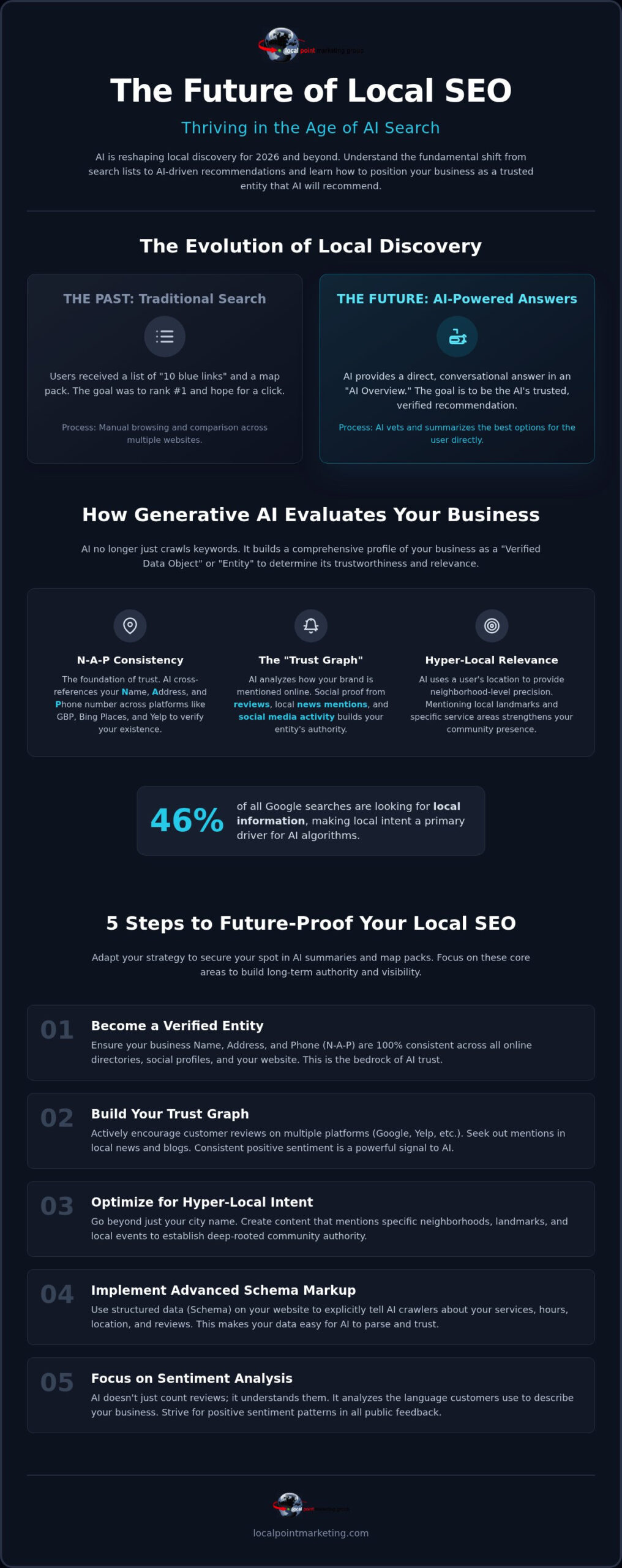
Discovery has moved past the era of manual browsing. In 2026, AI Search platforms like Google’s Search Generative Experience (SGE) and SearchGPT provide direct answers rather than just a list of options. This transition marks a significant milestone in Local search engine optimization (local SEO). Search engines now function as digital assistants rather than simple libraries. They evaluate millions of data points to find the perfect match for a user’s specific query. Understanding how AI search changes local SEO is essential for businesses that want to stay visible as the traditional “blue link” model of the internet fades away.

The Evolution of the Local Pack

The traditional “Top 3” map pack is no longer the only goal for local visibility. AI now summarizes Google Business Profile data into conversational answers that appear before any website links. These AI-curated lists supplement the map pack by explaining why a business is the right choice for a specific user. For example, a search for a lawyer might generate a summary that highlights specific specialties and client sentiment found in reviews. Users don’t feel the need to click multiple websites to compare options anymore. They trust the AI to vet businesses based on review patterns, operational consistency, and specific service details. Recognizing how AI search changes local SEO allows you to adapt your profile to meet these new AI-driven standards and secure your spot in these curated summaries.

Why Local Intent Matters More Than Ever

Local intent remains a primary driver for modern search algorithms. Research indicates that 46% of all searches are looking for local information, and AI models use this to offer neighborhood-level precision. Whether a customer is searching from Miami or Berlin, the AI prioritizes geographic proximity alongside relevance. AI Local Search is the synthesis of geographic data and natural language processing. Local businesses are at the forefront of this evolution because their value is tied to the physical world where AI users live and work. By focusing on these hyper-local signals, small businesses can compete with larger national brands that lack a physical presence in the community. This precision allows AI to recommend the most convenient and trustworthy options in real time, ensuring your business stays relevant to the customers who are closest to you.

How Generative AI Evaluates Local Relevance and Trust

AI engines don’t just crawl your website; they build a comprehensive profile of your business as a distinct entity. This shift toward Entity-Based SEO means your business is now viewed as a data object rather than just a collection of keywords. To appear in AI-generated local answers, your business must be verifiable across multiple sources. This verification process is a primary way how AI search changes local SEO for small businesses. If the AI can’t verify who you are through external data, it’s unlikely to recommend you to users.

Consistency in your Name, Address, and Phone number (N-A-P) remains the foundation of this digital trust. AI crawlers cross-reference your details across several platforms to assign a trust score:

  • Google Business Profiles and Bing Places
  • Major review platforms like Yelp and TripAdvisor
  • Industry-specific directories and local South Florida listings
  • Social media profiles and official business registrations

If your data is fragmented or outdated, the AI may experience hallucinations or simply exclude you from recommendations to avoid providing inaccurate information. High-quality digital citations across niche South Florida business directories further validate your physical presence to these sophisticated algorithms.

The “Trust Graph” for Local SMBs

AI models create a Trust Graph by analyzing how your brand is mentioned across the digital landscape. They look at your website content, but they also weigh social media activity and news mentions. If a local news outlet mentions your grand opening or a community event you sponsored, it strengthens your entity’s authority. Social proof acts as the primary filter for AI-generated “Best of” lists. High-volume, positive sentiment in reviews across various platforms tells the AI that you are a reliable choice for its users. This consensus prevents the AI from relying on a single, potentially biased source.

Neighborhood Authority and Local Keywords

Establishing authority requires more than just listing a city name. Mentioning specific landmarks like Las Olas Boulevard in Fort Lauderdale or the Jupiter Inlet helps AI pin your precise location. This hyper-local content signals to crawlers that you are deeply embedded in your specific community. AI evaluates trust by the consensus of information found across the entire web. When your site mentions local events and is backed by citations in South Florida directories, your relevance increases. Keeping your data accurate across these platforms is vital for long-term success. Working with an expert in AI integration and visibility ensures your business data remains authoritative as search technology evolves.

The Zero-Click Reality: Navigating Local Visibility in AI Overviews

If an AI provides your business hours and phone number immediately, why would a customer click through to your homepage? This is the central question for many SMBs facing the rise of zero-click searches. A zero-click search occurs when the search engine satisfies the user’s intent directly on the results page. In local service industries, this is becoming the standard rather than the exception. While it might look like a loss of traffic in your traditional analytics, it’s actually a high-authority brand impression. Understanding how AI search changes local SEO means accepting that a “mention” is often as valuable as a “click.” Your goal is to ensure that when the AI answers, your brand is the only logical choice it presents.

Capturing Leads Within the AI Interface

You can still capture leads without a website visit by optimizing for direct-action triggers. Use advanced structured data to feed the AI specific information like your phone number, service areas, and direct “Book Now” links. When these elements appear inside an AI overview, they remove friction for the customer. Google Business Profile messaging also plays a critical role here. By enabling direct chat and appointment scheduling, you allow the AI to facilitate a transaction without the user ever leaving the search interface. This transforms the AI from a barrier into a powerful lead-generation tool that works on your behalf.

Measuring Success Beyond Organic Traffic

Relying on raw website hits to judge your marketing success is an outdated approach. Modern ROI-driven digital marketing focuses on high-intent actions rather than vanity metrics. You should prioritize tracking call volume, direction requests, and direct messages initiated from search results. These metrics represent customers who are ready to buy right now. We use data-driven analytics to identify where your brand is cited in generative responses, even when a link isn’t clicked. This provides a clearer picture of your actual market reach and local influence. By focusing on these tangible outcomes, you can accurately measure how AI search changes local SEO for your specific business and adjust your strategy to maximize lead quality. This shift in perspective ensures your marketing spend is always tied to measurable growth.

How AI Search Changes Local SEO: The 2026 Strategy for SMBs

5 Essential Steps to Future-Proof Your Local SEO Strategy

Adapting to the next era of discovery requires a shift from traditional tactics to a more sophisticated, data-driven approach. Success in 2026 depends on your ability to feed AI engines the exact information they need to verify your authority. Understanding how AI search changes local SEO allows you to stay ahead of competitors who are still relying on outdated keyword stuffing. By following these five essential steps, you can ensure your business remains a top recommendation in an AI-dominated market.

  • Implement Advanced Schema Markup: Use specific tags for LocalBusiness, FAQ, and Review data to help AI engines categorize your services accurately.
  • Prioritize Sentiment Analysis: Manage your reviews aggressively by focusing on the specific words customers use, as AI evaluates the sentiment behind the stars.
  • Create Conversational Content: Develop pages that answer the nuanced, long-tail questions your local customers are actually asking.
  • Secure Community-Based Backlinks: Build trust with AI by earning links from South Florida community organizations and local chambers of commerce.
  • Monitor AI Share of Voice: Track how often your brand appears in generative summaries compared to your local competitors.

Technical Foundations for AI Crawlers

Schema.org is the primary language of AI search engines. It provides a structured way to communicate your business details directly to machine crawlers. When you implement AI search optimization, you remove the guesswork for engines like SearchGPT or Google SGE. This technical clarity ensures your business attributes are categorized correctly every time. Beyond data structure, your technical health remains vital. Site speed and mobile-first indexing are non-negotiable factors because AI engines prioritize reliable, fast-loading sources for their users.

Local Content That Answers “Why,” Not Just “What”

User behavior has shifted toward more complex queries. Instead of searching for “Plumber Miami,” customers now ask, “Why is my water heater leaking in Fort Lauderdale humidity?” Your strategy must evolve to answer these specific local pain points. Professional blog content creation services can help you target these long-tail AI queries effectively. By creating neighborhood-specific landing pages, you demonstrate deep local expertise that AI engines find highly relevant. This approach positions your brand as a helpful resource rather than just a service provider. If you are ready to secure your digital footprint, contact Local Point Marketing today to start building your 2026 visibility strategy.

Strategic AI Integration: Partnering for Measurable Local Growth

Staying ahead of technological shifts requires more than just awareness; it demands a proactive partnership. The speed at which AI models evolve makes it difficult for small business owners to manage daily operations while keeping their digital presence optimized. Navigating these complexities alone often leads to missed opportunities or technical errors that can hurt your visibility. Understanding how AI search changes local SEO is a full-time commitment that our team manages for you. We transform the challenge of AI integration into a structured path for measurable growth and long-term success.

A dedicated local SEO retainer provides the stability needed in a rapidly changing technical landscape. Instead of reacting to algorithm updates after they happen, we anticipate shifts and adjust your strategy in real time. This continuous optimization ensures that your business remains the top recommendation for local users. We focus on high-intent lead generation and brand authority, ensuring your marketing spend produces a tangible return on investment. Our goal is to provide you with the peace of mind that comes from having a reliable expert partner at your side as search technology matures.

The Local Point Marketing Advantage

We bring 10 years of agency experience to every campaign we manage. Our unique perspective comes from serving diverse markets in both Berlin and South Florida, from Miami to Vero Beach. This international expertise allows us to apply global insights to your local business needs with precision. We take a methodical approach to measuring ROI, moving beyond surface-level metrics to track actual lead quality and conversion rates. Our values of integrity and innovation anchor every project. We don’t just follow trends; we use data-driven strategies to ensure your business thrives regardless of how AI search changes local SEO in the coming years.

Getting Started with an AI Visibility Audit

Your journey toward future-proofed growth begins with a comprehensive AI readiness check. We evaluate your current digital footprint to see how AI engines perceive your business entity. This audit covers everything from technical schema health to the sentiment of your third-party reviews. We tailor these strategies for businesses in Boca Raton, Palm Beach, and throughout the South Florida region. You’ll receive a clear roadmap that outlines exactly how to improve your standing in generative search results. It’s time to move forward with confidence and secure your place in the future of local discovery. Schedule your 2026 AI Visibility Consultation with Local Point Marketing today to begin your transformation.

Securing Your Place in the Future of Local Discovery

The shift to AI-driven answers is a significant opportunity for businesses that act now. By focusing on entity authority and technical precision, you ensure your brand remains a trusted recommendation in 2026. Understanding how AI search changes local SEO is the first step toward a more resilient digital presence. Success depends on providing verifiable data to machine crawlers while maintaining a strong local reputation among your customers.

Local Point Marketing is here to serve as your steady partner through this transition. We offer 10 years of agency experience and specialize in delivering data-driven results for South Florida businesses. As specialists in AI search integration, we focus on the measurable outcomes that actually grow your bottom line. Your business is well-positioned for success in the age of AI, and we’re ready to help you reach your goals.

Ready to dominate local AI search? Contact Local Point Marketing today.

Frequently Asked Questions

Will AI search completely replace traditional Google search results?

AI search won’t completely replace traditional Google results; instead, it refines how they’re presented. You’ll still see traditional links below AI-generated summaries. This hybrid model helps users get quick answers while still allowing them to dive deeper into specific websites. For local businesses in Miami or Palm Beach, this means visibility is split between the conversational AI interface and the standard map pack. Adapting to how AI search changes local SEO ensures you capture traffic from both sources.

How does Google’s AI Overview decide which local businesses to feature?

Google’s AI Overview selects local businesses by evaluating entity authority and data consistency across the web. The algorithm looks for a consensus of information, cross-referencing your Google Business Profile with third-party review sites and local South Florida directories. Sentiment analysis of your customer reviews also plays a major role. If the AI sees consistent, positive mentions of your business in Fort Lauderdale or Boca Raton, it’s more likely to feature you as a trusted recommendation.

Do I still need a website if AI provides all the answers to customers?

You absolutely still need a website because it serves as the primary source of truth for AI crawlers. AI engines like SearchGPT and SGE don’t invent information; they synthesize it from existing web content. Without a well-structured site, an AI can’t verify your services, location, or expertise. A professional website also allows you to capture the high-intent traffic that wants to learn more after seeing an initial AI summary or recommendation from a search assistant.

What is Generative Engine Optimization (GEO) for local business?

Generative Engine Optimization (GEO) is the process of formatting your digital presence to be easily understood by large language models. For local businesses, this involves using advanced schema markup and creating content that answers specific neighborhood-level questions. It’s a key part of how AI search changes local SEO today. By focusing on GEO, you ensure that AI engines can identify your business as a relevant data object when users ask for recommendations in Jupiter or Stuart.

How can I track if my business is showing up in AI search results?

Tracking visibility in AI search requires looking beyond traditional organic click data. You should monitor your AI Share of Voice by checking how often your brand appears in generative summaries for your target keywords. Tools that track search engine results pages now include AI overview tracking. We also recommend monitoring direction requests and call volume from your Google Business Profile, as these metrics often signal that a user found you through an AI-driven local search.

Is my Google Business Profile still important for AI search visibility?

Your Google Business Profile remains the most critical asset for local AI visibility. AI engines prioritize verified data from these profiles to populate their recommendations and map summaries. Keeping your profile updated with fresh photos, accurate hours, and frequent posts tells the AI that your business is active and reliable. For a business in Port St. Lucie or Vero Beach, a well-managed profile is often the deciding factor in whether an AI recommends your services to local searchers.

How much does it cost to optimize a local business for AI search?

The cost for AI search optimization varies based on the specific needs and competitive landscape of your industry. Most professional agencies, including Local Point Marketing, offer these services as part of a managed SEO retainer or a specialized AI integration project. These fees typically cover technical schema implementation, local content creation, and ongoing visibility monitoring. We provide customized strategies that align with your growth goals and ensure a measurable return on your marketing investment through high-quality lead generation.

AI Search Optimization: The Business Guide to Visibility in 2026

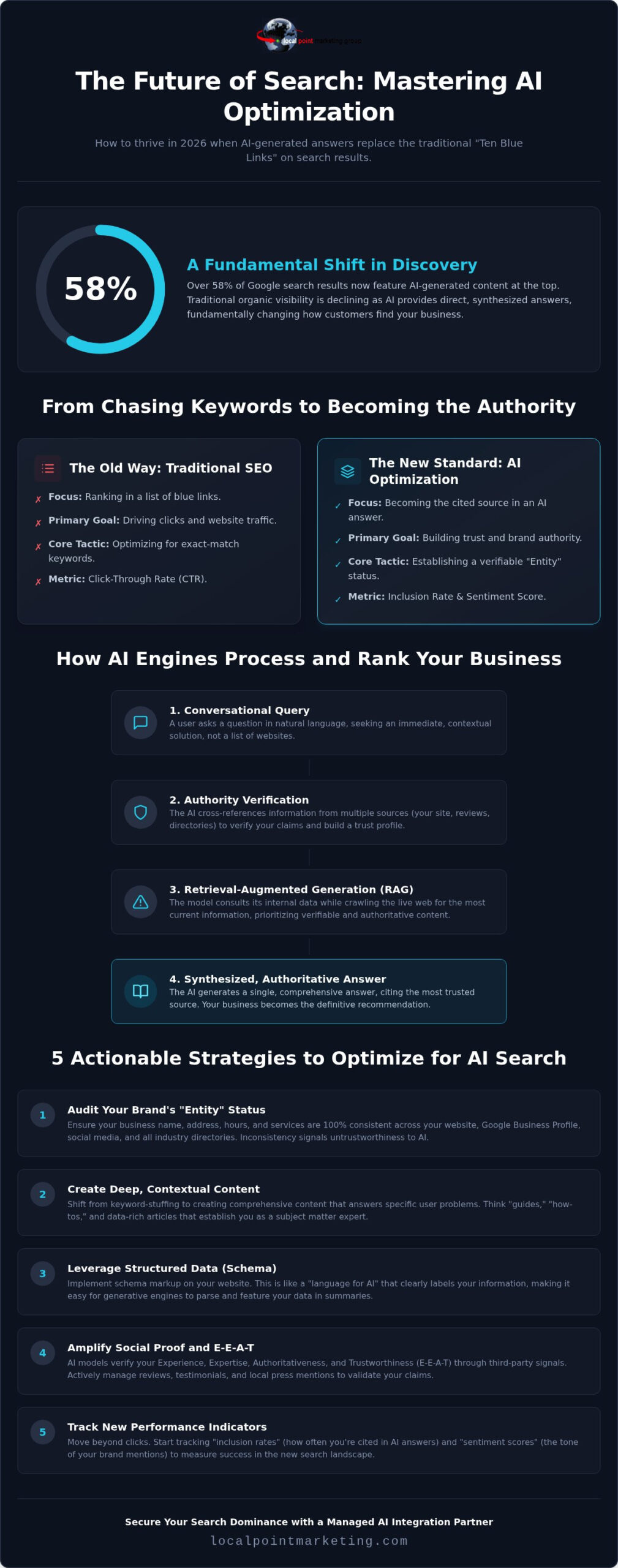
Over 58% of Google search results now feature AI-generated content at the top of the page, fundamentally changing how customers find your business. This shift makes AI search optimization the most critical factor for maintaining your visibility in 2026. It’s understandable to feel unsettled as traditional organic click-through rates decline and the old rules of keywords seem to vanish. You’ve likely noticed that a simple blue link is no longer enough to capture attention in a zero-click environment where answers are delivered instantly.

This guide provides a clear path to master the transition from chasing keywords to becoming a trusted entity that AI models prioritize. You’ll learn how to adapt your content for generative engines, the growing importance of E-E-A-T, and how to measure success when clicks are no longer the only metric. We’ll show you how to secure your search dominance and find the right partner to manage this evolution with confidence. By focusing on data-rich, authoritative content, your business can thrive as a leader in this new era of digital discovery.

Key Takeaways

  • Understand the shift from traditional keyword lists to conversational AI answers and what it means for your brand’s visibility.
  • Gain insight into how Retrieval-Augmented Generation (RAG) allows AI models to process and rank your business information in real-time.
  • Master the transition to AI search optimization by tracking new performance indicators like inclusion rates and sentiment scores.
  • Implement actionable strategies to audit your brand’s “Entity” status and create content that AI engines prioritize as the definitive answer.
  • Learn how a managed approach to AI integration ensures your business remains a steady and authoritative leader in the evolving search landscape.

What is AI Search Optimization and Why Does it Matter in 2026?

The digital landscape has reached a decisive turning point. As of August 2026, the era of the “Ten Blue Links” has evolved into a conversational ecosystem where answers are delivered instantly. AI search optimization is the strategic process of ensuring your business is the primary source these generative engines use to provide those answers. Unlike Traditional SEO, which focuses on ranking in a list of results, this new discipline ensures your brand is synthesized into a single, authoritative response. With over 58% of Google search results now featuring AI-generated content at the top, the window to secure your spot in these summaries is closing.

Consumer behavior has shifted rapidly. In January 2026, data showed that 37% of consumers began their online searches using AI tools rather than standard search bars. This trend has only accelerated. If your business isn’t optimized for these models, you risk being filtered out entirely by digital assistants that prioritize clear, structured, and factual data. Staying ahead of this curve isn’t just about growth; it’s about remaining discoverable in a world where AI assistants act as the new gatekeepers of information. Our Generative AI Search Visibility 2026 Trend Report for Small Businesses provides a deeper look at how these shifts are affecting local brands and what specialized AI SEO services for small business can do to close the gap.

From Keywords to Contextual Intent

Modern AI models no longer just look for matching words. They seek to understand the “why” behind a query to provide a relevant solution. This shift has led to a decline in the importance of exact-match keywords. Instead, semantic relevance has become the new gold standard for visibility. AI search engines now identify your business as an “entity” within a broader knowledge graph. To succeed, your content must provide deep, contextual value that answers specific user problems. When your brand consistently provides the most helpful information, AI models recognize you as a reliable authority in your field.

The Rise of Generative Engines: SGE, Perplexity, and Beyond

The search market is more diverse than ever before. While Google maintains approximately 80% of the global search share through Gemini and Search Generative Experience (SGE), new players have gained significant ground. ChatGPT now holds a 10-15% share, while Perplexity processes an estimated 50 million weekly queries. These platforms aggregate data differently than traditional crawlers, often prioritizing “extractable” content that fits neatly into a summary. This has led to an increase in zero-click searches, where users find everything they need without ever leaving the search interface. Success in this environment means being the cited source that the AI trusts to represent the facts.

How AI Search Engines Process and Rank Your Business Information

AI search engines operate differently than the index-based systems of the past. They utilize a process called Retrieval-Augmented Generation (RAG). This allows the model to consult its massive internal training sets while simultaneously crawling the live web for the most current information. This dual approach makes AI search optimization a continuous effort. It isn’t enough to have been relevant three years ago; your brand must remain active and verifiable in real-time. By combining stored knowledge with fresh data, AI models provide answers that are both deep and timely.

Research into Generative Engine Optimization (GEO) shows that AI models prioritize content that is authoritative and easily verifiable. Your digital footprint matters more than ever. AI assistants don’t just look at your homepage. They scan third-party reviews, social media profiles, and industry directories to build a complete profile of your business as an entity. This holistic view helps the AI determine if your business is the best recommendation for a user’s specific intent. Every mention of your brand across the web contributes to your overall authority score.

The Authority Gap: How AI Verifies Your Claims

AI engines are designed to reduce inaccuracies by cross-referencing information across multiple sources. If your business hours or service descriptions vary between your website and your Google Business Profile, the AI may view your brand as less reliable. Consistent information across all platforms builds the necessary trust for AI to recommend you. Social proof, such as customer testimonials and local press mentions, serves as validation for the claims you make on your own site. When multiple reputable sources agree on your expertise, the AI is more likely to feature your business in its generated answers.

Structured Data and Schema: The Language of AI

While human readers focus on your prose, AI bots focus on your code. Structured data, or Schema markup, acts as a translator. It tells the AI exactly what your data represents. In 2026, using Schema is no longer optional for businesses that want to stay visible. For example, a professional service firm in Miami or a retail business in Vero Beach should use LocalBusiness schema to define its specific service area and operating hours. This precision ensures that when a user asks an AI assistant for a local recommendation, your business is presented with complete accuracy. If you want to ensure your technical foundation is ready for these changes, exploring our AI integration and visibility services can provide the steady guidance your brand needs.

AI Search Optimization vs. Traditional SEO: Key Differences

Search has historically functioned as a “pull” mechanism. A user entered a query, scanned a list of results, and pulled the information they found most relevant. In 2026, the model has shifted toward a “push” mechanism. AI engines now push a single, synthesized recommendation directly to the user. This fundamental change requires a new set of success metrics. We no longer focus solely on ranking in the top three positions. Instead, we prioritize the “Inclusion Rate,” which measures how frequently AI models cite your brand as a primary source. We also track “Sentiment Score” to ensure the AI describes your business with the appropriate level of authority and trust.

The user journey has evolved from a linear search into a multi-turn conversation. Users now ask follow-up questions and refine their needs through dialogue with an AI assistant. This makes a hybrid approach essential for businesses in transition. You must maintain the technical foundations of a high-quality website while simultaneously optimizing for the conversational models that now act as the primary interface for many consumers. Understanding these nuances is the core of effective AI search optimization. It ensures your brand isn’t just present, but is actively recommended during these digital interactions.

Keyword Volume vs. Answer Relevancy

High-volume keywords are no longer the reliable traffic drivers they once were. AI models prioritize answer relevancy over simple keyword matching. This means that a page optimized for a broad, high-traffic term might be ignored if it doesn’t provide a direct, extractable solution to a specific user problem. Modern optimization focuses on long-tail, conversational queries. The objective is to move beyond “ranking #1” and become the “primary citation.” When an AI engine uses your content to build its answer, it provides a level of third-party validation that a traditional search result cannot match.

The Death of the Ten Blue Links

The Search Engine Results Page (SERP) of 2026 is a visual and interactive experience. The classic list of links has been replaced by AI-generated summaries, product carousels, and suggested follow-up questions. Capturing real estate in the AI “snapshot” box is now the highest priority for local visibility. While the interface has changed, traditional SEO foundations still provide the necessary data for these AI summaries. Our Local SEO Guide for South Florida Businesses demonstrates how established local signals support your broader AI visibility goals. By building a strong local presence, you provide the “entities” and “facts” that AI models need to feature your business in their snapshots.

AI Search Optimization: The Business Guide to Visibility in 2026

Transitioning to AI search optimization requires moving from passive observation to active participation in how your brand is perceived by large language models. AI engines don’t just read your website; they digest your entire digital presence to determine if you are a credible recommendation. To stay visible, you must provide clear, factual, and authoritative data points that these models can easily extract and summarize.

  • Audit your brand’s “Entity” status. AI models view your business as an entity within a knowledge graph. Ensure your core facts, such as your founding date, key executives, and primary services, are consistent across the web.
  • Create “Answer-First” content. Structure your blog posts and service pages so the direct answer to a user’s question appears in the first paragraph. This modular approach makes your content highly extractable for AI summaries. Professional blog content creation services can help you consistently produce this type of precision-structured content that AI engines prioritize as a definitive source.
  • Enhance your local digital footprint. For businesses operating from Miami to Jupiter, local relevance is a major competitive advantage. AI models prioritize geographically relevant data when answering localized queries.
  • Secure high-quality niche citations. Being mentioned in industry-specific publications or South Florida business journals provides the third-party validation AI engines use to verify your authority.
  • Monitor online sentiment. AI models are trained on public data, including customer feedback. Maintaining a high volume of positive reviews across multiple platforms builds the trust necessary for AI to recommend your business.

Optimizing for Conversational Queries

Modern search is no longer about typing fragmented keywords into a bar. It’s about natural dialogue. You should structure your content in a Q&A format to match the way customers speak to AI assistants. Using natural language that reflects your actual customers’ speech patterns helps models identify your content as the best match for voice and conversational searches. Creating comprehensive guides that address potential follow-up questions ensures the AI views your brand as the definitive source for that topic.

Reputation as a Ranking Factor

AI search engines evaluate your broader reputation to decide if you are a reliable recommendation. They analyze customer reviews and social mentions to gauge the sentiment surrounding your brand. Negative sentiment in training data can lead an AI assistant to overlook your business in favor of a competitor with a stronger “Trust Moat.” Consistently gathering positive feedback and responding to customer interactions professionally is essential for long-term visibility. Pairing this with a well-executed social media marketing strategy for local business amplifies your brand signals and strengthens the trust indicators that AI engines rely on. If you are ready to secure your brand’s future in this new era, our team can help you implement these strategies through our managed AI integration and visibility services.

Partnering with Local Point Marketing for AI Visibility

Local Point Marketing acts as the steady partner your business needs to navigate the complexities of digital discovery. We integrate AI search optimization directly into our managed SEO retainers, ensuring that your visibility evolves alongside the technology. Our team doesn’t rely on guesswork. We use a methodical, data-driven approach to track how frequently your brand appears in generative engines and the specific sentiment associated with those mentions. This focus on measurable results allows South Florida SMBs to maintain their market position while the search landscape undergoes its most significant change in decades. We provide the reassurance that your digital presence is being managed by experts who value evidence over hype.

Our Methodical Approach to Growth

Our process is built on ten years of experience in digital marketing. We start with a comprehensive audit of your brand’s current “entity” status to identify gaps in how AI models perceive your authority. From there, we move into continuous optimization, refining your content to be more extractable and authoritative. Our local expertise in the Miami and Palm Beach markets is a critical asset. We understand the specific nuances of the South Florida business environment, from the vibrant markets of Miami to the professional hubs in Vero Beach. This allows us to create customized strategies that resonate with both AI models and your local customers. We provide regular, transparent reporting that connects technical metrics to your actual business growth.

Ready to Secure Your Future in Search?

The window for early-mover advantage is narrowing. Businesses that adopt these strategies now will secure their place as the primary citations in AI summaries before the market becomes oversaturated. Waiting to adapt carries the risk of being filtered out by the very tools your customers use to make buying decisions. We invite you to a consultation to assess your current readiness for these shifts. Our goal is to empower your business with the tools and strategies needed for long-term success. We provide a clear roadmap to ensure your brand remains a leader in your industry. We handle the technical evolution so you can focus on running your business with confidence. Let’s work together to make your business the most trusted entity in your market.

Securing Your Brand’s Authority in the Era of AI

The transition to a generative search environment represents a fundamental shift in how your customers interact with the digital world. By prioritizing entity-based authority and clear, structured data, you ensure that your business remains the primary citation for AI assistants. Mastering AI search optimization allows you to move beyond the traditional list of links and become the definitive answer your customers receive. This proactive approach turns technological change into a significant competitive advantage for your brand.

With over 10 years of digital marketing excellence, Local Point Marketing provides the steady guidance needed to navigate these changes. We offer specialized AI Integration and Visibility services designed specifically for the unique needs of South Florida businesses. From Miami to Vero Beach, our dedicated local support ensures your brand’s growth remains measurable and consistent. We handle the technical complexities so you can focus on the long-term success of your business.

Secure your business visibility with a data-driven AI strategy from Local Point Marketing. The future of search is conversational, and your brand is ready to lead the way.

Frequently Asked Questions

What is the difference between SEO and AI search optimization?

AI search optimization focuses on becoming the primary citation in a generative summary rather than just a link in a list. Traditional SEO targets the “Ten Blue Links,” while this new approach targets the conversational response. It’s about being the source of the answer rather than one of many options. This shift requires a focus on structured data and entity authority to ensure AI models trust your information.

Will AI search completely replace traditional Google search?

Traditional search hasn’t disappeared, but it has evolved into a hybrid model. As of 2026, over 58% of Google results include AI-generated content. Users still use standard search for quick navigation, but they rely on AI for complex decision making. Your strategy must address both the classic search engine results and the new generative snapshots to maintain full market coverage.

How can a local business in Miami appear in AI search results?

Local businesses must prioritize geographic relevance and data consistency. If you’re a Miami-based firm, your brand should be cited in local directories and South Florida business journals. AI engines cross-reference these sources to verify your location and services. Using specific LocalBusiness Schema helps these models accurately present your business to users searching within the Miami or Palm Beach areas.

Do I need to change my current content strategy for AI?

Your strategy should evolve to prioritize “extractable” information. This involves using a Q&A format and placing direct answers at the beginning of your content. AI models prefer modular data that they can easily pull into a summary. While quality remains paramount, the structure of your content now plays a much larger role in whether you are featured as a primary source.

How does AI search impact my website traffic and leads?

You might see a decline in raw click-through rates due to zero-click searches, but lead quality often improves. When an AI assistant recommends your business, it has already filtered the information for the user. This means the traffic reaching your site is more qualified and closer to a conversion. The focus shifts from total volume to the measurable impact of authoritative citations.

Is AI search optimization more expensive than traditional SEO?

The cost is comparable to a standard SEO strategy, as the core activities overlap. The difference lies in the allocation of resources toward technical markup and reputation management. At Local Point Marketing, we integrate these advanced AI search optimization techniques into our existing managed retainers. This ensures your business stays visible without requiring a separate, high-cost investment for every technological shift. For a broader view of how these trends are reshaping the market, our 2026 Generative AI Search Visibility Trend Report for Small Businesses outlines the key data points and AI SEO services for small business that are driving results this year.

How do I track my business performance in AI search engines?

Tracking now requires looking at inclusion rates and brand sentiment. You need to monitor how often AI models include your business in their generated answers for specific industry queries. Specialized reporting tools now allow us to see the “Share of Voice” your brand holds within AI responses. These metrics provide a clearer picture of your authority than traditional keyword rankings alone.

What role does social media play in AI search visibility?

Social platforms provide the real-time validation AI models seek. Active social media profiles and positive customer interactions signal that your business is a current, relevant entity. AI engines use these public signals to gauge your authority and trustworthiness. Maintaining a consistent, positive social presence helps build the “Trust Moat” that encourages AI search engines to recommend you. A focused social media marketing strategy for local business ensures your profiles actively contribute to your AI visibility rather than functioning as static digital brochures. If you rely on paid advertising alongside your organic efforts, understanding how AI search impacts PPC campaigns is equally critical to protecting your overall lead volume and ROI in 2026.