
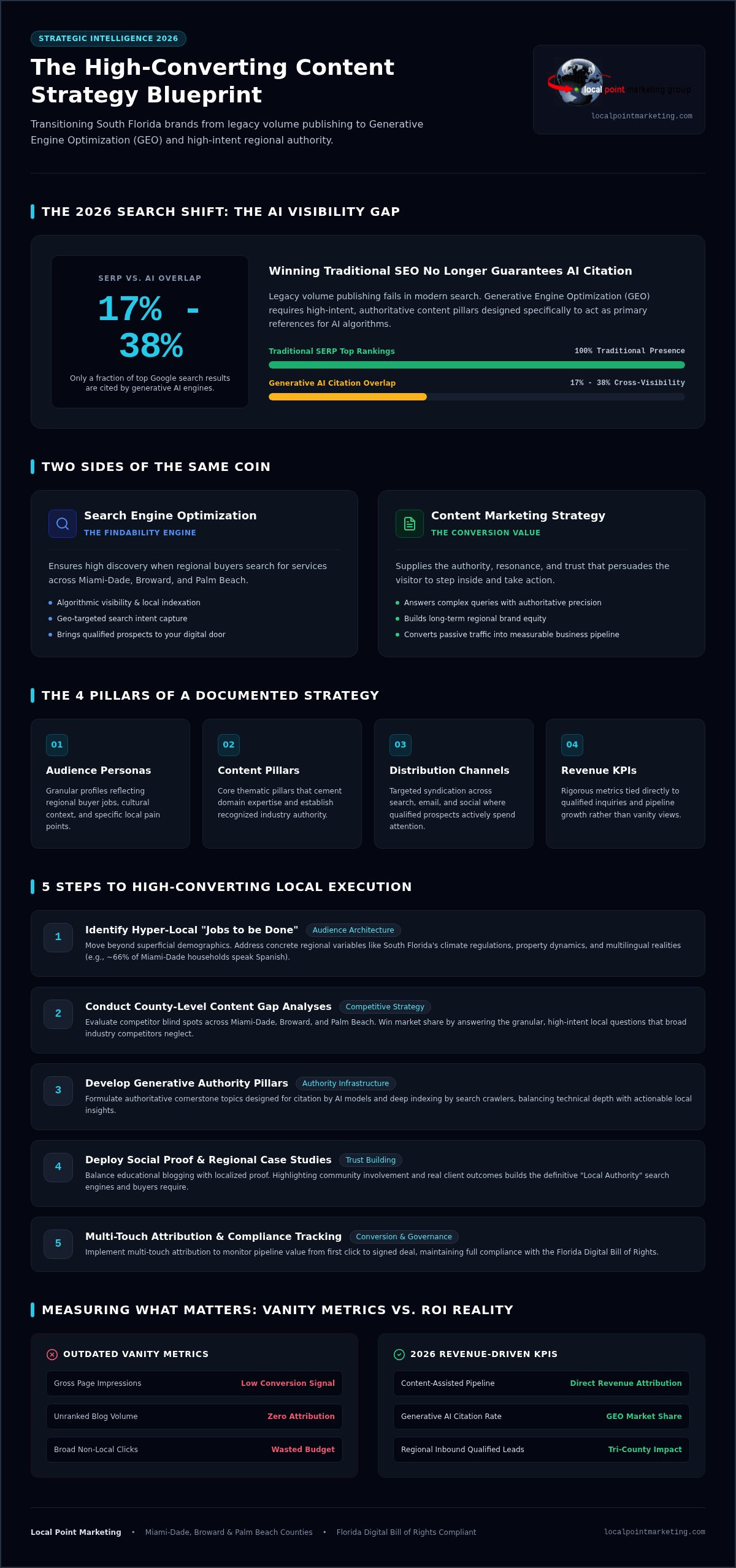
In 2026, ranking at the top of Google only tells half the story. Recent data shows the overlap between traditional search results and AI citations has dropped to between 17% and 38%. This means your business could be winning the SEO game but losing the AI visibility battle. Many South Florida business owners feel the pressure of creating a content marketing strategy that fails to attract readers or generate measurable leads. You’re likely facing high competition and feeling unsure about how to track the actual return on your marketing spend.
It’s time to shift from a volume-based approach to a precise, data-driven system. This guide provides a clear roadmap to build local authority across Miami-Dade, Broward, and Palm Beach counties. You’ll learn how to leverage Generative Engine Optimization to ensure your brand is the primary reference for AI search tools. We’ll also cover how to align your content with lead generation goals while staying compliant with the Florida Digital Bill of Rights. By the end of this article, you’ll have a repeatable system to drive higher organic rankings and turn your digital assets into a consistent source of new business.
Key Takeaways
- Develop a documented content marketing strategy that shifts focus from high-volume publishing to high-intent assets designed for conversion.
- Establish local authority to improve visibility in both traditional search engines and the generative AI tools that dominate the 2026 landscape.
- Identify and address the specific pain points of South Florida buyer personas to build deeper trust with your regional audience.
- Implement a multi-touch attribution framework to accurately track the ROI of your content from initial engagement to final lead generation.
- Utilize a structured 90-day roadmap to transition smoothly from strategic planning to measurable execution with a dependable agency partner.
What is a Content Marketing Strategy in 2026?
A content marketing strategy serves as a documented roadmap for your brand’s growth. It guides how you use written and visual assets to attract, engage, and convert a specific audience. In 2026, the focus has moved away from sheer volume. Search engines and AI tools now prioritize better intent over more content. Simply publishing daily blog posts isn’t enough to capture attention in a crowded digital space. Your assets must answer specific, complex queries with authoritative precision to remain visible in generative search results.
Strategy acts as the essential bridge between creative ideas and measurable business growth. It transforms a collection of ideas into a systematic engine for lead generation. Without this structure, your marketing efforts lack direction and accountability. A structured approach ensures every piece of content supports your bottom line and builds long-term equity. The core components of a modern plan include:
- Audience Personas: Detailed profiles that reflect the specific needs and behaviors of South Florida customers.
- Content Pillars: The primary topics that establish your brand as a local expert in your industry.
- Distribution Channels: The specific platforms, from email to social media, where your audience spends their time.
- KPIs: The data points and metrics that prove your content is generating actual revenue rather than just vanity clicks.
The Difference Between Content Marketing and SEO
SEO provides the findability while content delivers the value. They’re two sides of the same coin, and you need both to succeed. In the competitive South Florida market, SEO ensures your pages appear when users search for services in Miami or West Palm Beach. High-quality content ensures those users stay on the page, trust your brand, and take action. Effective SEO brings the right people to your door, while a strong content marketing strategy convinces them to walk inside and start a conversation.
Why Local Businesses Need a Documented Plan
Random acts of content are expensive and often ineffective. When you publish without a strategic North Star, you waste time and marketing budget on assets that don’t perform. A documented plan ensures consistency across your Miami, Fort Lauderdale, and Palm Beach campaigns. It aligns your messaging with the customer journey, moving prospects from initial awareness to a final purchase. By mapping content to specific stages of the funnel, you create a seamless experience that builds trust and drives sustainable growth.
5 Steps to Building a High-Converting Content Strategy
Success in the South Florida market requires more than just creative ideas. It demands a rigorous, repeatable process. A high-converting content marketing strategy follows five distinct phases to turn digital assets into revenue. By following this structured framework, you ensure that every piece of content you produce serves a specific business purpose.
Identifying Your Local Audience Personas
You need to understand the “Jobs to be Done” for your specific neighbors. Look beyond basic demographics like age or income. A property manager in Miami-Dade faces different regulatory and climate challenges than a retail business owner in Jupiter. Use local data to refine these profiles. For instance, in Miami-Dade, where approximately 66% of residents speak Spanish at home, a bilingual approach often becomes a necessity for building trust. Mapping your topics to the emotional states of these buyers ensures your message resonates when they’re ready to make a decision.
Once you understand your audience, follow these steps to build your roadmap:
- Conduct a content gap analysis: Look at your direct competitors in Broward or Palm Beach. Identify the questions they’re failing to answer. If they focus only on broad topics, you can win by providing the hyper-local, detailed answers they’ve overlooked.
- Develop content pillars: These pillars establish your brand as a regional authority. They should be broad enough to cover your expertise but narrow enough to stay relevant to your local market. Consulting a Forbes content marketing guide can provide additional framework for aligning these pillars with 2026 search trends.
- Create an editorial calendar: Balance your schedule between SEO-driven blogs and social proof. Highlighting local case studies or community involvement builds the “Local Authority” search engines crave.
- Establish a distribution plan: Don’t just post and hope for the best. Use email marketing, social media, and search optimization to ensure your content reaches your target audience across multiple touchpoints.
Setting Measurable Content Goals
It’s easy to get distracted by vanity metrics like likes or shares. Instead, focus on business outcomes such as qualified leads, inbound calls, and sales opportunities. This transition is a core part of ROI-driven digital marketing. Set clear 90-day benchmarks to measure your progress and adjust your tactics based on real-world performance. If you aren’t sure where to set your initial targets, consulting with a local marketing partner can provide the data-backed clarity you need to move forward with confidence.
Local Authority and AI Visibility: The 2026 Differentiator
Local Authority has emerged as the most critical ranking factor for South Florida businesses. It’s no longer enough to produce generic industry advice. Search engines now prioritize brands that demonstrate deep roots and specific expertise within their geographic region. This shift aligns with the Content Marketing Institute’s definition of content marketing, which emphasizes delivering consistent value to a clearly defined audience. For a business operating between Miami and Vero Beach, that audience expects content that reflects the unique climate, economy, and culture of the region.
Generative AI has fundamentally changed how this content is discovered. In 2026, many users receive synthesized answers directly on the search results page rather than clicking through to individual websites. To remain visible, your content must be structured so these engines recognize your brand as the primary reference. Balancing AI-assisted production with human experience and trust is the only way to maintain this edge. While AI can draft text, it can’t visit a job site in Coral Gables or understand the specific needs of a business owner on Las Olas Boulevard.
Optimising for AI Search Results
Visibility in 2026 depends on how well you feed the generative engines. Content must provide direct, authoritative answers to complex local queries. Implementing AI search optimization involves using structured data and clear, summary-style conclusions. AI models look for empirical facts and primary sources. By placing key information in the first 30% of your pages, you increase the likelihood of being cited in AI-generated overviews. This structural precision ensures your brand stays at the forefront of conversational search.
Building Trust Through Local Expertise
Trust is your brand’s most valuable asset in an AI-driven world. You can build this by incorporating “human-only” elements into your content marketing strategy. Use original photography of your team working in recognizable South Florida locations rather than relying on stock images. Include detailed case studies that highlight successful projects from West Palm Beach to Stuart. These geographic specifics signal relevance to both users and search algorithms. When your local SEO efforts are supported by genuine regional expertise, you create a level of authority that generic competitors cannot replicate. This human-centric approach turns casual visitors into loyal local clients.
Measuring Success: Metrics That Matter for ROI
Measurement is the final step in closing the loop between creative production and business growth. A successful content marketing strategy relies on a balanced framework of traffic, engagement, and conversion data. While high traffic numbers look impressive on a report, they don’t always translate to revenue. You must distinguish between vanity metrics and the data points that actually signal a healthy sales pipeline. In 2026, mature content engines deliver an average 3:1 ROI, but reaching that benchmark requires a methodical approach to tracking.
Tracking the multi-touch customer journey is essential for understanding how your assets perform over time. A prospect in Fort Lauderdale might read a blog post about local property regulations in January but not fill out a contact form until March. If you only look at last-click attribution, you’ll miss the value that early-stage content provided. High-performing strategies account for these long-term interactions, recognizing that organic equity builds slowly but offers more stability than paid advertising alone.
Conversion Tracking for Local Leads
Setting up precise goal tracking is the only way to prove the value of your regional campaigns. You should monitor specific actions like phone calls, contact form submissions, and clicks for map directions to your physical office. These assisted conversions tell the true story of how your digital presence influences real-world behavior. The ultimate North Star metric for regional content performance is the volume of Marketing Qualified Leads (MQLs) sourced specifically from organic search queries. This focus ensures your team prioritizes lead quality over simple pageviews.
Refining Your Strategy Based on Data
Data should drive your monthly refinement process to prevent your rankings from slipping. It’s common to encounter content decay, where older posts lose their search visibility as competitors publish newer information. Identifying these declining pages allows you to refresh them with updated statistics and local insights. Many businesses utilize professional blog content creation services to maintain this performance and keep their libraries relevant. Using heatmaps also helps you see how South Florida users interact with your long-form guides. If readers consistently drop off at a certain point, you can adjust the layout or messaging to improve retention. If you’re ready to see how these metrics apply to your specific goals, contact our team for a performance audit.
Implementing Your Strategy with Local Point Marketing
Transitioning from a theoretical content marketing strategy to a live, high-performing campaign requires a structured approach. We use a 90-day roadmap to ensure your brand’s growth remains steady and predictable. During the first month, we focus on auditing your existing assets and identifying quick wins that improve your immediate search visibility. The second month moves into the development of core content pillars and AI optimization. By the third month, we integrate social media and email distribution to maximize the reach and impact of every asset produced.
Local Point Marketing acts as your reliable expert partner throughout this entire journey. With 10 years of experience in the South Florida market, we understand the nuances of regional competition and local buyer behavior. Our managed retainer model provides the consistency necessary for long-term organic growth. You gain access to a dedicated team that handles the technical complexities of SEO and content creation. This partnership allows you to focus on your core business operations while we build your digital authority.
Tailored Solutions for Florida SMBs
Our approach is specifically designed for the unique needs of Florida small and medium-sized businesses. We serve companies from Miami to Fort Lauderdale and beyond, creating a cohesive strategy that blends SEO, social media, and email marketing into a single engine. This integration ensures that your brand message reaches the right audience at every stage of the customer funnel. We provide data-driven reporting that translates complex analytics into clear business outcomes. You’ll see exactly how your marketing spend impacts your lead generation and overall revenue growth.
Get Started with a Content Audit
Every successful content marketing strategy begins with a thorough understanding of your current digital footprint. A comprehensive content audit reveals which pages are performing well and which require a refresh to regain their competitive edge. This process identifies gaps in your topical authority that your competitors might be currently exploiting. Booking a consultation allows us to discuss your specific 2026 growth goals and map out a path to regional dominance. We’ll help you identify the most efficient ways to turn your website into a lead-generating asset.
Schedule your strategy session with Local Point Marketing today.
Securing Your Brand’s Future in the South Florida Market
Navigating the digital landscape in 2026 requires a shift from generic publishing to a precise, intent-focused content marketing strategy. You’ve seen how establishing local authority and optimizing for generative search results can separate your business from the competition. By moving away from vanity metrics and focusing on measurable lead generation, you ensure that every asset contributes to your bottom line. Success in Miami, Fort Lauderdale, and Palm Beach depends on this data-driven approach to visibility and trust.
Local Point Marketing is here to serve as your reliable expert partner. We offer managed SEO and content retainers backed by 10 years of experience in South Florida’s unique local markets. Our team provides the methodical trustworthiness you need through detailed, data-driven performance reporting. We focus on your results so you can focus on running your business. Ready to grow your business with a data-driven content strategy? Contact Local Point Marketing today. We look forward to helping you reach your 2026 growth goals and building a more successful future together.
Frequently Asked Questions
What is a content marketing strategy and why do I need one?
A content marketing strategy is a documented roadmap that aligns your brand’s digital assets with specific business goals. You need one to ensure every blog post, video, or email serves a purpose in your sales funnel rather than being a random act of publishing. Without a plan, businesses in competitive areas like Miami often waste resources on content that fails to rank. A strategy provides the structure needed to build measurable local authority.
How long does it take to see results from content marketing in 2026?
Most businesses begin to see measurable traction within three to six months of consistent execution. While initial quick wins can occur through asset optimization, the compounding benefits of organic equity typically mature after one year. In the 2026 search landscape, establishing trust with AI search models takes time. We use a 90-day roadmap to move from planning to execution, ensuring your efforts produce a reliable stream of qualified leads as they scale.
Do I need to hire a content creation agency or can I do it myself?
While you can manage content internally, a professional agency provides the technical expertise required for 2026 visibility. Modern content must be optimized for both traditional search and generative AI engines. Agencies like Local Point Marketing bring ten years of experience and specialized tools to handle complex tasks like schema markup and data-driven reporting. Partnering with experts ensures your content remains consistent and high-quality while allowing you to focus on your primary business operations.
How much should a small business in South Florida spend on content marketing?
Marketing budgets vary based on your specific growth goals and industry competition. Many South Florida small businesses allocate a percentage of their total revenue toward digital marketing efforts to maintain a competitive edge. Instead of focusing on a flat fee, consider the cost of customer acquisition and the potential ROI of a mature content engine. Investing in managed services often proves more cost-effective than hiring a full-time in-house team to handle SEO and content creation.
How does AI change content marketing strategy for local businesses?
AI has shifted the focus from simple keyword matching to comprehensive topic authority. For local businesses, this means content must be structured to provide direct, authoritative answers that AI generative engines can easily synthesize. Your content marketing strategy should now include Generative Engine Optimization (GEO) techniques. This involves placing key facts early in your articles and using empirical data to ensure your brand is cited as a primary source in AI-generated search overviews.
What are the most important metrics to track for content ROI?
You should prioritize metrics that directly impact your sales pipeline, such as Marketing Qualified Leads (MQLs) and conversion rates. Vanity metrics like pageviews or social media likes don’t tell the full story of your content’s value. Focus on tracking the multi-touch customer journey to see how specific assets influence a user’s decision to call or visit your office. Measuring pipeline velocity and customer acquisition cost provides a much clearer picture of your total marketing ROI.
How often should I publish new content to stay relevant?
Consistency is more important than high-frequency publishing in the current search environment. Most local businesses find success by publishing one or two high-quality, authoritative pieces per week. It’s also essential to set aside time for refreshing older assets to prevent content decay. A steady rhythm helps build trust with both your local audience and search algorithms. Quality, intent-driven content will always outperform a high volume of thin, unoptimized posts that provide little value.
Is blogging still effective for local SEO in Miami and Fort Lauderdale?
Blogging remains a cornerstone of local SEO for businesses from Miami to Vero Beach. It allows you to target long-tail keywords and address hyper-local pain points that broader landing pages might miss. Detailed articles signal your regional expertise to search engines, helping you rank for specific service-related queries. By incorporating local landmarks and geographic specifics, your blog becomes a powerful tool for building the local authority necessary to dominate regional search results and AI citations.