
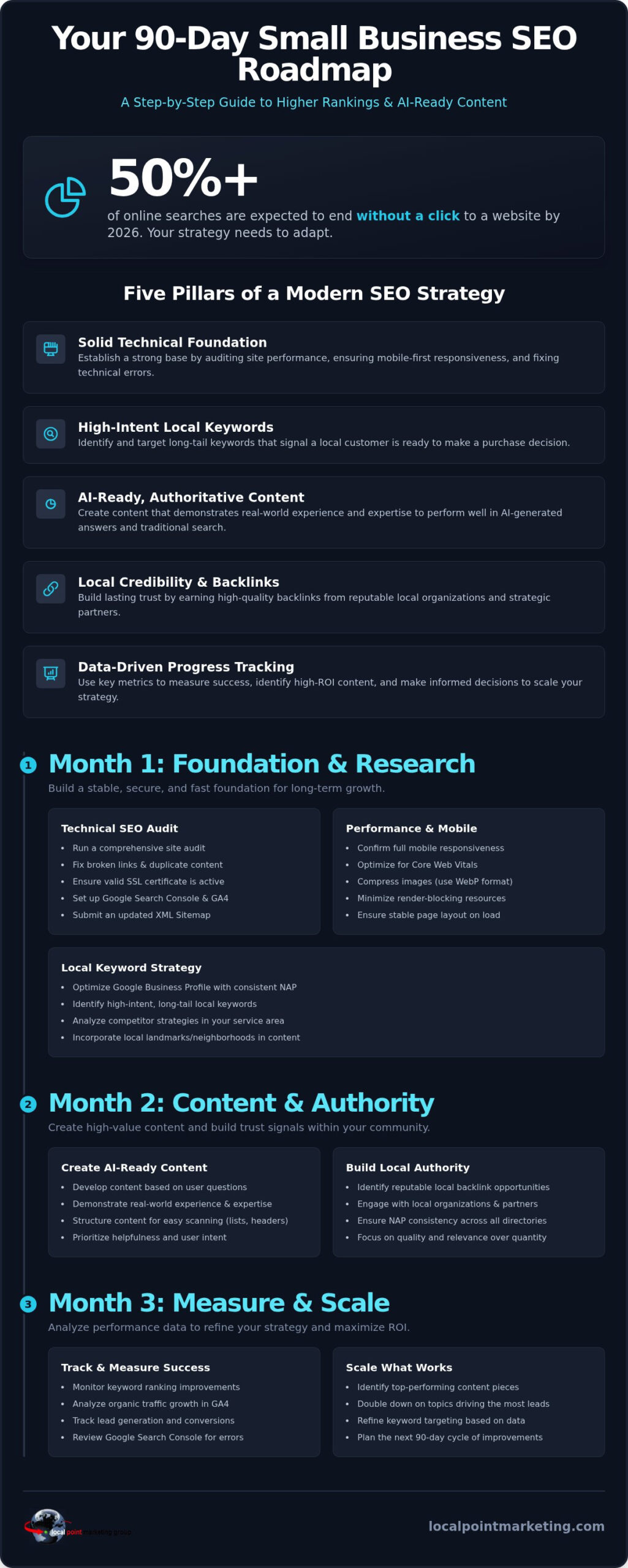
Did you know that by 2026, over 50% of online searches are expected to end without a single click to a website? This statistic highlights a significant shift where users find answers directly on the search results page. It’s understandable if you feel concerned about rising PPC costs or the rapid evolution of AI-generated answers. You deserve a small business SEO strategy that provides stability and drives measurable growth in this evolving environment.
We’ve designed this guide to be your steady partner in achieving long-term digital visibility. This comprehensive 90-day checklist offers a clear, manageable roadmap to higher local rankings and a better presence in AI-generated answers. You’ll learn how to build authority, optimize for user experience, and capture more leads without the stress of technical confusion. We will outline the essential steps to take each month to ensure your business remains a prominent, trustworthy choice for your local customers as the search landscape continues to change.
Key Takeaways
- Establish a solid technical foundation by auditing site performance and ensuring full responsiveness for mobile-first indexing.
- Identify high-intent, long-tail keywords that signal a local customer’s readiness to make a purchase.
- Implement a small business SEO strategy that prioritizes AI-ready content and demonstrates real-world experience and authority.
- Build lasting local credibility by earning quality backlinks from reputable South Florida organizations and strategic partners.
- Track your progress using data-driven metrics to scale the specific content pieces that drive the highest ROI and lead generation.
Phase 1: The Technical Foundations & SEO Audit Checklist
Every successful small business SEO strategy begins with a firm understanding of where you stand today. You can’t reach your growth goals without first identifying the technical barriers holding your site back. We recommend starting with a comprehensive site audit to establish a clear baseline. This process involves checking for broken links, duplicate content, and indexing issues that might prevent search engines from understanding your value. By documenting your current performance metrics, you create a measurable starting point for your 90-day journey.
Security is a non-negotiable standard for 2026. A valid SSL certificate protects your visitors and signals to search engines that your site is a safe destination. If you’re still wondering What is SEO? and why these technical steps matter, think of it as building a house on a stable foundation. Without security and a clean technical structure, your content won’t have the support it needs to rank. A secure site builds immediate trust with potential leads, which is essential for conversion.
Essential Tools and Tracking Setup
Data drives better decisions. You’ll need Google Search Console to monitor how search engines see your pages and alert you to crawl errors. Simultaneously, install Google Analytics 4 (GA4) with custom conversion tracking to measure lead generation rather than just traffic. These tools help you see exactly how your small business SEO strategy is performing in real-time. Finally, submit an updated XML sitemap. This simple file acts as a roadmap for search bots, ensuring they find and index your most important pages quickly. Setting these up now ensures you have accurate data to analyze in the coming months.
Mobile and Performance Benchmarks
Google predominantly uses the mobile version of your site for indexing and ranking. This means your site must be fully responsive across all devices, from smartphones to tablets. We suggest testing your usability on multiple screens to ensure buttons are clickable and text is readable without zooming. Speed is equally vital to your success. To meet the 2026 Core Web Vitals standards, focusing on a smooth user experience is paramount. You should prioritize these actions:
- Compress images: Use next-gen formats like WebP to reduce file sizes without losing quality.
- Minimize resources: Reduce render-blocking scripts that delay your page from loading.
- Improve stability: Ensure your layout doesn’t shift unexpectedly as elements load.
These technical refinements create a professional experience for users and search engines alike. When your site loads quickly and functions perfectly on mobile, you’ve already surpassed many of your competitors. Once your foundation is secure, you’re ready to move into the strategic world of local intent and keyword research.
Phase 2: Mastering Local Intent and Keyword Research
Your technical foundation is the engine of your website, but keyword research is the fuel that drives it. A successful small business SEO strategy requires a deep understanding of how your local community searches for your services. With research showing that 96% of people use online searches to find local businesses, you can’t afford to guess which terms matter. You need to identify high-intent keywords that signal a customer is ready to make a purchase today. This involves mapping your keywords to specific stages of the customer journey, from initial awareness to the final decision.
Analyzing your competition in the Miami and Fort Lauderdale markets provides a significant advantage. By seeing which terms your competitors overlook, you can claim those gaps for yourself. There are many impactful ways to improve SEO, but focusing on local relevance is often the most efficient path for growth. When you align your content with the specific questions your audience asks, you build a bridge between their problem and your solution.
Claiming Your South Florida Digital Territory
Consistency is the hallmark of a reliable brand. You must optimize your Google Business Profile with accurate Name, Address, and Phone (NAP) data to ensure search engines trust your location. We recommend including local landmarks and neighborhood names in your metadata to signal your presence in specific areas like Wynwood or Las Olas. This local specificity helps you stand out in a crowded market. You should also verify that your information is identical across directories like Yelp and Yellow Pages. If managing these moving parts feels overwhelming, a managed SEO retainer can provide the steady support needed to maintain your digital footprint.
Finding Your Long-Tail Keyword Opportunities
Broad terms are often too competitive for smaller budgets. Instead, focus on long-tail phrases that indicate a readiness to buy. These are often question-based queries that start with “who,” “what,” or “how.” By 2026, AI Overviews are expected to appear in over 25% of searches, and these AI systems favor content that directly answers specific questions. Target these opportunities by:
- Targeting “near me” modifiers: Use these naturally within your service descriptions to capture local intent.
- Identifying content gaps: Look for specific problems your competitors aren’t solving.
- Using city-specific modifiers: Mentioning your service area helps search engines connect you with nearby users.
By capturing these specific queries, you attract visitors who are further along in the buying process. This methodical approach ensures your small business SEO strategy produces high-quality leads rather than just empty traffic. Once you’ve mastered local intent, you can begin crafting the high-authority content that converts these visitors into loyal clients.
Phase 3: Creating AI-Ready, High-Authority Content
Your technical foundation and keyword list are now ready. It’s time to build the authority that search engines and users crave. A modern small business SEO strategy must account for the fact that nearly 70% of marketers now use AI tools for content creation. To stand out in this crowded space, you need to provide what AI cannot: authentic, real-world experience. We recommend developing a content calendar that addresses specific customer pain points. By focusing on E-E-A-T (Experience, Expertise, Authoritativeness, and Trustworthiness), you prove that your business is a reliable, human-led source of information.
Don’t rely on text alone to tell your story. In 2026, multimedia elements like video and infographics are critical for maintaining engagement. A well-placed video can keep a visitor on your page longer, which signals value to search engines. Infographics simplify complex topics, making your expertise more shareable and easier to digest. These elements help break up long blocks of text and cater to different learning styles, ensuring your message resonates with a wider audience.
Optimizing for Generative AI and Search Summaries
AI Overviews now appear in more than 25% of search results. To be featured in these summaries, your content must be easy for generative engines to parse. Use clear headings and provide concise answers within the first few sentences of each section. We’ve found that including factual data and expert quotes significantly boosts your chances of being cited as a source. Implementing schema markup is another essential step. This structured data provides the context search engines need to display your business in rich results and AI-generated summaries. It’s about making your expertise machine-readable and highly visible.
On-Page Optimization Best Practices
Effective on-page SEO ensures your high-quality content actually gets found by your target audience. Start by writing compelling meta titles and descriptions that include clear calls to action. These are your first chance to win a click from the search results page. Internal linking is another powerful tool for your small business SEO strategy. By guiding users toward related services or helpful blog posts, you keep them engaged with your brand for longer periods. Don’t forget image alt text. This simple step improves accessibility for all users while providing search engines with additional context about your visual content. These small, methodical details aggregate to create a professional, high-performing website that wins in 2026.
Phase 4: Building Local Authority and Quality Backlinks
Establishing local authority is the bridge between having great content and actually ranking for it. While your technical foundation and keyword research provide the structure, backlinks act as votes of confidence from the digital community. In 2026, search engines place immense value on the quality and relevance of these links rather than the sheer quantity. A successful small business SEO strategy focuses on earning mentions from reputable South Florida organizations that share your geographic or industry space. This external validation proves to search engines that your business is a pillar of the local community.
Amplify your reach by integrating your efforts with social media marketing. When you share your expert content on platforms where your local audience spends time, you increase the likelihood of earning natural, high-quality backlinks. It’s also vital to monitor your backlink profile regularly. Google’s 2026 updates have intensified enforcement against manipulative link-building and spam. Keeping your profile clean of toxic links ensures your site maintains its reputation and avoids unnecessary penalties that could stall your progress.
Strategic Networking in the South Florida Market
Digital growth often mirrors real-world relationships. We recommend joining local Chambers of Commerce in areas like Boca Raton or Jupiter to build foundational local links. Sponsoring community events or local charities provides visibility while earning you authoritative mentions on high-trust local domains. You can also collaborate with South Florida influencers or bloggers who align with your brand values. These partnerships create cross-promotion opportunities that drive both direct traffic and SEO value. When a local leader mentions your business, it signals to search engines that you are a trusted entity in the Miami to Vero Beach corridor.
Leveraging Social Proof and Customer Reviews
Customer feedback is a powerful tool for building trust with both users and search engines. You should implement a consistent system to request reviews from happy clients immediately after a successful interaction. High ratings on your Google Business Profile directly impact your visibility in local search results. It’s equally important to respond to every review you receive. Professional, calm responses to both positive and negative feedback demonstrate that you are a client-centric business that values integrity. Showcase these testimonials prominently on your service pages to provide the social proof needed to convert visitors into leads. If you are ready to elevate your brand’s authority, our team at Local Point Marketing can help you implement a managed SEO strategy tailored to the South Florida market.
Phase 5: Measuring Success and Scaling Your Strategy
You have reached the end of your first 90 days. This milestone is the perfect time to evaluate the impact of your hard work. A successful small business SEO strategy relies on consistent refinement rather than guesswork. By comparing your current results against the baseline you established in Phase 1, you can see exactly how far you’ve come. We recommend reviewing your data monthly to ensure your efforts align with your long-term growth goals. This methodical approach allows you to celebrate your wins while identifying areas that need more attention.
Data analysis is about more than just checking boxes. It’s about understanding the “why” behind your traffic. If certain pages are attracting visitors but not conversions, you have an opportunity to refine your messaging. Conversely, if a specific blog post is generating a high volume of leads, you should consider creating more content around that topic. This cycle of measurement and adjustment is what separates stagnant websites from those that dominate their local markets. Your goal is to build a predictable engine for lead generation that grows more efficient over time.
Tracking ROI Beyond Simple Rankings
Rankings are helpful indicators, but they don’t always tell the full story of your business health. You should focus on metrics that directly impact your bottom line. We suggest tracking these specific indicators to measure your true return on investment:
- Lead generation: Monitor how many contact forms and quote requests originate from organic search.
- Phone call tracking: Use unique tracking numbers to see how many customers call you directly from your search listings.
- Cost-per-lead comparison: Calculate what you’re spending on SEO versus your previous PPC advertising costs.
- User behavior: Use heatmaps to see where users click and how far they scroll on your most important landing pages.
These insights provide a clear picture of how your small business SEO strategy is performing. When you see your cost-per-lead drop while your call volume increases, you know your strategy is working.
Transitioning to Managed SEO Services
As your business grows, your time becomes your most valuable asset. There often comes a point where the DIY approach reaches its limit. Evaluate whether your internal team has the capacity to scale your content and technical needs without sacrificing quality. Complex tasks like deep technical audits or aggressive link-building often require a dedicated partner. If you find that managing these details is pulling you away from serving your clients, it might be the right time to explore Monthly Retainer Fees for Managed SEO. A professional agency can provide the steady, expert support needed to turn your 90-day foundation into a multi-year success story. Whether you operate locally or are evaluating options like a SEO agency Berlin businesses rely on for measurable growth, the criteria for choosing the right partner remain the same: transparency, proven results, and a data-driven approach.
Elevate Your Digital Presence for 2026
Success in the modern search landscape requires a blend of technical precision and local authority. You’ve now seen how a secure foundation and mobile-first optimization create the necessary platform for growth. By aligning your content with local intent and preparing for AI-driven summaries, you ensure your brand remains visible to the customers who need you most. Building this authority takes time; however, the long-term rewards in lead generation and ROI are undeniable.
Executing a consistent small business SEO strategy provides the steady momentum needed to thrive as search algorithms evolve. At Local Point Marketing, we specialize in delivering measurable results driven by data and a deep expertise in South Florida local markets. Whether you’re just starting your journey or ready to scale with comprehensive managed SEO services, we’re here to support your success. Ready to grow your South Florida business? Get a custom SEO strategy from Local Point Marketing. Your brighter future in search starts with a single, methodical step forward.
Frequently Asked Questions
How long does it take for a small business SEO strategy to work?
Measurable results from a small business SEO strategy typically appear within three to six months of consistent execution. While technical foundation fixes can improve site indexing in just a few weeks, building the local authority needed for top rankings is a gradual, methodical process. This timeline allows search engines to crawl your new content and recognize your business as a trusted provider in your specific market.
Can I do SEO for my small business myself or should I hire an agency?
You can certainly manage basic tasks like updating your Google Business Profile or writing experience-based blog posts yourself. However, scaling your growth often requires the specialized knowledge of a professional partner. Tasks such as advanced AI integration, complex technical audits, and high-level backlink acquisition are often more efficient when handled by an expert who understands the 2026 search landscape.
How much should a small business spend on SEO in 2026?
Research indicates that managed local SEO services generally range between $500 and $1,500 per month for a single location. Businesses seeking more comprehensive growth through extensive content creation and link building should expect to invest between $999 and over $3,000 monthly. These rates reflect the data-driven expertise and time required to navigate a competitive digital environment effectively and drive measurable ROI.
What is the difference between local SEO and traditional SEO?
Local SEO focuses on capturing customers in a specific geographic area through tools like Google Maps and location-based keywords. Traditional SEO aims for broader, often national visibility without geographic constraints. For most small businesses, prioritizing local intent is the most direct and cost-effective path to increasing foot traffic and generating high-quality leads from your immediate community.
How is AI changing the way small businesses rank on Google?
AI is shifting search results toward generative answers that summarize information directly on the results page. This change means your content must be structured to provide clear, expert answers that AI models can easily parse and cite. Visibility is now about being featured in these AI Overviews as much as it’s about ranking in the traditional list of blue links.
Why is my business not appearing in Google Maps or local search?
Invisibility in local search often stems from an unverified or incomplete Google Business Profile. Inconsistent name, address, or phone number data across various web directories can also confuse search engines and hurt your rankings. Improving your local prominence through consistent customer reviews and accurate directory listings is essential for appearing in the highly coveted Map Pack.
Is social media a part of a small business SEO strategy?
Social media plays a vital supportive role in a small business SEO strategy by amplifying your expert content and driving traffic to your site. While social links don’t act as direct ranking factors, the increased visibility often leads to natural backlink opportunities from other local organizations. It’s an excellent tool for building the community engagement that search engines associate with a reputable brand.