
Your business growth shouldn’t depend on how many manual emails you can send before the end of the day. Many South Florida owners find that implementing email marketing automation for small business is the only way to stay competitive without burning out. You likely know the frustration of watching a promising lead go cold because you were tied up with a client. It’s difficult to balance manual outreach with the daily demands of running your company, and when leads fall through the cracks, your bottom line feels the impact immediately.
This 2026 guide will show you how to scale your operations by replacing generic newsletters with automated sequences that actually convert. You’ll discover how to reclaim your time while building deeper connections with your audience through data-driven timing and personalization. We focus on turning your contact list into a steady engine for growth and measurable ROI. By automating these touchpoints, you ensure that every prospect receives the right message at the perfect moment.
We will examine the latest platform capabilities, essential compliance updates such as the 2025 FTC inflation adjustments for the CAN-SPAM Act, and the exact workflows that drive results. This article provides a clear roadmap to turn your manual outreach into a high-converting automated machine that works while you focus on your core business operations. You can expect to see higher engagement rates and a more predictable flow of new leads.
Key Takeaways
- Learn how to transition from broad newsletters to targeted lead nurturing systems that respond to specific customer actions.
- Identify the essential automation sequences, such as welcome series and lead magnet delivery, that build professional trust without manual effort.
- Evaluate the most effective platforms for email marketing automation for small business to find the perfect fit for your 2026 growth goals.
- Map your customer’s journey from initial discovery to final conversion to ensure your messaging remains relevant at every touchpoint.
- Discover the advantages of a managed partnership to handle technical maintenance while you focus on core business operations.
What is Email Marketing Automation for Small Business?
Email automation is a sophisticated system of pre-written messages that are sent automatically when a user takes a specific action. Instead of you sitting at a desk and hitting “send” every time someone signs up, the software does the work for you. It’s essentially a tireless digital assistant that understands your customers’ needs. To fully grasp the broader context of these tools, it helps to understand What is Marketing Automation and how it streamlines repetitive tasks to boost efficiency. For local owners, email marketing automation for small business is the difference between a stagnant list and a vibrant revenue stream.
The industry has shifted away from the old “batch and blast” newsletter model. In 2026, successful companies focus on nurturing individual leads based on their unique interests. Email marketing for lead generation is the strategic use of automated sequences to move prospects toward a sale. This approach ensures that your business stays relevant without requiring constant manual oversight.
In competitive markets like Miami, the efficiency gap is a real threat to growth. If you’re still sending manual follow-ups, you’re likely losing prospects to faster, more agile competitors. Automation bridges this gap by delivering the right information at the exact moment a lead is most interested in your services.
Automation vs. Manual Newsletters
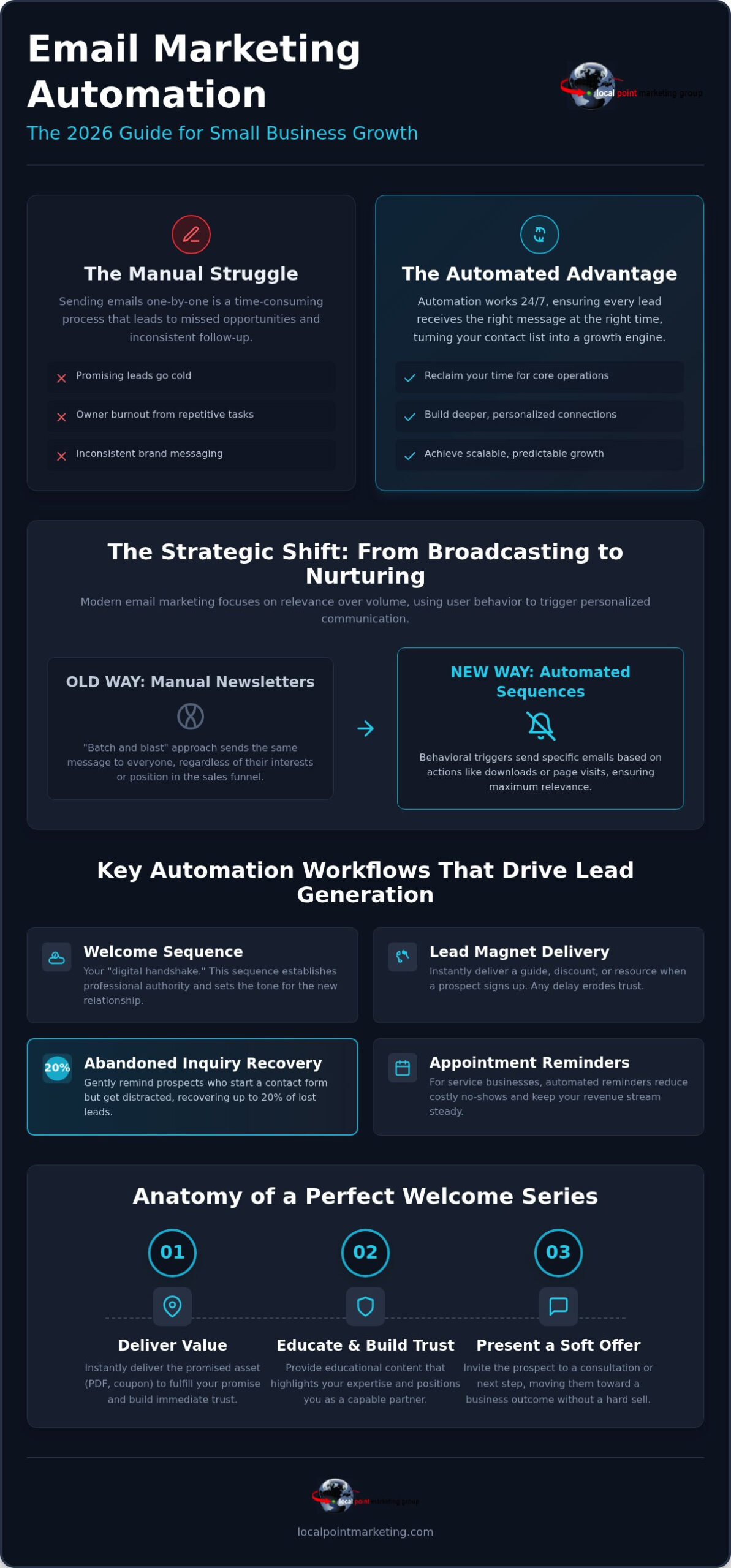
One-size-fits-all newsletters are losing their effectiveness. Modern consumers expect content that reflects their specific behavior. A broadcast method sends the same message to everyone, regardless of where they are in the buying process. In contrast, behavioral triggers send emails based on actions, such as downloading a guide or visiting a specific service page. When you prioritize relevance over volume, your open rates typically see a substantial increase because you’re providing actual value rather than noise.
The Core Benefits for South Florida SMBs
Implementing a managed system allows for significant time reclamation. You can focus on high-level service delivery while your automated workflows handle the initial introductions and follow-ups. Consistency is another major advantage. Whether your leads are in Fort Lauderdale or Boca Raton, automation ensures that no prospect goes cold due to a busy schedule. This reliability builds trust and positions you as a steady partner in your industry. Scalability becomes simple; your system can handle 100 new leads just as easily as it handles 10, allowing your business to grow without increasing your administrative workload.
Key Automation Workflows That Drive Lead Generation
Successful implementation of email marketing automation for small business relies on specific, goal-oriented workflows. These aren’t just simple autoresponders; they’re strategic sequences designed to guide a prospect from initial curiosity to a confirmed sale. By mapping out these touchpoints, you create a seamless experience that feels personal to the recipient while remaining entirely hands-off for you.
- Welcome Sequence: This is your digital handshake. It establishes your professional authority immediately and sets the tone for the relationship.
- Lead Magnet Delivery: When a prospect trades their contact information for a guide or discount, the delivery must be instant. Any delay in this process erodes trust.
- Abandoned Inquiry: Many prospects start a contact form but get distracted before clicking submit. An automated follow-up can recover up to 20% of these lost leads by gently reminding them to finish the process.
- Appointment Reminder: For service-based businesses in Palm Beach or Broward, no-shows are expensive. Automated reminders keep your schedule full and your revenue steady.
Building the “Perfect” Welcome Series
A great series follows a logical three-step progression. First, you must deliver the value you promised right away. This could be a PDF, a coupon code, or a simple “thank you” message. Second, provide educational content that builds trust and highlights your expertise. This establishes you as a capable partner before you ever ask for a sale. Finally, present a soft-sell or an invitation to a consultation. This structure ensures you aren’t rushing the relationship while still moving toward a measurable business outcome.
Nurturing Leads Through the Funnel
Automated drip campaigns allow you to address common customer concerns before they become deal-breakers. You can align these emails with your local SEO strategy to answer the exact questions people are searching for in your area. By sharing educational insights, you stay top-of-mind without appearing pushy or aggressive. You can also set up internal sales alerts within your system. When a lead engages with high-value content, your team gets notified to reach out personally. If managing these technical sequences feels like a distraction from your daily tasks, a managed email marketing partner can handle the setup and monitoring for you.
Evaluating the Best Automation Platforms for SMBs
Selecting the right platform is more than just a technical choice. It’s about finding a tool that aligns with your specific growth goals. When evaluating email marketing automation for small business, you must prioritize ease of use alongside powerful features. A tool that’s too complex will often remain unused, while one that’s too simple will eventually limit your ability to scale. You need a platform that offers a favorable cost-to-feature ratio and integrates directly with your existing CRM.
In 2026, three platforms stand out for South Florida business owners. ActiveCampaign remains the leader for those needing advanced logic and deep personalization. MailerLite is an excellent budget-friendly choice that doesn’t sacrifice essential automation features. For businesses looking for a comprehensive CRM and marketing suite, HubSpot offers an all-in-one environment that keeps your data centralized and accessible. Each of these options provides a steady foundation for your outreach efforts.
Your email system should never operate in isolation. It’s essential to ensure your chosen platform integrates seamlessly with your social media strategy. This connection allows you to create a cohesive experience for your prospects across multiple digital channels. You should also be wary of legacy tools. Many older platforms lack the behavioral triggers necessary to compete in modern markets, making them a poor choice for high-growth companies.
Features Every Small Business Needs
Visual automation builders are non-negotiable. They allow you to map out your customer’s journey with a simple drag-and-drop interface, making complex workflows easy to understand. You also need robust segmentation capabilities. This feature lets you separate “hot” leads who are ready to buy from researchers who still need education. Finally, detailed analytics are vital. You need to know exactly which emails are driving revenue so you can refine your strategy based on measurable data.
Budgeting for Automation Software
Most platforms use a subscriber-count pricing model. As your list grows, your monthly investment will increase. It’s tempting to stay on a free plan, but these often limit your lead generation by restricting access to advanced automation or removing your ability to remove platform branding. Don’t view software costs as a burden. Instead, calculate the potential ROI. A $50 monthly investment is a small price to pay if it helps you secure even one additional high-value client. Choosing the right email marketing automation for small business is an investment in your future efficiency and professional success.
How to Build Your First Automated Campaign
Success in email marketing automation for small business begins with a single, well-defined objective. You must decide exactly what you want the recipient to do next. Whether your goal is booking a strategy call, completing a direct sale, or encouraging a visit to your local office, every email in the sequence should support that specific outcome. A clear focus prevents your messaging from becoming cluttered or confusing for the prospect.
Once your goal is set, you need to map the user journey. The moment a prospect discovers your brand through your blog content, the automation should pick up the conversation naturally. Think of this as a digital hand-off where you provide additional value that builds upon what they’ve already read. This continuity reassures the reader that you understand their needs and have the expertise to help them succeed.
When writing your sequence, aim for a warm-professional tone that reflects a steady, reliable partnership. Avoid aggressive sales tactics or high-pressure language. Instead, use declarative sentences that offer solutions and project confidence. Remember that your first version doesn’t have to be perfect. You’ll need to test and refine your messages based on real-world engagement data to ensure they continue to resonate with your audience.
Segmentation: The Secret to High Open Rates
Effective automation relies on sending the right message to the right person. Beyond segmentation, understanding how to improve email open rates in 2026 requires debunking common myths that may be distorting your engagement data. You can achieve this through strategic segmentation:
- Location-Based Segments: Create regional offers specifically for Miami clients versus those in Jupiter or Boca Raton to increase local relevance.
- Interest-Based Segments: Group subscribers based on which service pages they’ve visited on your site to tailor your follow-ups to their specific needs.
- Engagement-Based Segments: Identify your most active subscribers to send them exclusive invitations or early access to new services.
Crafting Content That Converts
In 2026, clarity is more valuable than cleverness. Your subject lines should tell the reader exactly what’s inside the email without relying on clickbait tactics. A clear, honest subject line builds trust before the email is even opened. Within the body, stick to a single Call to Action (CTA) to avoid decision paralysis. You can also use dynamic content to automatically insert the recipient’s name or specific industry, making the message feel deeply personal. If you’re ready to build a system that delivers measurable results, our team can help you launch your first automated campaign with professional precision.
Scaling Growth with Managed Email Marketing
Many business owners start with great intentions but soon find that maintaining a complex system is a full-time job. DIY email marketing automation for small business often fails not because the technology is lacking, but because the owner lacks the time for consistent technical maintenance and strategic refinement. When you’re focused on serving your clients, it’s easy to let your sequences become outdated or ignore the data that could improve your results. This is where a steady, capable partner makes the difference between a tool that merely exists and one that actively grows your company.
A managed approach allows you to integrate your email efforts with other digital channels like SEO and PPC. This creates a holistic lead generation engine where every part of your marketing works in harmony. For example, the traffic you gain through search visibility can be captured and nurtured through your automated sequences, ensuring no marketing dollar is wasted. Professional analytics and reporting further refine this strategy. By looking at deep conversion metrics rather than just open rates, you gain a clear understanding of your measurable ROI. Pairing your email automation with a broader ROI-driven digital marketing strategy ensures every channel you invest in contributes directly to your bottom line.
The Local Point Marketing Advantage
We provide more than just technical setup; we offer a comprehensive partnership focused on your long-term success. Our team develops custom strategies specifically tailored to the unique South Florida market. We understand the local landscape and how to communicate effectively with audiences from Miami to Palm Beach. Our professional copywriters capture your brand’s unique voice, ensuring every message feels personal and authentic. We also provide continuous optimization. By monitoring performance daily, we make the small adjustments that improve your conversion rates month-over-month, keeping your business on an upward trajectory.
Getting Started: Your Next Steps
Scaling your outreach begins with a clear understanding of your current position. The first step is conducting a thorough audit of your existing email list and any tools you currently use. We look for gaps in your lead nurturing process and identify opportunities for immediate improvement. From there, we help you set realistic lead generation goals for the next 90 days. This structured approach ensures your growth is both predictable and sustainable. If you’re ready to turn your manual outreach into a professional automated machine, we invite you to book a strategy session to map your automation journey and discover how we can elevate your business together.
Elevate Your Business with Automated Outreach
Implementing email marketing automation for small business is a fundamental strategy for scaling personal relationships without sacrificing your time. By choosing the right platform and mapping out behavioral workflows, you ensure that every prospect receives a professional and timely response. This consistency builds the trust necessary to turn a casual researcher into a loyal client. You’ve seen how targeted sequences like welcome series and abandoned inquiry recovery can protect your bottom line from missed opportunities.
Managing these technical systems requires a methodical approach and continuous refinement. With over 10 years of experience in the South Florida market, Local Point Marketing acts as your reliable expert partner. We provide managed services that handle everything from design to deployment. Our focus remains on delivering data-driven strategies and measurable ROI that align with your specific goals. We take the complexity out of automation so you can focus on your core operations.
Ready to turn your emails into a lead generation machine? Contact Local Point Marketing today.
Your future success depends on the systems you build today. We look forward to helping you reach your full potential and achieve lasting growth in a competitive digital landscape.
Frequently Asked Questions
Is email marketing still effective for small businesses in 2026?
Yes. It remains one of the highest ROI channels because you own the audience. Unlike social media algorithms, email provides a direct line to your prospects. Email marketing automation for small business ensures your brand stays visible even when you’re busy. By 2026, the focus has shifted to deep personalization and behavioral triggers, making it more effective than traditional mass blasts. This targeted approach helps you build lasting professional relationships.
How much does email marketing automation cost for a small business?
Costs vary based on your subscriber count and required features. Entry-level platforms like Constant Contact start around $12 per month for small lists. More advanced tools like ActiveCampaign or HubSpot can range from $50 to several hundred dollars monthly as your lead generation needs grow. Investing in a managed service adds a professional fee but often yields higher returns by ensuring your technical setup is optimized for maximum conversion and impact.
How do I get people to sign up for my automated email list?
Offer immediate value through a lead magnet, such as a localized guide or a professional consultation. Place clear signup forms on high-traffic pages and within your blog content to capture interest at the right moment. You can also use social media to drive traffic to dedicated landing pages. Providing a clear promise of what subscribers will receive helps build the trust needed to secure their contact information reliably. For a complete step-by-step approach, our guide on how to build an email list for local business covers the exact strategies that work in the South Florida market.
What is the best email automation tool for a beginner?
MailerLite is often the best choice for beginners due to its intuitive drag-and-drop interface and affordable pricing. It offers a clean visual automation builder that makes mapping out your first sequence straightforward. As your needs become more complex, you might transition to ActiveCampaign for its advanced logic. Starting with a user-friendly tool prevents technical overwhelm and allows you to focus on crafting high-quality content for your local audience.
How often should I send automated emails to my leads?
Frequency depends on your industry and the specific workflow. A welcome sequence might include three emails sent over the first week to establish your authority. For ongoing nurturing, once or twice a week is generally sufficient to stay top-of-mind without becoming intrusive. The goal is to provide consistent value rather than just filling their inbox. Monitoring your engagement metrics will help you find the perfect rhythm for your South Florida subscribers and leads.
Do I need a large list to start with email marketing automation?
You don’t need a large list to see significant results. In fact, starting early allows you to build a high-quality, engaged audience from the ground up. Implementing email marketing automation for small business allows you to scale your personal touch as you grow. Smaller, highly targeted lists often have better conversion rates than massive, generic ones. Quality and relevance are far more important than raw numbers for achieving a measurable ROI.
Can I use email automation for a local service business?
Absolutely. Local service businesses in South Florida use automation to handle appointment reminders, follow-up requests, and educational content. For example, a landscaping company can send seasonal maintenance tips automatically based on the time of year. This keeps your brand relevant and ensures you’re the first person they call when they need professional assistance. It’s an excellent way to maintain a steady, reassuring presence in your local community without extra manual work.
How do I prevent my automated emails from going to the spam folder?
Focus on proper technical authentication and maintaining a clean list. Ensure you have SPF, DKIM, and DMARC records set up, as bulk senders now face permanent rejection without them. You must also comply with the CAN-SPAM Act, which carries penalties of up to $53,088 per individual email violation. Keeping your spam complaint rate below 0.1% is essential for maintaining your delivery reputation with major providers like Gmail and Yahoo. These technical safeguards protect your sender authority. For a deeper look at why your metrics may not tell the full story, our guide on how to improve email open rates and avoid common engagement myths in 2026 explains how privacy protections are affecting deliverability data.