
2026 Local SEO Keyword Guide for South Florida

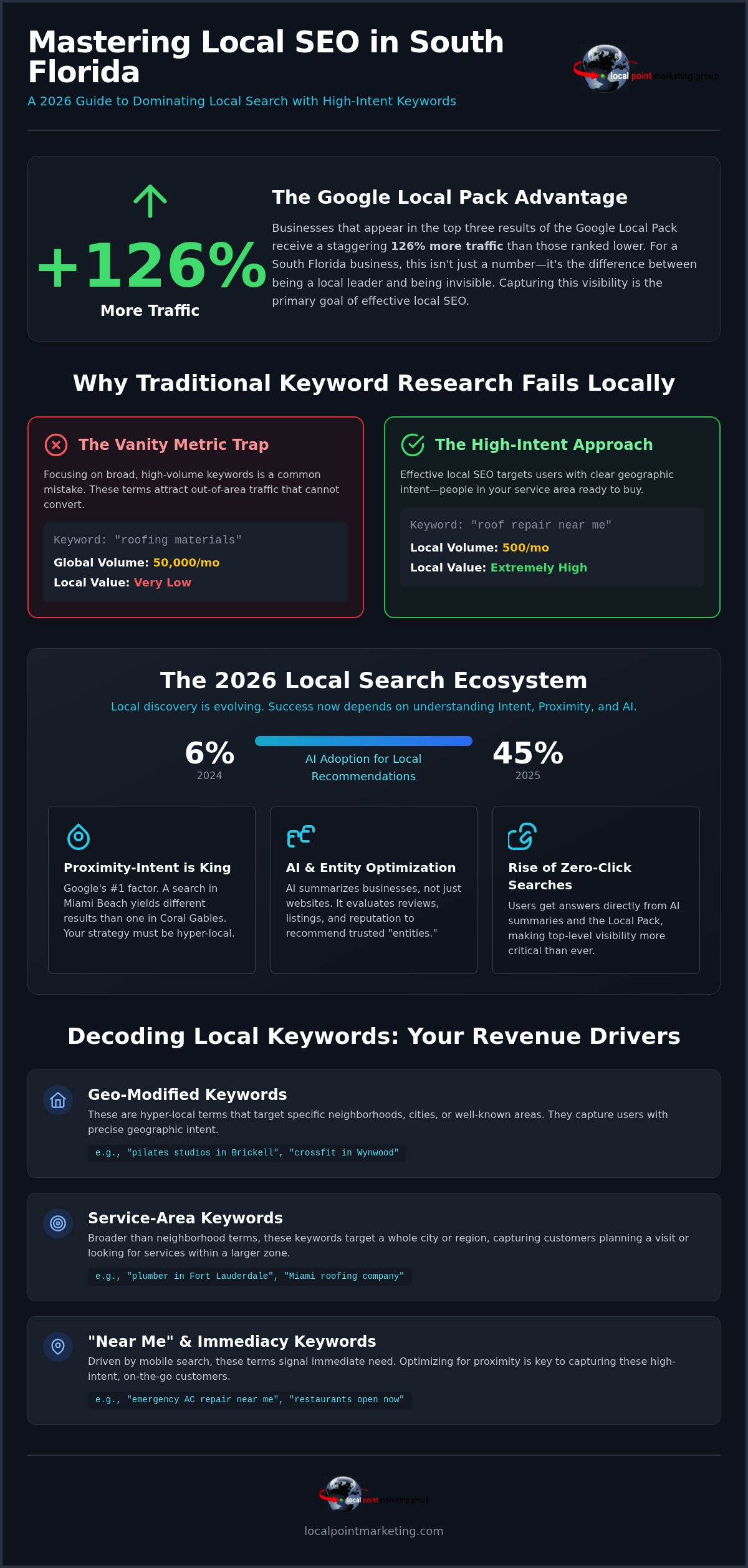
Businesses appearing in the top three results of the Google Local Pack receive 126 percent more traffic than those further down the page. In a competitive market like South Florida, capturing that visibility starts with effective local SEO keyword research. You’ve likely seen how broad keywords can drain your marketing budget without bringing a single customer through your doors. It’s a common struggle for local owners who feel overshadowed by larger brands with massive national reach and confusing technical jargon.

We believe your digital presence should be a steady source of growth rather than a source of confusion. This guide provides a clear roadmap to finding high-intent keywords that drive real foot traffic and qualified leads to your specific service area. You’ll master the art of identifying profitable search terms and understanding how 2026 AI trends impact your local visibility. We’ll explore the exact steps needed to improve your rankings and ensure your business remains the first choice for customers from Miami to Vero Beach.

Key Takeaways

  • Learn why global search volume is a vanity metric and how to prioritize search terms that reflect true geographic intent.
  • Discover how Generative AI and AI agents are reshaping local discovery in 2026 and what it means for your Google Local Pack ranking.
  • Master the process of local SEO keyword research to identify high-converting “Money Keywords” specific to the South Florida market.
  • Differentiate between service-area and geo-modified keywords to capture customers at every stage of their local search journey.
  • Develop a scalable visibility plan that transforms raw keyword data into a steady stream of leads and measurable business growth.

Why Traditional Keyword Research Fails South Florida Businesses

Effective local search engine optimization (local SEO) begins with identifying search terms that carry specific geographic intent. This process is about uncovering exactly what your neighbors are typing when they need immediate solutions. Many businesses make the mistake of relying on national tools that prioritize global search volume. However, global volume is often a vanity metric for a service provider tied to a physical location. If you operate a roofing company in West Palm Beach, 50,000 monthly searches for “roofing materials” won’t help your bottom line. You need the 500 people searching for “roof repair near me” within your specific zip code.

Performing local SEO keyword research requires a shift in perspective. You must account for the Proximity Gap. Ranking for a term in Miami doesn’t guarantee visibility for a customer in Jupiter, even though both cities are in South Florida. In 2026, the primary driver for success is Proximity-Intent. This concept focuses on aligning your digital presence with the user’s physical location and their immediate needs. We help our partners bridge this gap by focusing on data that reflects local reality rather than national trends.

The Problem with Broad Keywords

Targeting broad terms like “plumber” is often a waste of marketing budget for a Fort Lauderdale business. These terms attract out-of-area traffic that cannot convert into customers. A user in another state might search for a broad term to find general information, or a searcher in Orlando might click your ad by mistake. This leads to high competition and low-intent traffic that drains your PPC and organic SEO resources. Narrowing your focus ensures your local SEO keyword research targets individuals who are actually ready to hire you.

Understanding Hyper-Local Geographic Modifiers

South Florida residents search with unique local nuances that national strategies often overlook. They don’t just look for “Miami gyms”; they search for “pilates studios in Brickell” or “crossfit in Wynwood.” Capturing this traffic requires an understanding of how neighborhoods function as distinct markets. Mobile searchers also rely heavily on “near me” or “open now” modifiers to find immediate services while they are on the move. Geo-modifiers serve as the vital bridge between a digital searcher and your physical storefront.

The 2026 Local Search Ecosystem: Intent, Proximity, and AI

Local discovery has fundamentally changed with the rise of Search Generative Experience (SGE) and sophisticated AI agents. In 2026, these tools don’t just provide a list of links; they offer direct answers and business comparisons. This shift makes the Google Local Pack more influential than traditional organic results. Many users now engage in zero-click searches, finding all the information they need directly on the search results page. To remain visible, your local SEO keyword research must target high-intent terms that trigger these AI summaries. Understanding the benefits of conducting local keyword research is the first step in ensuring your business is the one the AI recommends.

The use of AI for local recommendations has risen from 6 percent to 45 percent in just one year. This rapid adoption means your digital presence must be optimized for machine understanding as much as for human readers. We focus on building your brand authority so that AI agents recognize your business as a reliable solution for South Florida residents.

AI Visibility and Local Search

AI models now summarize business information from reviews, social media, and third-party directories to provide instant suggestions. Success in this environment requires a transition from simple keywords to “entities.” Search engines now look at the characteristics and reputation of your business to determine relevance. Targeting phrases that trigger AI-generated local recommendations is a core part of modern AI search optimization. By aligning your content with these entity-based search patterns, you ensure your business remains a top choice in automated summaries.

The Proximity Factor in 2026

Google uses real-time user location with incredible precision to filter local results. A searcher in Miami Beach will see entirely different recommendations than someone in Coral Gables for the same query. This proximity factor means your keyword strategy must account for multiple service areas if you operate across South Florida. The distance between a searcher and your storefront directly impacts your competitiveness for specific terms. Effective local SEO keyword research identifies the micro-markets where you have the highest chance of ranking. Our team can help you navigate these geographic nuances through professional SEO services tailored to your growth goals.

Service-Area vs. Geo-Modified Keywords: Finding Your Revenue Drivers

Successful local SEO keyword research requires a clear understanding of how search intent is categorized. We divide these terms into two primary groups: Service-Area keywords and Geo-Modified keywords. Service-Area terms are implicit, meaning the searcher expects local results based on their current physical location without naming a city. Geo-Modified terms are explicit, as the user includes a specific location like “Miami” or “Jupiter” in their query. Balancing both types ensures your business captures users at different stages of the decision-making process.

Analyzing the conversion rates between these two types reveals a clear pattern. A search for “Miami SEO agency” indicates a user is researching providers in a specific business hub. In contrast, “SEO agency near me” often signals a higher level of immediate urgency. Research shows that 76 percent of consumers who search for something “near me” on a smartphone visit a related business within a single day. While explicit terms help you establish authority in specific geographic markets, implicit terms are the primary drivers of mobile-driven foot traffic. For a comprehensive strategy, you can refer to our Local SEO Guide for South Florida Businesses.

We also look for “Hidden Local Gems” during the research phase. These are low-volume search terms that possess 100 percent local intent. For example, targeting a niche neighborhood problem or a very specific local service might only yield a few searches per month, but the conversion rate is often much higher than broad city-level terms. These keywords face less competition and allow smaller businesses to dominate specific micro-markets.

Explicit Local Intent Keywords

Explicit keywords include city or neighborhood names, such as “Boca Raton accounting” or “Delray Beach landscaping.” These are often the highest-converting terms for new customer acquisition because the user has already narrowed their geographic preference. To maximize ROI, we recommend mapping these explicit keywords to specific landing pages. A dedicated page for “Fort Lauderdale estate planning” will perform significantly better than a generic homepage when a user is looking for a professional in that exact area.

Implicit Local Intent and the “Near Me” Phenomenon

Google uses IP addresses and GPS data to interpret implicit intent. Even if a user doesn’t type a city name, Google provides a Local Pack of results nearby. Optimizing for these terms involves strengthening your Google Business Profile and local relevance rather than just adding city names to your text. This is closely tied to mobile usage; since 46 percent of all Google searches have local intent, your local SEO keyword research must prioritize these proximity-based queries to capture the local mobile market.
2026 Local SEO Keyword Guide for South Florida

Step-by-Step: Conducting Local SEO Keyword Research that Converts

Converting searchers into customers requires moving beyond generic lists to a tailored strategy. To start your local SEO keyword research, audit your existing services to define your “Money Keywords.” These are the specific terms that represent your highest-margin offerings and highest-intent queries. Once identified, expand this list by applying South Florida modifiers such as “West Palm Beach” or “Coconut Grove” to capture geographically specific intent. Residents often search by neighborhood rather than city, so including modifiers like “Las Olas” or “Doral” can uncover high-intent traffic that competitors often miss.

Next, analyze how competitors are ranking in the Local Pack across Miami and Fort Lauderdale. Since businesses in the top three results receive 126 percent more traffic, understanding why rivals rank there is essential for your growth. You should then cluster these keywords by intent to inform your blog content creation services. This organization ensures you address both informational queries and direct service requests. Finally, validate your findings using Google Business Profile insights and existing PPC data. This confirms you’re targeting terms that have a proven track record of generating leads. If you’re ready to build a data-backed roadmap for your business, schedule a professional SEO consultation with our team today.

Mining Google Business Profile (GBP) for Data

Google Business Profile provides a wealth of direct data that national tools often miss. Use the “Queries used to find you” report to see the exact language customers use when they discover your listing. This report often reveals long-tail questions, such as “how to find a reliable plumber in Boca,” which are perfect for informational content. You can also identify specific service variations you hadn’t considered. Google Business Profile is the most accurate source of local intent data because it reflects real-time interactions within your specific service area.

Competitor Gap Analysis in South Florida

A competitor gap analysis helps you identify where other businesses in Palm Beach or Stuart are succeeding. By finding content gaps, you can target specific neighborhoods that your rivals have ignored. We recommend using tools that simulate searches from different GPS coordinates. This ensures you see exactly what a searcher in Jupiter sees versus someone in Tequesta. This precise view of the local competitive landscape allows you to claim territory where the competition is currently weak.

Scaling Your Local Visibility with Managed SEO Strategy

Transitioning from initial local SEO keyword research into a full-scale ROI-driven digital marketing plan is the final step in securing your market position. While identifying keywords is essential, the real value lies in execution and consistent optimization. We use data-driven strategies to help businesses dominate the South Florida market, ensuring your brand remains visible from Miami to Vero Beach. Our approach focuses on turning search traffic into measurable growth through methodical, evidence-based tactics.

Regular reporting and deep analytics are vital for long-term success. These insights allow us to refine your keyword targeting as customer behaviors and local trends evolve. In the fast-paced digital environment of 2026, a managed monthly retainer ensures your strategy stays ahead of rapid algorithm shifts and new AI search integrations. This steady partnership provides the reassurance that your digital presence is always working to generate new leads while you focus on running your business.

The Local Point Marketing Advantage

We position ourselves as a reliable expert partner for South Florida business owners. Our focus remains on high-quality lead generation and measurable results rather than empty metrics. To build a holistic presence, we integrate several core services:

  • Search Engine Optimization (SEO) to build long-term organic authority.
  • Social Media Marketing to engage with your local community.
  • Content Creation that speaks directly to the needs of South Florida residents.
  • AI Integration and Visibility to ensure you appear in modern AI-generated summaries.

This collaborative approach ensures that every marketing channel works in harmony toward your shared goals. We don’t just provide a service; we work alongside you to elevate your brand’s impact.

Ready to Own Your Local Search Results?

Partnering with an agency for managed SEO starts with a clear understanding of your current performance. During your initial local keyword audit, we identify the most profitable “Money Keywords” for your specific service area and uncover gaps your competitors have missed. We then create a structured roadmap to improve your rankings in the Google Local Pack and traditional search results. This methodical process removes the guesswork from your marketing spend. Start your journey toward local dominance today and secure the visibility your South Florida business deserves.

Securing Your Future in the South Florida Market

Dominating the local market requires more than just showing up; it requires a strategic alignment with how modern customers search. We’ve explored how 2026 AI trends and proximity factors have redefined the path to digital visibility. By mastering local SEO keyword research, you move beyond vanity metrics and focus on the high-intent terms that drive actual revenue. This targeted approach ensures your business remains the first choice for residents from Miami to Vero Beach.

Local Point Marketing brings over 10 years of SEO excellence and specialized South Florida market expertise to every partnership. We focus on delivering measurable lead generation results through data-driven strategies that keep you ahead of algorithm shifts. Our team is ready to serve as your steady, expert partner in navigating this evolving landscape. To see how your business can reach its full potential, Get Your Custom South Florida Local SEO Audit today. The future of your local visibility is bright, and we’re here to help you claim it.

Frequently Asked Questions

How do I find the best local keywords for my business?

Start by auditing your core services and analyzing the “Queries used to find you” report in your Google Business Profile. This identifies the real-world language your customers already use. You should also look at competitors in cities like Miami or Boca Raton to find content gaps. Focus on “Money Keywords” that represent high-margin services to ensure your efforts drive measurable lead generation and revenue growth for your business.

What is the difference between local SEO and traditional SEO keyword research?

Traditional SEO focuses on broad, informational terms with global reach, while local SEO keyword research prioritizes geographic intent and proximity. Local research targets users looking for immediate solutions in specific areas like Fort Lauderdale or Jupiter. Success in local search depends on capturing “near me” queries and city-specific modifiers. Traditional SEO often chases high search volume, but local strategies value high-intent traffic that physically visits your storefront or service area.

Are “near me” keywords still important in 2026?

Yes, “near me” keywords remain vital because 76 percent of consumers who search for something “near me” visit a related business within 24 hours. In 2026, Google uses real-time GPS data to filter these results with extreme precision. While you don’t necessarily type “near me” into your website copy, you optimize for these queries by strengthening your Google Business Profile and local relevance across South Florida neighborhoods like Brickell or Las Olas.

How many local keywords should I target per page?

You should focus on one primary keyword and two to three closely related variations per page. For example, a page targeting “Estate Planning Miami” might also include “Miami probate attorney” or “will preparation in Palm Beach.” Overloading a page with too many locations can dilute your authority. It’s more effective to create dedicated landing pages for specific South Florida cities to provide a better user experience and improve your conversion rates.

Can I do local keyword research for free?

You can certainly start for free by using Google Business Profile insights and the “People Also Ask” section in search results. These sources provide direct data on how South Florida residents phrase their needs. Tools like Google Keyword Planner also offer geographic filtering at no cost. While free methods are excellent for initial discovery, a managed SEO strategy often uses premium data to uncover deeper competitor gaps and long-term trends you might otherwise miss.

How does AI change the way I should choose local keywords?

AI shifts the focus from exact-match keywords to “entities” and conversational intent. In 2026, search engines use AI to summarize business information from reviews and social media to provide direct recommendations. You should choose keywords that answer specific local questions or trigger AI-generated summaries. This means prioritizing natural language and detailed service descriptions during local SEO keyword research to help AI agents recognize your business as a reliable authority in markets like Palm Beach or Stuart.

What are geo-modified keywords and why do they matter in South Florida?

Geo-modified keywords are search terms that include a specific location, such as “Boca Raton accounting” or “Jupiter landscaping.” They are essential in South Florida because they signal explicit intent to find a provider in a particular city or neighborhood. These keywords often have higher conversion rates than broad terms. By targeting specific geographic modifiers, you ensure your business reaches the most relevant audience in your immediate service area from Miami to Vero Beach.

How often should I update my local keyword research?

You should review your local keyword strategy at least once every quarter. South Florida is a dynamic market with shifting competition and seasonal search trends. Regular updates allow you to adapt to algorithm changes and new AI search features that impact visibility. We recommend a monthly review of your analytics to refine your targeting and ensure your digital presence remains a steady, reliable source of growth for your business.

Generative AI Search Visibility: The 2026 Trend Report for Small Businesses

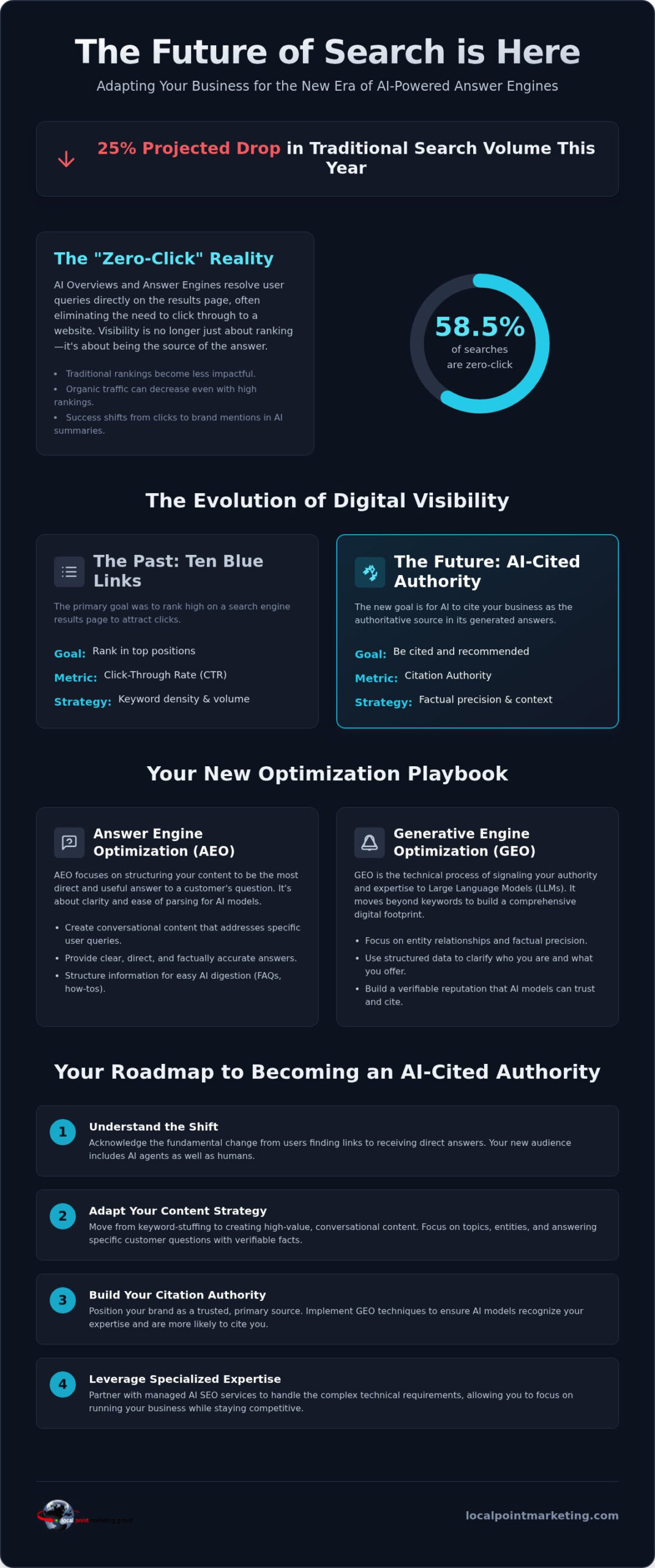
Did you know that traditional search engine volume is projected to drop by 25% this year? As we move through 2026, the era of the “ten blue links” is quickly fading into the background. It’s natural to feel concerned when AI-generated summaries provide immediate answers, often bypassing the need for a click to your website. You likely feel the pressure to keep up with complex jargon like Generative Engine Optimization while managing your daily operations. It’s a significant shift, but it doesn’t have to be a setback for your local growth.

Many owners are now turning to specialized AI SEO services for small business to bridge this technical gap and ensure their brand isn’t left behind. We’ve designed this report to help you reclaim your visibility and move forward with confidence. You’ll discover how to position your brand as a preferred source for AI agents so your expertise is the one being cited. We will break down the 2026 search landscape and provide a clear roadmap to ensure your business remains a trusted authority in an AI-first world. By the end of this guide, you’ll have actionable steps to turn these technological shifts into your competitive advantage.

Key Takeaways

  • Understand the shift from traditional search engines to answer engines and how being cited by AI models defines modern digital visibility.
  • Discover why existing SEO foundations require new content formats to remain effective in a zero-click search environment.
  • Learn how to optimize your presence in South Florida so AI agents recommend your business to customers in Miami and Fort Lauderdale.
  • Identify how managed AI SEO services for small business provide the technical expertise needed to stay ahead without overwhelming your team.
  • Gain a clear roadmap for transitioning your brand from a simple list of links to a trusted, AI-cited authority.

What is Generative AI Search Visibility in 2026?

The digital landscape of 2026 has shifted from finding a website to receiving a direct answer. Generative AI search visibility refers to the ability of your brand to be cited and recommended by AI models rather than just appearing in a list of links. We have moved past the era where search engines were simple directories. Today, platforms like Google Search Generative Experience (SGE), Perplexity, and ChatGPT act as answer engines. They synthesize information from across the web to provide users with immediate solutions. For small businesses, this means that visibility is now measured by how often an AI model uses your content as a primary source.

Traditional metrics like click-through rates are no longer the only way to measure success. In this new environment, citation authority has become the gold standard. When an AI summarizes your services, it often provides a citation link to your site as proof of its answer. This transition is driven by Large Language Models (LLMs) that prioritize factual accuracy and authoritative voices. Consumer discovery happens within these conversational interfaces, making it vital to secure a place within the AI’s response. Utilizing specialized AI SEO services for small business ensures your brand is formatted correctly for these models to digest and display.

The Rise of Answer Engine Optimization (AEO)

AI engines work by summarizing high-quality web content to resolve direct user queries. This shift has given rise to Answer Engine Optimization (AEO). In 2026, being the source for an AI-generated answer is the equivalent of ranking in the top spot on Page 1. To achieve this, content must be structured conversationally. You should focus on providing clear, direct answers to the specific questions your customers are asking. When your content is easy for an AI to parse and repeat, your likelihood of being the cited authority increases significantly. This strategy helps you capture the attention of users who want immediate information without scrolling through multiple results.

Generative Engine Optimization (GEO) Explained

Generative Engine Optimization (GEO) is the process of optimizing content for citation by LLMs. Unlike traditional SEO, which often relied on keyword density, GEO focuses on entity relationships and factual precision. It’s about demonstrating your business’s role within your local industry and community. By providing structured data and verifiable facts, you help AI models understand exactly who you are and what you offer. This approach moves away from keyword stuffing and toward building a comprehensive digital footprint. Integrating Generative Engine Optimization (GEO) into your marketing strategy allows your business to remain relevant as search technology continues to evolve. Professional AI SEO services for small business focus on these technical nuances to keep your brand visible and trusted by the systems consumers use every day.

Why Traditional SEO Isn’t Enough for Small Businesses Anymore

The search experience has undergone a fundamental transformation. For years, the primary goal was to rank in the top ten blue links. Today, those links often appear below a massive AI Overview that satisfies the user’s intent instantly. This has created a zero-click reality. Research indicates that over 58.5% of Google searches now conclude without a single click to an external website. For a local business, this means your traditional rankings might still be high, but your organic traffic could be disappearing as AI answers the query on the results page.

Basic keyword targeting no longer captures how users interact with modern search engines. Users now input complex, conversational queries that require more than a simple phrase match. AI models don’t look for exact word repetitions; they look for the most authoritative answer. This shift requires a move from volume-based metrics to “brand mentions” within AI responses. If an AI summary doesn’t mention your name as a source, you are effectively invisible to the user. Seeking out AI SEO services for small business helps you navigate this shift by focusing on how AI perceives your brand’s relevance and authority.

The Death of the Keyword-Only Strategy

AI now understands context better than any previous algorithm. It looks at the intent behind a search rather than just the specific phrases used. This means your strategy must move from “keywords” to “topics and entities.” AI systems are designed to filter out low-value, repetitive content that doesn’t add new information to the conversation. As highlighted in a recent OECD report on AI and SMEs, the adoption of these technologies is a critical step for smaller firms to maintain their competitive edge. Relying on old-school keyword stuffing will likely lead to being ignored by modern answer engines that value depth and clarity.

Building Entity Authority

To stay visible, your business must become a recognized entity in your local market. This involves more than just having a website. It requires a cohesive digital footprint that Google’s Knowledge Graph can verify. When generative AI looks for a source, it seeks out entities it trusts. Your customer reviews, social signals, and consistent business information all feed into this trust. Building this authority ensures that when a customer asks for a recommendation in South Florida, the AI has the confidence to cite your business as the expert solution. Managed services can provide the steady guidance needed to build this digital reputation without taking time away from your daily operations.

AI Visibility vs. Traditional SEO: A 2026 Comparison

Understanding the distinction between traditional search rankings and AI visibility is essential for sustained growth. While traditional SEO focuses on optimizing for specific keywords to secure a spot in the top results, AI search optimization leverages this foundation to achieve a different objective. Instead of simply appearing in a list of links, your goal is to be the primary source an AI model uses to construct its narrative answer. This shift requires a change in content formatting because AI models prioritize narrative depth and structured context over simple, repetitive lists.

The technical requirements have also evolved significantly. Schema markup remains a vital tool for communicating with search engines, but we are moving toward a world of LLM-readable API data that allows AI models to pull real-time information about your business. Measuring success in 2026 looks different than it did just a few years ago. Rank tracking is being supplemented by sentiment and citation tracking to see how often your brand is recommended. Utilizing AI SEO services for small business ensures that these technical nuances are managed correctly to maintain your competitive edge.

The Complementary Nature of Modern Search

You still need a strong technical SEO base to feed the AI models. Without a crawlable site structure, AI agents cannot find the information they need to recommend your brand to users. Your local SEO strategy provides the geographic data these systems use to answer location-based questions. A recent paper on Generative AI’s impact on small business processes highlights that businesses successfully blending human-centric content with machine-readable structures see the highest engagement levels. It’s about balancing the warmth of your brand voice with the precision that modern algorithms require.

New Metrics for a New Era

Success is no longer just about where you sit on a results page. We now track “Share of Model,” which measures how frequently AI platforms mention your brand compared to your competitors. Brand sentiment has also become a critical factor in AI training data. If the digital conversation around your business is positive and consistent, AI models are much more likely to trust and cite you as an authority. Brand Salience has emerged as the primary metric for 2026 because it measures how prominent your brand is in the “mind” of the AI. Investing in AI visibility marketing ensures that these new metrics are tracked and optimized to secure your long-term visibility.

Generative AI Search Visibility: The 2026 Trend Report for Small Businesses

Winning the Local AI Search Battle in South Florida

AI handles local intent with a level of precision that traditional search could never match. It identifies proximity and verified presence in cities like Miami and Fort Lauderdale by triangulating data from multiple sources. Your Google Business Profile has become the primary source of truth for these generative results. AI models pull your operating hours, specific service offerings, and physical location directly from this profile to answer user questions without a single click. Ensuring this information is consistent across the web is the first step toward securing an AI recommendation.

Local reviews are now the most significant trust signal for AI. These systems don’t just count your stars; they perform sentiment analysis on the actual text of your customer feedback. If a user asks for a reliable contractor in Fort Lauderdale, the AI scans your reviews for phrases like “on time” or “fair pricing” to validate its answer. Professional AI SEO services for small business help you manage these reputation signals to ensure you remain the top choice. High-quality strategy also focuses on creating hyper-local content that bridges the gap between a general city search and a neighborhood-specific recommendation.

Geographic Signals for AI Citations

Optimizing for “near me” queries in 2026 requires more than just a zip code. AI uses local landmarks and neighborhood names to verify your proximity and relevance to a specific area. This is why targeting neighborhoods from Boca Raton to Jupiter with specific content is so effective. Miami businesses can anchor their AI visibility by referencing hyper-local landmarks like the Vizcaya Museum or the Wynwood Walls within their service descriptions. This provides the necessary context for the AI to confirm your business is a true fixture in the local community.

The Importance of Local Structured Data

Schema.org allows you to communicate directly with AI models in a language they understand. By using local structured data, you tell the AI exactly where you are and what services you provide in areas like Palm Beach or Stuart. This technical layer ensures your business is connected to the right local service entities. Effective AI search optimization relies on this verified data to build authority with Large Language Models. When your technical data is clean and accurate, AI models can cite your business as the definitive local option. To secure your brand’s future in the South Florida market, you can partner with Local Point Marketing to handle these complex technical requirements through specialized AI SEO services for small business.

Managed AI SEO Services: The Small Business Solution

Many small business owners attempt a DIY approach by subscribing to the latest AI software suites. While these tools are powerful, they often carry a hidden cost in the form of your most valuable resource: time. Managing a complex array of AI tools can easily consume 20 hours or more each week. A software subscription is not a marketing strategy; it is simply a utility that requires expert handling to produce results. Investing in professional AI SEO services for small business allows you to reclaim your schedule while ensuring your digital strategy is managed by specialists.

The return on investment for professional AI integration far exceeds the value of a standalone tool. Managed services focus on high-level lead generation and brand authority rather than just technical maintenance. By partnering with a dedicated agency, you gain access to a team that monitors citation rates and AI sentiment in real time. Local Point Marketing prioritizes measurable visibility growth, moving your business beyond simple rankings and into the realm of trusted AI recommendations. This methodical approach provides the steady growth your business needs to thrive in a competitive market.

Bridging the Technical Gap

The shift from traditional SEO to Generative Engine Optimization (GEO) is happening faster than many expected. Letting experts handle this transition ensures your business doesn’t fall behind as search engines evolve into answer engines. Managed retainers are designed to adapt to the rapidly changing AI landscape, providing a level of agility that DIY methods cannot match. You gain the peace of mind that comes with a data-driven partner who values evidence over hype. This collaboration allows your brand to maintain a consistent presence across all major AI models without requiring you to master new technical skills every month.

Starting Your AI Visibility Journey

The transition from being invisible to becoming a cited authority typically takes place over the first 90 days of a managed campaign. During this time, your digital footprint is audited and reorganized to meet the specific requirements of Large Language Models. It is also important to consider how AI search impacts PPC campaigns, as your paid and organic efforts must work in harmony to dominate the results page. Aligning these strategies ensures that your business is visible whether a user is looking for a quick answer or a sponsored solution. To begin this transformation, you can schedule your 2026 AI Visibility Audit with Local Point Marketing and secure your place as a leader in your industry. Our AI SEO services for small business are built to provide the technical expertise and reliable partnership you need for long-term success.

The transition to 2026 search requires moving beyond traditional ranking lists to focus on citation authority and entity trust. Your visibility now depends on being the primary source that AI models rely on to answer direct customer questions. By optimizing for specific local intent and technical schema, you ensure your South Florida brand remains at the forefront of this digital shift. It is no longer about just showing up; it is about being the trusted recommendation that answer engines provide to your future customers.

Navigating this landscape alone can be overwhelming, but you don’t have to manage it by yourself. Utilizing professional AI SEO services for small business provides the strategic framework needed to stay ahead without sacrificing your valuable time. Local Point Marketing offers ten years of search marketing experience and specialized AI integration to help South Florida SMBs achieve measurable results focused on lead generation. We invite you to secure your business’s future with managed AI SEO services from Local Point Marketing. The path to growth is clear, and we are ready to help you lead the way in this new era of search.

Frequently Asked Questions

What is the difference between SEO and Generative AI search visibility?

Traditional SEO focuses on optimizing your website for a list of blue links, whereas AI search visibility targets being the specific source cited by an answer engine. While SEO builds your foundation, AI visibility ensures your brand is synthesized into the narrative responses generated by models like ChatGPT or Google SGE. It moves the goal from simply getting a click to becoming the trusted answer.

Will AI search kill traditional organic traffic for my small business?

AI search doesn’t kill traffic, but it fundamentally changes how users discover your business. While zero-click searches are increasing, the traffic that does reach your site is often higher in intent because the user has already vetted your brand through an AI summary. Businesses that adapt see their traffic shift from broad, informational visits to qualified leads who are ready to engage with a cited authority.

How does Google’s Search Generative Experience (SGE) pick which businesses to cite?

Google SGE selects businesses based on entity authority, factual accuracy, and the quality of structured data on your website. The system looks for clear, verified information that directly answers a user query with high confidence. By maintaining consistent business information and positive customer sentiment across the web, you increase the likelihood that Google’s Large Language Models will choose your brand as a primary citation.

Do I need special software to rank in AI search results?

You don’t necessarily need special software to rank, but you do need a specialized strategy that includes technical schema and conversational content. While many tools exist to analyze AI results, the real work involves restructuring your digital footprint to be machine-readable. Most small businesses find that managed AI SEO services for small business are more effective than software because they provide the expert analysis that automated tools miss.

How much do AI SEO services for small businesses typically cost?

Pricing for professional services is typically structured as a monthly retainer that scales with your specific business goals. This model allows for the ongoing monitoring and technical adjustments required to keep up with rapid AI updates. By focusing on a data-driven approach, you ensure that your marketing budget is directed toward measurable visibility and lead generation rather than just paying for software tool subscriptions.

Can I still rank locally in Miami if I don’t use AI SEO?

You may still appear in traditional local results for a time, but your visibility will likely decrease as more users shift to AI-driven discovery. In a competitive market like Miami or Fort Lauderdale, answer engines are becoming the primary way consumers find service providers. Without a strategy focused on AI visibility marketing for South Florida businesses, your business risks being bypassed by competitors who are actively being cited as the top local experts.

How long does it take to see results from AI search optimization?

Most small businesses begin to see measurable shifts in their AI citation rates within the first 90 days of an optimized campaign. This initial period is used to audit your digital footprint and implement the structured data necessary for AI models to trust your information. Because AI models are constantly retraining on new data, your visibility typically grows as your brand sentiment and authority strengthen over several months.

Is AI SEO just another word for Answer Engine Optimization?

Answer Engine Optimization (AEO) is a key component of AI SEO, but the two are not identical. AI SEO is a broader strategy that includes Generative Engine Optimization (GEO) and the management of your brand presence across multiple Large Language Models. A comprehensive approach using AI SEO services for small business ensures your brand is also cited, recommended, and trusted in various conversational contexts beyond just direct answers.