
How to Increase Website Traffic Organically: The 2026 Growth Guide

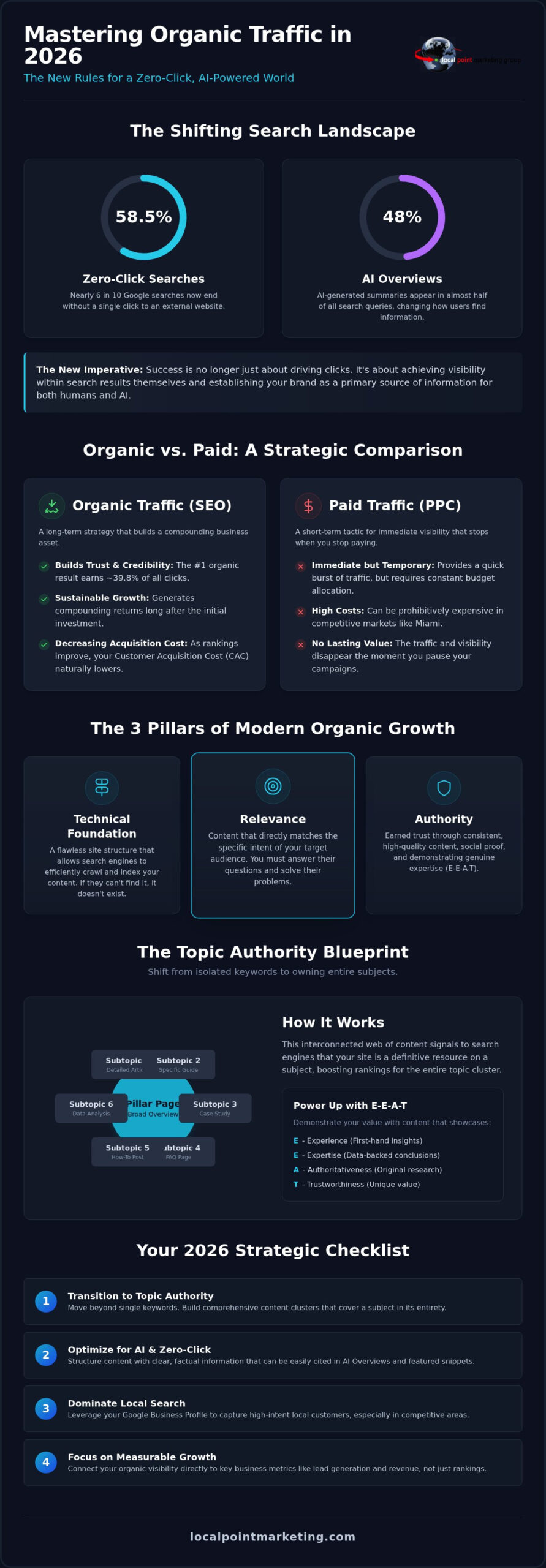
Nearly 58.5% of Google searches now end without a single click to an external website. This zero-click reality has fundamentally changed how to increase website traffic organically in 2026. You aren’t just competing with other businesses for attention. You’re competing with AI Overviews that now appear in 48% of all queries. Success in this new environment requires a move away from simple keywords toward building a comprehensive topic authority ecosystem.

It’s natural to feel frustrated by stagnant lead generation or the rising costs of PPC in competitive markets like Miami. You need a strategy that offers stability and measurable growth without the constant threat of the next algorithm update. We’ve designed this guide to help you reclaim your search presence. You’ll master the data-driven strategies necessary to turn your website into a high-quality lead generation machine.

We’ll detail the exact steps to dominate local search results and future-proof your content against AI shifts. This roadmap ensures your business maintains a steady stream of inbound leads that convert into long-term success.

Key Takeaways

  • Transition from basic keyword targeting to a topic authority model that aligns with how current search engines interpret intent.
  • Master the data-driven framework for how to increase website traffic organically to build a sustainable stream of high-quality inbound leads.
  • Leverage your Google Business Profile to dominate the local search results and capture high-intent customers in South Florida.
  • Implement strategic content structures that ensure your brand is cited within AI Overviews and generative search results.
  • Focus on measurable growth by connecting your organic visibility directly to conversion metrics and business revenue.

What is Organic Traffic and Why it Matters in 2026

Organic traffic represents the visitors who arrive at your website through unpaid channels. This includes standard search engine results, social media shares, and direct discovery. In 2026, the definition has expanded. It now includes visibility within AI-generated summaries and voice assistant responses. Unlike paid traffic, these visitors find you because your content provides a direct answer to their specific needs.

Trust is the primary driver of organic success. Data shows that the top organic result on Google earns approximately 39.8% of clicks. Users view these listings as more credible than paid advertisements. This inherent trust translates into higher conversion rates. While PPC offers immediate visibility, it requires continuous investment. In contrast, search engine optimization (SEO) builds a long-term business asset. This asset generates value long after the initial work is completed.

The search environment has shifted significantly. AI Overviews now appear in 48% of Google queries, and zero-click searches account for 58.5% of all sessions. Learning how to increase website traffic organically in 2026 means optimizing for both human readers and AI crawlers. You must provide fact-dense, structured information that these systems can easily interpret and share.

Organic vs. Paid Traffic: The Strategic Balance

PPC provides a quick burst of traffic, but the costs remain high in competitive markets like Miami. Organic growth offers a compounding return on investment. As your rankings improve, your customer acquisition cost (CAC) naturally decreases. You aren’t paying for every click. Instead, you’re building a sustainable foundation that supports managed growth. This makes organic visibility a reliable partner for your long-term business goals.

The Core Pillars of Organic Growth

Successful organic growth relies on three specific pillars. First, your technical foundation must allow search engines to crawl and index your site efficiently. If the technical structure is weak, your content won’t surface. Second, relevance is critical. Your content must align with the specific intent of South Florida customers. Finally, authority is earned through consistent quality and social proof. We focus on these pillars to ensure your site remains visible as search technology evolves. Understanding how to increase website traffic organically requires balancing these technical and creative elements to build lasting authority.

Building Topic Authority Through Strategic Content

Modern search engines have moved beyond simple word matching. They now prioritize semantic understanding and user intent. Success in this environment requires a shift from targeting isolated keywords to owning entire subjects. Topic Authority is the measure of a site’s credibility on a specific subject. To achieve this, you must implement a content cluster model. This strategy involves creating a central pillar page that provides a broad overview and surrounding it with related articles that explore specific subtopics in detail. This interconnected web of information signals to algorithms that your site is a definitive resource.

Google’s 2026 updates place heavy weight on E-E-A-T standards. You must demonstrate experience, expertise, authoritativeness, and trustworthiness in every piece of content. This means providing original research, first-hand insights, and data-backed conclusions rather than rehashing existing information. When you provide unique value, you naturally earn the trust of both users and search engines. This methodical approach is a fundamental part of learning how to increase website traffic organically while establishing long-term market leadership.

Creating a Content Roadmap

Successful growth requires a structured plan that addresses the specific needs of your audience. Start by identifying the “pain point” queries your South Florida customers use when they face a challenge. You should balance evergreen pillar content that remains relevant for years with trending industry news that captures immediate interest. Many business owners rely on professional blog content creation services to maintain the consistency needed for these roadmaps. If you want to streamline this process, you can partner with an expert team to handle the technical execution of your strategy.

Optimizing for User Intent

Every search has a specific goal. Some users seek information, while others are ready to make a purchase. You must create content that serves both informational and transactional needs. Use long-tail phrases to capture high-intent traffic from users looking for specific solutions. These detailed queries often lead to higher conversion rates because they align perfectly with the user’s current stage in the buying journey. Structure your posts for maximum readability by using clear headers, bulleted lists, and bolded key takeaways. This approach ensures your readers find value quickly, which is essential when learning how to increase website traffic organically in a competitive digital landscape.

Dominating Local Search in South Florida

Local search is the engine of growth for South Florida businesses. While global SEO builds broad authority, local strategies capture immediate demand in Miami, Fort Lauderdale, and Palm Beach. The “Local Pack” is the most valuable real estate on the results page. For service providers, this is the most direct way to understand how to increase website traffic organically with high conversion potential. Approximately 46% of all Google searches now have local intent, making geographic visibility a top priority.

Your Google Business Profile (GBP) functions as a secondary homepage. It often provides the first impression a customer has of your brand. Optimization involves more than just basic contact info. To stand out, you should focus on these specific actions:

  • Upload over 100 high-quality photos to your profile.
  • Update your business hours for seasonal changes or holidays.
  • Post weekly updates about local services or promotions.

Data indicates that businesses with over 100 photos on their GBP receive 520% more calls than those with fewer images. Consistency in your Name, Address, and Phone number (NAP) across every directory is also essential. Search engines use this consistency to verify your legitimacy. Reviews are the social currency of local search. About 87% of consumers read online reviews for local businesses before making a purchase. Active engagement with these reviews builds trust and signals relevance to search algorithms.

Geographic Keyword Integration

Relevancy increases when you naturally integrate city names like Boca Raton or Stuart into your content. You should avoid keyword stuffing by creating location-specific landing pages that address the unique needs of each neighborhood. Referencing local landmarks or regional news stories helps search engines associate your site with a specific geographic area. This specialized approach is a key component of how to increase website traffic organically within a crowded local market.

Earning Local Backlinks

Digital authority in South Florida is often built through community involvement. Networking with local chambers of commerce or being listed in regional directories provides high-quality backlinks. Sponsoring community events in Jupiter or Palm City often leads to digital mentions and links from reputable local organizations. You can also collaborate with non-competing local businesses for cross-promotion to strengthen your digital footprint. These relationships create a reliable network of support that drives steady inbound leads for your business.
How to Increase Website Traffic Organically: The 2026 Growth Guide

Optimizing for AI Search Visibility and SGE

AI Overviews have transformed the search results page. Your goal is no longer just a blue link; it’s becoming the source for AI-generated answers. AI search optimization is the process of making your data digestible for Large Language Models. When an AI Overview is present, traditional organic click-through rates can drop by 61%. However, being cited within that overview positions your brand as the definitive authority. AI models favor specific, unique insights over generic summaries. Providing original data or niche expertise ensures your content remains a primary source for these systems. This strategy turns the challenge of AI search into a significant growth opportunity for your business.

The Future of Search Intent

Conversational queries are rapidly replacing short, fragmented keyword phrases. Users now ask complex, multi-part questions that require nuanced answers. Your content must evolve to provide direct, comprehensive solutions to these inquiries. This approach is a critical part of how to increase website traffic organically as search behavior shifts. By positioning your site as the “source of truth” for industry-specific data, you capture high-intent users who rely on AI for detailed information. We focus on creating content that answers the “why” and “how” behind every search. This ensures your brand remains relevant as user expectations continue to climb.

Structured Data and Technical AI-Readiness

Structured data acts as a translator for AI crawlers. Implementing Organization, Service, and FAQ schema helps these models understand exactly what you offer. Clean code and technical excellence are more important than ever. AI crawlers prioritize sites that are easy to parse and load quickly. Technical debt can prevent even the best content from being recognized by modern algorithms.

  • Implement FAQ schema to answer common customer questions directly within the search results.
  • Use Service schema to define the scope and value of your specific South Florida offerings.
  • Maintain high mobile-readiness and site speed to meet 2026 performance standards.

Optimizing these technical elements is essential for anyone looking to understand how to increase website traffic organically in an AI-driven market. If you want to ensure your site is fully prepared for the future of search, you can integrate AI visibility into your marketing strategy with our expert team.

Measuring ROI and Scaling Your Organic Traffic

Generating visibility is only the first half of a successful digital strategy. High traffic numbers mean very little if they don’t result in tangible business growth. Moving beyond vanity metrics like page views allows you to focus on the data that truly impacts your bottom line. Effective ROI-driven digital marketing ensures that your traffic growth aligns perfectly with your specific sales targets. This methodical approach transforms your website from a digital brochure into a high-performing lead generation engine.

Setting up robust conversion tracking is essential for this transition. You must track every phone call, form submission, and email signup to understand which pages are driving value. This data provides the clarity needed to refine your strategy over time. Monthly reporting allows you to iterate on your successes and address any gaps in your performance. By analyzing these metrics, you gain a clear understanding of how to increase website traffic organically while maximizing the return on every content investment.

Key Performance Indicators (KPIs) to Track

Success is measured through a combination of visibility and engagement. You should monitor your Organic Click-Through Rate (CTR) and Average Position to gauge your standing in the search results. However, conversion rate by traffic source is the most critical metric for assessing quality. High-intent visitors often spend more time on your site and engage more deeply with your content. Tracking dwell time and scroll depth provides insights into how well your pages satisfy user intent. These indicators help you identify which topics resonate most with your South Florida audience.

Scaling Through Managed SEO

Consistency is the primary challenge for growing businesses. While DIY efforts can provide an initial boost, scaling requires a more structured approach. Many owners choose to move toward a professional managed SEO retainer once they reach a plateau. This allows an expert partner to handle the technical complexities while you focus on operations. A managed relationship provides the steady, 24/7 growth engine needed to dominate your market. You can then reinvest your organic wins into broader social media and email campaigns. This creates a multi-channel ecosystem that amplifies your reach and secures your position as a local leader. Understanding how to increase website traffic organically is a long-term commitment that pays dividends through sustained, measurable success.

Building Your Sustainable Growth Engine

Mastering how to increase website traffic organically in 2026 requires a shift from simple keyword matching to building a robust topic authority ecosystem. By focusing on helpful, data-dense content and optimizing for AI search visibility, you position your brand as a reliable source of truth. Dominating the local search landscape in Miami and Fort Lauderdale further ensures that your business captures high-intent customers exactly when they need your services. Success is no longer about raw traffic numbers; it’s about creating a steady stream of leads that drive measurable revenue.

Local Point Marketing brings 10+ years of digital marketing excellence to your growth strategy. We specialize in navigating the technical complexities of 2026 AI search trends to deliver measurable results for South Florida businesses. Ready to grow your South Florida business? Contact Local Point Marketing for a data-driven SEO strategy.

Your path to sustainable, high-quality traffic starts with a commitment to quality and a focus on long-term authority. We’re here to help you turn these strategies into a predictable engine for success. Your business has the potential to lead your market, and the right data-driven approach will get you there.

Frequently Asked Questions

How long does it take to see results from organic SEO?

Most businesses in South Florida start seeing measurable shifts in organic visibility within four to six months. However, achieving a dominant position in competitive markets like Miami or Fort Lauderdale often requires a consistent 12-month commitment. This timeline allows search engines to verify your authority and index your growing content library. We focus on building a sustainable foundation that delivers compounding value over time.

Can I increase website traffic for free without an agency?

You can implement several strategies to improve your visibility without a financial investment. Optimizing your Google Business Profile and creating helpful content are effective starting points for any business. However, learning how to increase website traffic organically at scale usually requires technical expertise that most owners lack. While the tools may be free, the time required to manage a full strategy often outweighs the cost of professional assistance.

Is blogging still effective for organic traffic in 2026?

Blogging remains a cornerstone of digital growth because it builds the topic authority that modern algorithms require. In 2026, the focus has shifted from short posts to comprehensive, fact-dense articles that answer specific user questions. This content provides the data that AI Overviews need to cite your brand as an expert. High-quality articles continue to drive the majority of long-term inbound leads for our clients.

How does social media impact organic website traffic?

Social media acts as a powerful discovery channel that drives referral traffic and builds brand recognition. When your content is shared across platforms, it signals to search engines that your brand is relevant and trustworthy. These social signals contribute to your overall authority. While it’s not a direct ranking factor, a strong social presence often leads to more natural backlinks and direct searches for your business.

What is the most important factor for ranking on Google today?

Demonstrating Expertise, Experience, Authoritativeness, and Trustworthiness (E-E-A-T) is the most critical factor for ranking in 2026. Google prioritizes content that provides original insights and satisfies the specific intent of the user. You must move beyond surface-level information to provide genuine value. This includes using structured data to help search engines and AI models understand the depth of your services and your local relevance in South Florida.

How do I know if my website traffic is high quality?

High-quality traffic is defined by its ability to convert into measurable business outcomes. You should analyze metrics such as conversion rate, dwell time, and scroll depth to assess visitor intent. If users from Boca Raton or West Palm Beach are spending several minutes on your service pages and submitting contact forms, your traffic is high quality. Traffic that bounces quickly without engaging indicates a mismatch between your content and expectations.

Should I focus on AI search or traditional SEO first?

You should treat AI search and traditional SEO as a single, integrated strategy. The same high-quality, structured data that helps you rank in standard search results also makes your content eligible for AI Overviews. We recommend building a strong technical foundation first. This ensures your site is readable by both traditional crawlers and Large Language Models. This dual approach is the most effective way to understand how to increase website traffic organically.

How often should I update my old website content?

We recommend reviewing and updating your core content every six to twelve months to maintain its accuracy and relevance. Search engines prioritize freshness, especially for topics involving industry trends or local news in South Florida. Updating old posts with new data, better images, or refined structured data can often lead to a significant boost in rankings. This practice protects your existing traffic from being overtaken by newer, more comprehensive competitors.

How to Generate Leads from Organic Traffic: A 2026 Growth Strategy

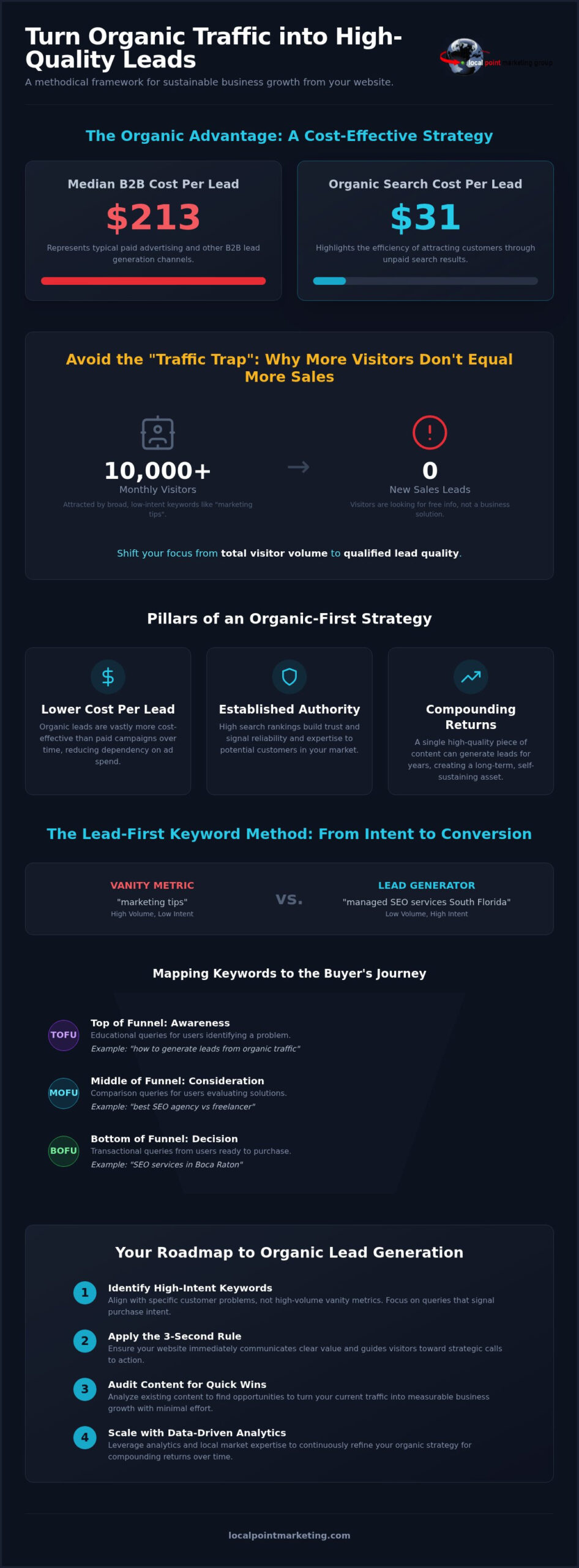
While the median B2B cost per lead has climbed to $213 this year, the average cost per lead for organic search remains significantly lower at approximately $31. This data highlights a clear opportunity for businesses to grow sustainably. You’ve likely felt the frustration of watching your website traffic increase while your actual sales numbers stay flat. It’s easy to feel overwhelmed by technical jargon or discouraged when you’re unsure how to generate leads from organic traffic effectively. These common challenges often lead to wasted time on content that fails to produce measurable results.

We’ve developed a methodical framework to help you turn passive website visitors into high-quality business leads without the need for a larger advertising budget. This article provides a clear roadmap to help you increase your lead volume and achieve a better ROI from your existing content. We’ll show you how to identify keywords that drive revenue and create a user experience that empowers your visitors to take the next step. By the end of this guide, you’ll have the tools to transform your digital presence into a reliable engine for growth.

Key Takeaways

  • Identify high-intent keywords that align with your customers’ specific problems rather than chasing high-volume vanity metrics.
  • Learn the methodical framework for how to generate leads from organic traffic by shifting your focus from total visitor volume to lead quality.
  • Implement the 3-second rule to ensure your website communicates clear value and guides visitors toward strategic calls to action immediately.
  • Audit your existing content to uncover quick win opportunities that turn current traffic into measurable business growth.
  • Scale your success by leveraging data-driven analytics and local market expertise to refine your organic strategy over time.

Understanding Organic Lead Generation: Why Traffic Is Only the Start

Organic lead generation is the methodical process of attracting potential customers through unpaid search engine results. Unlike paid advertising, which stops the moment your budget runs out, organic strategies build a permanent foundation for your digital presence. Understanding how to generate leads from organic traffic requires a shift in perspective. You must move past vanity metrics and focus on the actual business outcomes that drive growth. This approach transforms your website from a simple digital brochure into a sustainable, long-term asset.

Many business owners fall into the “Traffic Trap.” They celebrate when monthly visitors reach 10,000, yet they see zero growth in their sales pipeline. This disconnect happens when content attracts people who are looking for free information rather than specific solutions. In 2026, the definition of a “visit” is also evolving. AI-powered search engines now provide direct answers, which means every click to your site carries higher intent. Research indicates that traffic from AI search referrals converts at a rate of 3.49 percent. This is 22 percent higher than traditional organic search, making high-quality content more valuable than ever.

Traffic vs. Qualified Leads

There is a fundamental difference between a visitor who is browsing and one who is ready to buy. Broad keywords often fail to generate ROI for local businesses because they lack specific intent. For example, ranking for a generic term like “marketing tips” provides little value to a firm serving the Miami market compared to ranking for “managed SEO services South Florida.” Prioritizing lead quality over click quantity ensures that your team spends time on prospects who are genuinely interested in your offerings. This focus on qualified leads reduces wasted effort and improves your overall conversion rates.

The Benefits of an Organic-First Strategy

Focusing on organic growth creates a sustainable asset that reduces your dependency on fluctuating ad prices. The median cost per lead for organic search is approximately $31. This is significantly lower than the $110 average cost for PPC or search ads. Beyond the financial savings, organic rankings build higher levels of trust with your audience. People often view top organic results as more credible than sponsored placements. This credibility is vital in competitive markets like Miami and Palm Beach.

  • Lower CPL: Organic leads are more cost-effective than aggressive paid campaigns over time.
  • Established Authority: High rankings signal reliability and expertise to local searchers.
  • Compounding Returns: A single piece of high-quality content can generate leads for years without additional investment.

Targeting High-Intent Keywords: The Lead-First Research Method

High search volume is often a vanity metric that distracts from actual growth. While it’s tempting to chase keywords with tens of thousands of monthly searches, these broad terms usually attract people who are merely browsing. To master how to generate leads from organic traffic, you must prioritize intent over volume. High-intent keywords are specific queries that indicate a user is ready to solve a problem or make a purchase. These often have lower search volumes but significantly higher conversion rates because they align with a prospect’s immediate needs.

The “Problem-Solution” framework is an effective way to uncover these opportunities. Start by identifying the specific pain points your customers face daily. Instead of targeting generic terms, look for queries that describe a struggle. For businesses in the Miami and Fort Lauderdale markets, this means analyzing competitor gaps. Many local firms focus on broad industry terms while neglecting the specific questions their customers ask. By leveraging long-tail queries, you can capture users at the exact moment they’re looking for an expert partner to provide a solution.

Mapping Keywords to the Buyer’s Journey

Successful lead generation requires content for every stage of the decision-making process. Top of Funnel (TOFU) queries are educational, such as “how to generate leads from organic traffic.” Middle of Funnel (MOFU) searches involve comparisons, like “best SEO agency vs freelancer.” Finally, Bottom of Funnel (BOFU) queries are transactional and highly localized, such as “SEO services in Boca Raton.” Providing the right information at each stage builds the trust necessary to move a visitor toward a phone call or contact form submission.

Local Intent and Geographic Modifiers

South Florida is a diverse and competitive landscape where “near me” modifiers are no longer sufficient. To stand out, your strategy should incorporate neighborhood-specific terms naturally. A business serving Palm Beach needs to speak directly to that community while also appearing for searches in Jupiter or Stuart. Integrating these geographic modifiers into your content signals relevance to both search engines and local users. Our team at Local Point Marketing uses this methodical approach to ensure your brand remains visible where your customers actually live and work. Balancing broad educational pieces with hyper-local service pages creates a comprehensive web of visibility that captures high-quality leads consistently.

Optimizing Your Website for Conversion: Turning Clicks into Calls

Attracting visitors through search engines is a significant achievement, but your growth depends on what happens after the click. You must master how to generate leads from organic traffic by creating a seamless transition from reader to prospect. This process begins with the 3-second rule. Visitors from Miami to Vero Beach often decide whether to stay on your site within moments of landing. Your page must communicate clear value immediately. If a visitor cannot identify how you solve their specific problem within three seconds, they will likely return to the search results.

Mobile-first optimization is no longer optional for South Florida businesses. Google’s 2026 algorithm updates place a heavy emphasis on user experience signals like page load speed and intuitive navigation. A slow mobile site acts as a barrier to your lead flow. Most local searches happen on the move, and a frustrating mobile experience will cause potential clients to abandon their journey. Ensuring your site is responsive and fast protects your ranking and keeps your conversion funnel open.

Crafting High-Conversion Calls to Action (CTAs)

Strategic CTA placement is about more than just having a “Contact Us” page. You should use low-friction offers to encourage engagement without overwhelming the visitor. Free audits, local industry guides, or checklists are excellent ways to capture contact information early in the buyer’s journey. Use action-oriented language that tells the user exactly what to expect. Instead of a generic “Submit” button, try “Get My Free SEO Audit” or “Download the Miami Growth Guide.” Matching the intensity of your CTA to the content’s funnel stage ensures you aren’t asking for a sale before you’ve established value.

Trust Signals for South Florida Businesses

Building authority requires consistent trust signals that resonate with a local audience. Highlighting local awards, certifications, and community involvement shows that you’re an established part of the regional economy. Authentic testimonials from recognizable local clients provide the social proof necessary to reassure new visitors. Professional blog content creation services play a vital role here by demonstrating your expertise through helpful, data-driven articles. Finally, ensure your Name, Address, and Phone number (NAP) are consistent across every page. This technical detail builds trust with both users and search engines, confirming your business is a reliable local partner.

How to Generate Leads from Organic Traffic: A 2026 Growth Strategy

A 5-Step Roadmap to Increase Website Traffic Organically

Building a reliable engine for growth requires more than just publishing occasional updates. You need a structured execution plan that prioritizes high-impact activities. This 5-step roadmap outlines how to generate leads from organic traffic by focusing on data-driven improvements and local relevance. By following a methodical sequence, you transform your website into a high-performing business asset that works for you around the clock.

Step 1 & 2: Auditing and Content Strategy

Start by auditing your existing assets to identify “Quick Win” opportunities. Many businesses have older blog posts that attract steady traffic but fail to convert visitors into leads. Refreshing these pages with updated data, modern insights, and clearer calls to action can produce immediate results. Your plan should mirror the Local SEO Guide for South Florida Businesses to ensure you’re targeting the right regional intent. A content strategy is a structured roadmap for building authority and guiding prospects toward a solution. For Fort Lauderdale businesses specifically, a dedicated content marketing strategy for Fort Lauderdale can provide the structured growth template needed to turn local searchers into loyal customers.

Step 3: Optimizing for the AI Era

In 2026, capturing visibility in AI-generated answers is essential for maintaining a competitive edge. You must structure your content for easy extraction by using clear headings and providing concise, direct answers to common customer questions. Google’s continued focus on Experience, Expertise, Authoritativeness, and Trust (E-E-A-T) means that generic content will no longer rank well. Authenticity and first-hand experience are your greatest defenses against algorithm shifts. Investing in professional SEO content writing services ensures your content is structured to earn authority and appear in AI-generated answers. For deep technical tactics on appearing in generative search results, refer to our AI Search Optimization Guide.

Step 4 involves building local authority through strategic link-building. Focus on securing mentions from reputable South Florida organizations, local news outlets, and industry-specific directories. These signals tell search engines that your business is a trusted partner within the Miami and Palm Beach communities. This local relevance is a powerful ranking factor that broad, national competitors cannot easily replicate.

Finally, implement rigorous lead tracking and analytics. You cannot improve what you don’t measure. Use advanced tracking tools to connect specific content pieces to actual revenue and phone calls. This transparency allows you to refine your strategy based on evidence rather than guesswork. If you’re ready to implement this roadmap and see measurable results, partner with Local Point Marketing to develop a managed SEO strategy tailored to your business goals.

Scaling Your Results with a Managed SEO Partner

Implementing a strategy for how to generate leads from organic traffic is a significant first step toward digital independence. However, maintaining that momentum requires consistent attention and specialized expertise that many busy owners simply cannot spare. Many local business owners find that their initial results plateau because they lack the resources to monitor shifting algorithm trends or refine their content daily. Scaling your results involves moving beyond basic implementation toward a sophisticated, data-driven approach that maximizes every visitor’s potential.

A professional partnership provides the high-level strategy needed to turn search data into actual sales growth in the Miami and Fort Lauderdale markets. We focus on measurable outcomes rather than just ranking positions. By integrating your search efforts with a comprehensive social media marketing strategy, you create a holistic lead engine. This multi-channel approach ensures your brand remains visible across the entire digital landscape, reinforcing your authority and making your business the obvious choice for local customers.

The Managed SEO Advantage

Managed SEO offers a continuous optimization cycle that one-time projects or DIY efforts cannot match. You gain access to professional-grade tools and high-level strategy that clarify your specific path to success. This shift allows you to move from guesswork to measurable growth with complete confidence. Instead of wondering which tactics are working, you receive clear reports that link your organic visibility directly to your bottom line. This methodical approach is why we have spent 10 years helping businesses from Miami to Vero Beach achieve sustainable, predictable ROI.

Your Next Steps for Organic Growth

Taking the next step toward a more profitable digital presence doesn’t have to be overwhelming. You can begin improving your lead volume by focusing on these immediate actions:

  • Identify your top 3 high-intent keywords this week to focus your content efforts on revenue-generating terms.
  • Analyze your lead capture forms for friction points that might be discouraging visitors from completing their inquiry.
  • Schedule a consultation with a reliable expert partner to evaluate your current strategy and identify growth opportunities.

We are here to help you navigate the complexities of the 2026 search landscape. Our team provides the steady, capable support you need to reach your growth goals with confidence. By choosing a partner who understands the South Florida market, you ensure your business remains a leader in your industry for years to come.

Building Your Sustainable Path to Growth

Sustainable business growth in the South Florida market requires a shift from chasing vanity metrics to capturing genuine intent. By prioritizing high-quality content and optimizing for conversion, you build a digital asset that works for you every day. Mastering how to generate leads from organic traffic isn’t just about ranking. It’s about creating a reliable, trustworthy path for your customers to find the solutions they need. This methodical approach ensures your brand remains a leader in the Miami and Palm Beach communities as search behaviors continue to evolve.

Our team brings 10+ years of South Florida marketing expertise to every partnership. We provide data-driven analytics and customized local SEO strategies that turn complex search data into measurable success. If you’re ready to move past the traffic trap and start seeing a higher ROI from your digital presence, we invite you to Request a Free SEO and Lead Generation Audit. Your path to a more profitable and predictable future starts with a single methodical step. We’re ready to help you reach your goals with confidence.

Frequently Asked Questions

How long does it take to generate leads from organic traffic?

It typically takes six to twelve months to see measurable traffic gains from a new campaign. Full ROI is often realized between twelve and eighteen months. While this timeline is longer than paid ads, the results are more sustainable. You can accelerate this by auditing existing content for quick wins. This approach allows you to understand how to generate leads from organic traffic by improving assets you already own.

Is organic lead generation actually free?

Organic lead generation is unpaid in terms of media spend, but it isn’t strictly free. Success requires a consistent investment in high-quality content creation and technical optimization. You may choose to handle this internally or partner with a managed service provider. While there are no per-click costs, the resources required to build authority and trust are significant. It’s a long-term investment that reduces your dependency on expensive advertising platforms over time.

Why is my website getting traffic but no leads?

This disconnect usually happens when your content attracts informational seekers rather than buyers. If you rank for broad terms, you might get visitors who aren’t ready to purchase. Another common reason is high friction on your website. Slow page speeds or confusing contact forms can stop a prospect before they reach out. You must align your content with high-intent queries and ensure your user experience is seamless for South Florida visitors.

What is the best type of content for generating leads?

Case studies and problem-solution guides are among the most effective formats for driving conversions. These pieces demonstrate your expertise while addressing specific pain points your customers face. For local businesses, hyper-local service pages that include neighborhood-specific details also perform exceptionally well. This content builds trust by showing you understand the local market. Providing clear, actionable value helps move a visitor from the educational phase into the decision-making stage of their buyer journey.

Do I need a big budget to start organic lead generation?

You don’t need a massive budget to begin improving your organic results. Many businesses start by refreshing existing blog posts or optimizing their core service pages for local search. As your traffic increases and you see a return on investment, you can scale your efforts with more comprehensive strategies. The key is to focus on methodical growth rather than trying to compete for every keyword at once. Small, data-driven improvements lead to significant long-term gains.

How do I track where my organic leads are coming from?

Tracking your leads requires a combination of analytics tools and CRM integration. You should use Google Analytics 4 to monitor which specific pages are driving the most conversions. Call tracking software is also essential for local businesses to identify which search terms lead to phone inquiries. By connecting these data points, you gain a clear understanding of how to generate leads from organic traffic effectively. This transparency allows you to allocate resources toward the most profitable content.

Can AI search replace traditional organic lead generation in 2026?

AI search won’t replace organic lead generation; instead, it’s becoming a critical layer of the search landscape. While AI tools provide quick answers, users still visit websites for detailed expertise and to establish trust. Appearing in AI-generated summaries is a new way to capture high-intent traffic. Your goal should be to create authoritative content that AI engines want to cite. This strategy ensures you remain visible regardless of how search interfaces change for your audience.

How to Rank Higher on Google: Comprehensive Guide for 2026

Most businesses that struggle with low website traffic aren’t failing because of bad products or services. They’re failing because Google simply doesn’t know they exist. If you’ve been wondering how to rank higher on Google and feeling like the answer keeps moving further out of reach, you’re not alone.

The frustration is real. You’ve put time and energy into your website, yet the traffic stays flat and the leads don’t come. Here’s what most people miss: effective SEO isn’t just about stuffing in the right keywords. It’s about understanding what your audience is actually searching for and delivering content that genuinely answers their needs.

This guide cuts through the noise. You’ll walk away with a clear, structured approach to improving your search rankings, driving more qualified traffic to your site, and turning that visibility into real business growth. From technical foundations to content strategy and link building, every section is built around what actually works in 2026.

Key Takeaways

  • Understanding how Google’s search algorithm works is the foundation of any effective ranking strategy — and it directly determines whether your business gets found or overlooked.
  • Learning how to rank higher on Google starts with a thorough SEO audit and precise on-page optimization, two steps that reveal quick wins and long-term opportunities.
  • On-page and off-page SEO serve distinct but equally important roles — mastering both is what separates businesses that plateau from those that grow consistently.
  • Tracking the right KPIs, including organic traffic and conversion rates, gives you a clear picture of what’s working and where to focus your efforts next.
  • A tailored local SEO strategy, built around the specific dynamics of your market, can accelerate results significantly compared to a generic approach.

Understanding Google Rankings: Why They Matter

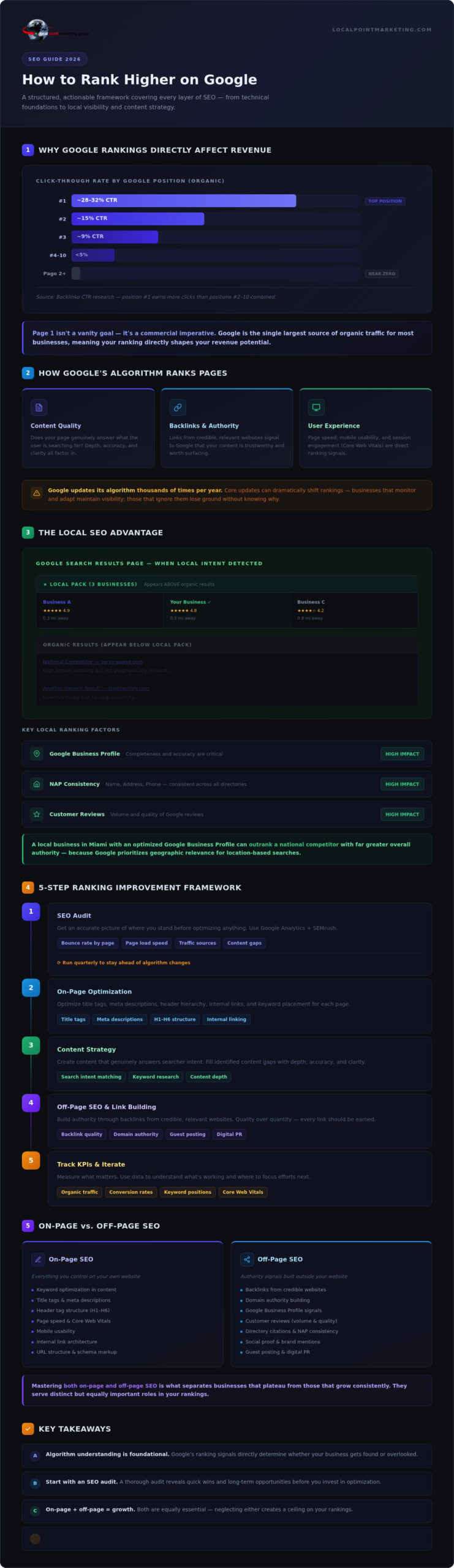
Your position on Google’s search results page isn’t just a number. It’s the difference between a steady stream of qualified leads and a website that sits invisible while competitors capture the business you should be winning. For most businesses, Google is the single largest source of organic traffic, which means your ranking directly shapes your revenue potential.

The stakes are concrete. Research from Backlinko consistently shows that the first organic result on Google earns a significantly higher click-through rate than positions two through ten combined, and results beyond the first page capture a fraction of total search traffic. Reaching page one isn’t a vanity goal; it’s a commercial imperative.

Understanding how to rank higher on Google starts with recognizing what rankings actually represent: Google’s best attempt to match a searcher’s intent with the most relevant, trustworthy, and useful content available. That framing changes how you approach everything.

How Google Determines Rankings

Google’s algorithm evaluates hundreds of signals simultaneously to decide which pages deserve top positions. The core factors fall into three broad categories:

  • Content quality and relevance: Does your page genuinely answer what the user is searching for? Depth, accuracy, and clarity all factor in.
  • Backlinks and authority: Links from credible, relevant websites signal to Google that your content is trustworthy and worth surfacing.
  • User experience signals: Page speed, mobile usability, and how long visitors stay on your site all influence how Google evaluates your pages.

Google updates its algorithm thousands of times each year. Most changes are minor, but core updates can shift rankings dramatically. Businesses that monitor these updates and adapt their strategies accordingly maintain their visibility; those that ignore them often find themselves losing ground without understanding why.

The Impact of Local SEO

For businesses in South Florida, local SEO isn’t optional. It’s the most direct path to capturing customers who are actively searching for services nearby. Google prioritizes local results when it detects geographic intent in a search query, displaying a “local pack” of three businesses above the standard organic results.

Local ranking factors include the completeness and accuracy of your Google Business Profile, the consistency of your business name, address, and phone number across directories, and the volume and quality of customer reviews. A business in Miami with a well-optimized local presence can outrank a national competitor with far greater overall authority simply because Google recognizes it as the most relevant answer for that searcher’s location.

This is where a tailored approach, built around the specific dynamics of your market, delivers results that a generic SEO strategy simply can’t match. Knowing how to rank higher on Google in a competitive local environment requires both technical precision and a deep understanding of how your target customers search. High rankings only create real business impact when they translate into inquiries, which is why understanding how to get more leads from Google in the South Florida market is just as important as achieving those positions in the first place.

Actionable Steps to Improve Your Google Ranking

Knowing what affects your rankings is one thing. Taking the right actions in the right order is another. The businesses that make consistent progress don’t chase every new tactic; they work through a structured process that builds on itself. Here are the five steps that form the foundation of any effective ranking strategy.

Conducting an SEO Audit

Before you optimize anything, you need an accurate picture of where you stand. An SEO audit surfaces the technical issues, content gaps, and missed opportunities that are quietly holding your site back.

Start with Google Analytics to understand your traffic sources and identify which pages are performing and which are losing visitors before they convert. Pair that with a tool like SEMrush to analyze your keyword positions, crawl errors, and backlink profile. The metrics that deserve your closest attention are:

  • Bounce rate by page: High bounce rates on key landing pages often signal a mismatch between what visitors expect and what they find.
  • Page load speed: Google’s Core Web Vitals make speed a direct ranking factor, not just a user experience consideration.
  • Traffic sources: Understanding how visitors arrive helps you prioritize where to invest next.
  • Content gaps: Topics your audience searches for that your site doesn’t currently address represent direct ranking opportunities.

An audit isn’t a one-time task. Running one quarterly keeps you ahead of technical drift and algorithm changes before they erode your positions.

On-Page Optimization Techniques

On-page optimization is where many businesses either gain a clear edge or leave easy wins on the table. Every page on your site should have a title tag that leads with your primary keyword and stays under 60 characters to display fully in search results. Meta descriptions don’t directly influence rankings, but a well-written one improves click-through rates, which signals relevance to Google.

Headers structure your content for both readers and search engines. Use your H1 for the page’s primary topic, and use H2s and H3s to organize subtopics logically. Avoid forcing keywords into headings unnaturally; clarity serves you better than keyword density. Image optimization matters too. Every image should carry a descriptive alt tag that reflects what the image shows, which improves accessibility and gives Google additional context about your page’s content.

Creating Quality Content

Understanding how to rank higher on Google ultimately comes down to this: create content that genuinely serves your audience better than anything else available. That starts with knowing what your audience is actually searching for.

Keyword research tools like SEMrush or Google’s own Search Console reveal the exact phrases your potential customers use. Target a mix of competitive head terms and longer, more specific phrases where intent is clear and competition is lower. Content length matters less than depth; a focused 800-word article that fully answers a specific question will outperform a bloated 2,500-word piece that circles the topic without resolution.

Engagement signals, including time on page and scroll depth, tell Google whether your content is delivering value. Write for the reader first, and the rankings follow. If building and executing this kind of content strategy feels like a significant lift alongside running your business, working with a local SEO and content partner can accelerate your results considerably. For a structured approach to getting started, the small business SEO strategy 90-day checklist offers a clear, month-by-month roadmap that takes the guesswork out of execution.

On-Page vs. Off-Page SEO: Key Differences

SEO isn’t a single discipline. It’s two interconnected systems working in parallel, and understanding where each one operates is fundamental to building a strategy that actually moves the needle. On-page SEO covers everything you control directly on your website. Off-page SEO covers everything that happens beyond it. Both matter. Neglecting either one limits your results regardless of how well you execute the other.

On-Page SEO Techniques

On-page SEO is the foundation. It includes your content, meta tags, header structure, and the technical signals that help Google understand what each page is about. Two elements that often get overlooked are URL structure and internal linking.

Clean, descriptive URLs give Google and your visitors an immediate signal about page content. A URL like /services/local-seo-miami communicates far more than /page?id=47. Keep URLs short, keyword-relevant, and free of unnecessary parameters. Internal linking is equally important: connecting related pages across your site distributes authority, helps Google discover new content, and keeps visitors moving deeper into your site rather than bouncing after one page.

Website layout also plays a direct role. A logical site structure, clear navigation, and fast-loading pages reduce friction for visitors and improve the user experience signals that influence rankings. Analytics tell you where the friction actually lives. If a page has strong traffic but high exit rates, that’s a signal to investigate the layout, the content match, or the call to action, not to simply add more keywords.

Off-Page SEO Strategies

Off-page SEO is primarily about authority. Backlinks from credible, relevant websites signal to Google that your content is worth trusting. The quality of those links matters far more than the quantity. A single link from an authoritative industry publication carries more weight than dozens of links from low-relevance directories.

Building that link profile takes deliberate effort. Effective outreach strategies include:

  • Guest blogging: Contributing articles to reputable industry sites earns backlinks while positioning your brand in front of a relevant audience.
  • Digital PR and earned media: Getting cited in news articles, local publications, or industry roundups builds authority naturally.
  • Social media visibility: While social signals aren’t direct ranking factors, consistent brand presence drives traffic and increases the likelihood that others will link to your content.

Balancing both sides of SEO is what separates businesses that plateau from those that grow consistently. On-page work makes your site worthy of ranking; off-page work signals to Google that others agree. Knowing how to rank higher on Google means treating these two systems as complementary rather than competing priorities. Strong on-page optimization without backlinks leaves authority on the table. A strong backlink profile pointing to weak, unoptimized pages wastes the authority you’ve earned.

The most effective approach is sequential: build a technically sound, well-optimized site first, then invest in off-page efforts that amplify what you’ve already built. That sequencing is a core part of how to rank higher on Google in a sustainable, compounding way.

How to Rank Higher on Google: Comprehensive Guide for 2026

Measuring Your SEO Success: Tools and Techniques

Execution without measurement is guesswork. You can optimize every page, build quality backlinks, and publish consistent content, but without tracking what those efforts actually produce, you have no reliable way to know what’s working, what isn’t, and where to focus next. Measurement is what transforms SEO from an activity into a strategy.

Setting Measurable Goals

Effective SEO goals share one quality: they’re specific enough to evaluate. A goal like “improve our rankings” gives you nothing to work with. A goal like “increase organic traffic to our services pages by 25% over the next 90 days” gives you a clear benchmark and a defined timeframe.

SMART goals — Specific, Measurable, Achievable, Relevant, and Time-bound — apply directly to SEO. Tie each goal to a business outcome rather than a vanity metric. Ranking on page one for a keyword matters only if that keyword brings visitors who convert. When you align SEO targets with revenue objectives, every reporting conversation becomes more productive and every decision carries clearer commercial weight.

Benchmarks matter too. Before you can measure progress, you need a baseline. Document your current organic traffic, average keyword positions, and conversion rates before making changes. That starting point is what makes future comparisons meaningful.

Tracking Performance with Tools

Three tools form the core of most effective SEO measurement setups:

  • Google Analytics: Tracks organic traffic volume, user behavior, bounce rates, and goal completions. It shows you not just how many people visit, but what they do once they arrive.
  • Ahrefs: Provides detailed backlink analysis, keyword ranking tracking, and competitive gap reporting. It’s particularly useful for identifying which pages are gaining or losing authority over time.
  • Moz: Offers domain authority scoring, on-page optimization suggestions, and rank tracking. Its interface is accessible for business owners who want clear, actionable data without deep technical expertise.

The KPIs that deserve consistent attention are organic traffic, keyword position changes, conversion rate from organic sessions, and page-level engagement metrics like time on page. Conversion rate is especially important; it connects your SEO efforts directly to business results and is the clearest signal that you’re attracting the right audience, not just more traffic.

Regular reporting closes the loop. A monthly review of your core KPIs reveals patterns that single data points miss. If organic traffic rises but conversions stay flat, that signals a content or targeting issue, not a rankings problem. Knowing how to rank higher on Google means reading that distinction correctly and adjusting accordingly. Data doesn’t just confirm success; it tells you exactly where to act next. For South Florida businesses specifically, pairing this measurement discipline with a clear framework for converting Google visibility into more leads ensures your analytics translate into actual revenue growth.

If interpreting this data and translating it into clear next steps feels like a stretch alongside your other responsibilities, partnering with a data-driven SEO team ensures your reporting actually drives decisions rather than sitting in a dashboard unread.

Local Point Marketing: Your Partner in SEO Success

Understanding how to rank higher on Google is one thing. Having the right team to execute that strategy consistently is another. Local Point Marketing specializes in SEO and digital marketing for businesses in South Florida, combining data-driven methodology with a genuine understanding of what drives growth in competitive local markets.

The agency’s approach isn’t built on generic templates. Every strategy is developed around the specific dynamics of your business, your audience, and your market. That distinction matters because a South Florida business competing for local customers faces a different set of challenges than a national brand, and a one-size-fits-all strategy rarely accounts for those differences with any precision.

Why Choose Local Point Marketing?

Local Point Marketing’s core strength is its focus on measurable outcomes. The team works across SEO, content creation, social media marketing, and email marketing, giving clients a cohesive strategy rather than disconnected tactics. Every recommendation ties back to performance data, which means decisions are grounded in evidence rather than assumptions. Three qualities define the partnership:

  • Local expertise: Deep familiarity with South Florida’s business landscape and how local customers search and make decisions.
  • Tailored strategies: Custom SEO plans built around your specific goals, competitive environment, and growth stage rather than a standard package applied to every client.
  • Consistent accountability: Ongoing performance monitoring ensures that results are tracked, reported clearly, and used to inform what happens next.

The focus stays on your outcomes. That’s not a positioning statement; it’s reflected in how the work is structured from the first conversation forward.

Getting Started with SEO

The process begins with a consultation focused on understanding your business, your current online presence, and where the most significant opportunities exist. From there, the team develops a customized SEO plan that addresses your technical foundation, content strategy, and off-page authority, prioritized by impact.

Ongoing support is built into the relationship. Rankings shift, algorithms update, and competitive landscapes evolve. Regular performance reviews keep your strategy aligned with what’s actually working and flag adjustments before small issues become larger problems.

If you’re ready to stop guessing and start building visibility that compounds over time, schedule a consultation with Local Point Marketing today. The first step toward knowing how to rank higher on Google is having a clear plan, and that’s exactly where the conversation starts.

Start Building Visibility That Compounds

Ranking higher on Google isn’t a single fix. It’s the result of consistent, layered work: a technically sound website, content that genuinely serves your audience, a growing backlink profile, and measurement that keeps your strategy honest. Every element covered in this guide reinforces the others.

The businesses that pull ahead aren’t necessarily the ones with the biggest budgets. They’re the ones with a clear plan and the discipline to execute it. Knowing how to rank higher on Google gives you that clarity. Putting it into practice is where the growth actually happens.

Local Point Marketing brings data-driven strategies, tailored SEO solutions, and proven experience with local businesses in South Florida to every client partnership. The goal is always the same: measurable visibility that translates into real business results.

You don’t have to figure this out alone. Contact Local Point Marketing for a free SEO consultation and take the first step toward building an online presence that works as hard as you do.

Frequently Asked Questions

What is SEO and why is it important for my business?

SEO, or search engine optimization, is the process of improving your website so it appears higher in search results when potential customers look for products or services like yours. It’s important because organic search is typically one of the largest sources of website traffic for businesses, and visibility in those results directly influences how many qualified leads you attract.

Without SEO, your website essentially relies on people already knowing you exist. With it, you’re positioned in front of customers at the exact moment they’re actively searching for what you offer.

How long does it take to see results from SEO efforts?

Most businesses begin seeing measurable movement in keyword rankings and organic traffic within three to six months of consistent SEO work. That timeline varies based on your starting point, your competitive landscape, and how aggressively you’re building content and backlinks. Newer websites or highly competitive markets typically take longer to gain traction.

SEO compounds over time. Early months build the foundation; later months deliver accelerating returns as authority grows and more pages rank. It’s a long-term investment, not a short-term fix.

What are the main factors that affect my Google ranking?

Google evaluates hundreds of signals, but three categories carry the most weight: content relevance and quality, backlink authority from credible external sites, and technical user experience factors like page speed and mobile usability. Getting all three right is what separates sites that plateau from those that climb consistently.

No single factor dominates in isolation. A technically flawless site with thin content won’t rank well, and strong content without any backlinks will struggle to gain authority. Knowing how to rank higher on Google means treating these factors as a system rather than a checklist.

Can I do SEO myself, or should I hire an agency?

You can handle basic SEO yourself, particularly keyword research, on-page optimization, and content updates. Free tools like Google Search Console give you meaningful data without any cost. The challenge is that effective SEO requires consistent time, technical knowledge, and the ability to interpret data and adapt quickly when results shift.

For business owners managing everything else simultaneously, the opportunity cost of doing SEO in-house often outweighs the savings. A specialized agency brings both the expertise and the dedicated focus that produces faster, more reliable results.

What is local SEO and how does it differ from regular SEO?

Local SEO focuses specifically on improving your visibility in searches that include geographic intent, such as “marketing agency in Miami” or “plumber near me.” It prioritizes your Google Business Profile, local directory listings, and customer reviews alongside traditional ranking factors. Regular SEO targets broader keyword rankings without a geographic component.

For businesses serving a specific area, local SEO is often the higher-value priority. It positions you directly in front of nearby customers who are ready to act, and it allows smaller local businesses to outrank larger national competitors who lack a genuine local presence.

How often should I update my website content for SEO?

There’s no universal rule, but a practical approach is to audit your existing content quarterly and publish new content consistently throughout the year. Pages that have dropped in rankings, contain outdated information, or no longer match current search intent should be refreshed before you focus on creating something new.

Fresh content signals to Google that your site is active and maintained. More importantly, updating underperforming pages is often faster and more effective than starting from scratch, especially when those pages already have some existing authority and indexing history.

What tools do you recommend for tracking SEO performance?

Google Search Console is the essential starting point; it’s free, accurate, and shows exactly which queries bring visitors to your site. Google Analytics pairs with it to reveal what those visitors do once they arrive. For deeper competitive analysis and keyword tracking, tools like SEMrush, Ahrefs, and Moz provide detailed reporting that Search Console alone doesn’t cover.

The most important habit isn’t which tools you use; it’s reviewing your data regularly and acting on what it shows. Dashboards that go unread don’t improve rankings. Schedule a monthly review of your core metrics and let those numbers drive your next decisions.