
How to Increase Website Traffic Organically: The 2026 Growth Guide

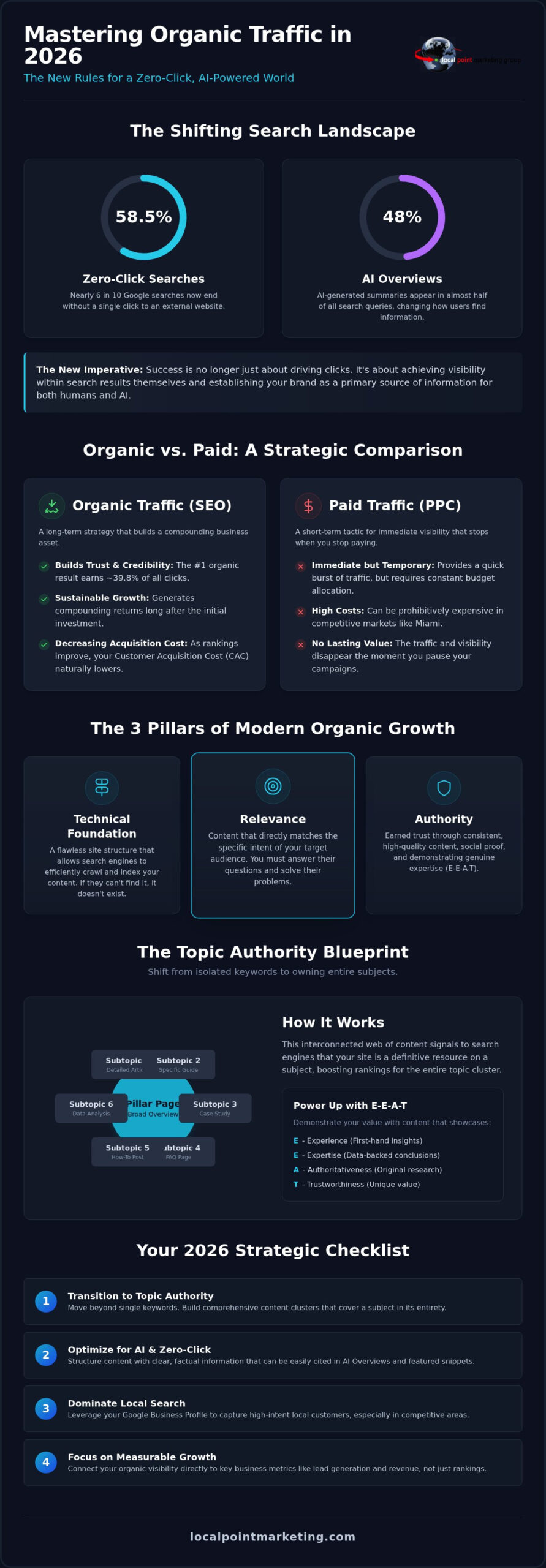
Nearly 58.5% of Google searches now end without a single click to an external website. This zero-click reality has fundamentally changed how to increase website traffic organically in 2026. You aren’t just competing with other businesses for attention. You’re competing with AI Overviews that now appear in 48% of all queries. Success in this new environment requires a move away from simple keywords toward building a comprehensive topic authority ecosystem.

It’s natural to feel frustrated by stagnant lead generation or the rising costs of PPC in competitive markets like Miami. You need a strategy that offers stability and measurable growth without the constant threat of the next algorithm update. We’ve designed this guide to help you reclaim your search presence. You’ll master the data-driven strategies necessary to turn your website into a high-quality lead generation machine.

We’ll detail the exact steps to dominate local search results and future-proof your content against AI shifts. This roadmap ensures your business maintains a steady stream of inbound leads that convert into long-term success.

Key Takeaways

  • Transition from basic keyword targeting to a topic authority model that aligns with how current search engines interpret intent.
  • Master the data-driven framework for how to increase website traffic organically to build a sustainable stream of high-quality inbound leads.
  • Leverage your Google Business Profile to dominate the local search results and capture high-intent customers in South Florida.
  • Implement strategic content structures that ensure your brand is cited within AI Overviews and generative search results.
  • Focus on measurable growth by connecting your organic visibility directly to conversion metrics and business revenue.

What is Organic Traffic and Why it Matters in 2026

Organic traffic represents the visitors who arrive at your website through unpaid channels. This includes standard search engine results, social media shares, and direct discovery. In 2026, the definition has expanded. It now includes visibility within AI-generated summaries and voice assistant responses. Unlike paid traffic, these visitors find you because your content provides a direct answer to their specific needs.

Trust is the primary driver of organic success. Data shows that the top organic result on Google earns approximately 39.8% of clicks. Users view these listings as more credible than paid advertisements. This inherent trust translates into higher conversion rates. While PPC offers immediate visibility, it requires continuous investment. In contrast, search engine optimization (SEO) builds a long-term business asset. This asset generates value long after the initial work is completed.

The search environment has shifted significantly. AI Overviews now appear in 48% of Google queries, and zero-click searches account for 58.5% of all sessions. Learning how to increase website traffic organically in 2026 means optimizing for both human readers and AI crawlers. You must provide fact-dense, structured information that these systems can easily interpret and share.

Organic vs. Paid Traffic: The Strategic Balance

PPC provides a quick burst of traffic, but the costs remain high in competitive markets like Miami. Organic growth offers a compounding return on investment. As your rankings improve, your customer acquisition cost (CAC) naturally decreases. You aren’t paying for every click. Instead, you’re building a sustainable foundation that supports managed growth. This makes organic visibility a reliable partner for your long-term business goals.

The Core Pillars of Organic Growth

Successful organic growth relies on three specific pillars. First, your technical foundation must allow search engines to crawl and index your site efficiently. If the technical structure is weak, your content won’t surface. Second, relevance is critical. Your content must align with the specific intent of South Florida customers. Finally, authority is earned through consistent quality and social proof. We focus on these pillars to ensure your site remains visible as search technology evolves. Understanding how to increase website traffic organically requires balancing these technical and creative elements to build lasting authority.

Building Topic Authority Through Strategic Content

Modern search engines have moved beyond simple word matching. They now prioritize semantic understanding and user intent. Success in this environment requires a shift from targeting isolated keywords to owning entire subjects. Topic Authority is the measure of a site’s credibility on a specific subject. To achieve this, you must implement a content cluster model. This strategy involves creating a central pillar page that provides a broad overview and surrounding it with related articles that explore specific subtopics in detail. This interconnected web of information signals to algorithms that your site is a definitive resource.

Google’s 2026 updates place heavy weight on E-E-A-T standards. You must demonstrate experience, expertise, authoritativeness, and trustworthiness in every piece of content. This means providing original research, first-hand insights, and data-backed conclusions rather than rehashing existing information. When you provide unique value, you naturally earn the trust of both users and search engines. This methodical approach is a fundamental part of learning how to increase website traffic organically while establishing long-term market leadership.

Creating a Content Roadmap

Successful growth requires a structured plan that addresses the specific needs of your audience. Start by identifying the “pain point” queries your South Florida customers use when they face a challenge. You should balance evergreen pillar content that remains relevant for years with trending industry news that captures immediate interest. Many business owners rely on professional blog content creation services to maintain the consistency needed for these roadmaps. If you want to streamline this process, you can partner with an expert team to handle the technical execution of your strategy.

Optimizing for User Intent

Every search has a specific goal. Some users seek information, while others are ready to make a purchase. You must create content that serves both informational and transactional needs. Use long-tail phrases to capture high-intent traffic from users looking for specific solutions. These detailed queries often lead to higher conversion rates because they align perfectly with the user’s current stage in the buying journey. Structure your posts for maximum readability by using clear headers, bulleted lists, and bolded key takeaways. This approach ensures your readers find value quickly, which is essential when learning how to increase website traffic organically in a competitive digital landscape.

Dominating Local Search in South Florida

Local search is the engine of growth for South Florida businesses. While global SEO builds broad authority, local strategies capture immediate demand in Miami, Fort Lauderdale, and Palm Beach. The “Local Pack” is the most valuable real estate on the results page. For service providers, this is the most direct way to understand how to increase website traffic organically with high conversion potential. Approximately 46% of all Google searches now have local intent, making geographic visibility a top priority.

Your Google Business Profile (GBP) functions as a secondary homepage. It often provides the first impression a customer has of your brand. Optimization involves more than just basic contact info. To stand out, you should focus on these specific actions:

  • Upload over 100 high-quality photos to your profile.
  • Update your business hours for seasonal changes or holidays.
  • Post weekly updates about local services or promotions.

Data indicates that businesses with over 100 photos on their GBP receive 520% more calls than those with fewer images. Consistency in your Name, Address, and Phone number (NAP) across every directory is also essential. Search engines use this consistency to verify your legitimacy. Reviews are the social currency of local search. About 87% of consumers read online reviews for local businesses before making a purchase. Active engagement with these reviews builds trust and signals relevance to search algorithms.

Geographic Keyword Integration

Relevancy increases when you naturally integrate city names like Boca Raton or Stuart into your content. You should avoid keyword stuffing by creating location-specific landing pages that address the unique needs of each neighborhood. Referencing local landmarks or regional news stories helps search engines associate your site with a specific geographic area. This specialized approach is a key component of how to increase website traffic organically within a crowded local market.

Earning Local Backlinks

Digital authority in South Florida is often built through community involvement. Networking with local chambers of commerce or being listed in regional directories provides high-quality backlinks. Sponsoring community events in Jupiter or Palm City often leads to digital mentions and links from reputable local organizations. You can also collaborate with non-competing local businesses for cross-promotion to strengthen your digital footprint. These relationships create a reliable network of support that drives steady inbound leads for your business.
How to Increase Website Traffic Organically: The 2026 Growth Guide

Optimizing for AI Search Visibility and SGE

AI Overviews have transformed the search results page. Your goal is no longer just a blue link; it’s becoming the source for AI-generated answers. AI search optimization is the process of making your data digestible for Large Language Models. When an AI Overview is present, traditional organic click-through rates can drop by 61%. However, being cited within that overview positions your brand as the definitive authority. AI models favor specific, unique insights over generic summaries. Providing original data or niche expertise ensures your content remains a primary source for these systems. This strategy turns the challenge of AI search into a significant growth opportunity for your business.

The Future of Search Intent

Conversational queries are rapidly replacing short, fragmented keyword phrases. Users now ask complex, multi-part questions that require nuanced answers. Your content must evolve to provide direct, comprehensive solutions to these inquiries. This approach is a critical part of how to increase website traffic organically as search behavior shifts. By positioning your site as the “source of truth” for industry-specific data, you capture high-intent users who rely on AI for detailed information. We focus on creating content that answers the “why” and “how” behind every search. This ensures your brand remains relevant as user expectations continue to climb.

Structured Data and Technical AI-Readiness

Structured data acts as a translator for AI crawlers. Implementing Organization, Service, and FAQ schema helps these models understand exactly what you offer. Clean code and technical excellence are more important than ever. AI crawlers prioritize sites that are easy to parse and load quickly. Technical debt can prevent even the best content from being recognized by modern algorithms.

  • Implement FAQ schema to answer common customer questions directly within the search results.
  • Use Service schema to define the scope and value of your specific South Florida offerings.
  • Maintain high mobile-readiness and site speed to meet 2026 performance standards.

Optimizing these technical elements is essential for anyone looking to understand how to increase website traffic organically in an AI-driven market. If you want to ensure your site is fully prepared for the future of search, you can integrate AI visibility into your marketing strategy with our expert team.

Measuring ROI and Scaling Your Organic Traffic

Generating visibility is only the first half of a successful digital strategy. High traffic numbers mean very little if they don’t result in tangible business growth. Moving beyond vanity metrics like page views allows you to focus on the data that truly impacts your bottom line. Effective ROI-driven digital marketing ensures that your traffic growth aligns perfectly with your specific sales targets. This methodical approach transforms your website from a digital brochure into a high-performing lead generation engine.

Setting up robust conversion tracking is essential for this transition. You must track every phone call, form submission, and email signup to understand which pages are driving value. This data provides the clarity needed to refine your strategy over time. Monthly reporting allows you to iterate on your successes and address any gaps in your performance. By analyzing these metrics, you gain a clear understanding of how to increase website traffic organically while maximizing the return on every content investment.

Key Performance Indicators (KPIs) to Track

Success is measured through a combination of visibility and engagement. You should monitor your Organic Click-Through Rate (CTR) and Average Position to gauge your standing in the search results. However, conversion rate by traffic source is the most critical metric for assessing quality. High-intent visitors often spend more time on your site and engage more deeply with your content. Tracking dwell time and scroll depth provides insights into how well your pages satisfy user intent. These indicators help you identify which topics resonate most with your South Florida audience.

Scaling Through Managed SEO

Consistency is the primary challenge for growing businesses. While DIY efforts can provide an initial boost, scaling requires a more structured approach. Many owners choose to move toward a professional managed SEO retainer once they reach a plateau. This allows an expert partner to handle the technical complexities while you focus on operations. A managed relationship provides the steady, 24/7 growth engine needed to dominate your market. You can then reinvest your organic wins into broader social media and email campaigns. This creates a multi-channel ecosystem that amplifies your reach and secures your position as a local leader. Understanding how to increase website traffic organically is a long-term commitment that pays dividends through sustained, measurable success.

Building Your Sustainable Growth Engine

Mastering how to increase website traffic organically in 2026 requires a shift from simple keyword matching to building a robust topic authority ecosystem. By focusing on helpful, data-dense content and optimizing for AI search visibility, you position your brand as a reliable source of truth. Dominating the local search landscape in Miami and Fort Lauderdale further ensures that your business captures high-intent customers exactly when they need your services. Success is no longer about raw traffic numbers; it’s about creating a steady stream of leads that drive measurable revenue.

Local Point Marketing brings 10+ years of digital marketing excellence to your growth strategy. We specialize in navigating the technical complexities of 2026 AI search trends to deliver measurable results for South Florida businesses. Ready to grow your South Florida business? Contact Local Point Marketing for a data-driven SEO strategy.

Your path to sustainable, high-quality traffic starts with a commitment to quality and a focus on long-term authority. We’re here to help you turn these strategies into a predictable engine for success. Your business has the potential to lead your market, and the right data-driven approach will get you there.

Frequently Asked Questions

How long does it take to see results from organic SEO?

Most businesses in South Florida start seeing measurable shifts in organic visibility within four to six months. However, achieving a dominant position in competitive markets like Miami or Fort Lauderdale often requires a consistent 12-month commitment. This timeline allows search engines to verify your authority and index your growing content library. We focus on building a sustainable foundation that delivers compounding value over time.

Can I increase website traffic for free without an agency?

You can implement several strategies to improve your visibility without a financial investment. Optimizing your Google Business Profile and creating helpful content are effective starting points for any business. However, learning how to increase website traffic organically at scale usually requires technical expertise that most owners lack. While the tools may be free, the time required to manage a full strategy often outweighs the cost of professional assistance.

Is blogging still effective for organic traffic in 2026?

Blogging remains a cornerstone of digital growth because it builds the topic authority that modern algorithms require. In 2026, the focus has shifted from short posts to comprehensive, fact-dense articles that answer specific user questions. This content provides the data that AI Overviews need to cite your brand as an expert. High-quality articles continue to drive the majority of long-term inbound leads for our clients.

How does social media impact organic website traffic?

Social media acts as a powerful discovery channel that drives referral traffic and builds brand recognition. When your content is shared across platforms, it signals to search engines that your brand is relevant and trustworthy. These social signals contribute to your overall authority. While it’s not a direct ranking factor, a strong social presence often leads to more natural backlinks and direct searches for your business.

What is the most important factor for ranking on Google today?

Demonstrating Expertise, Experience, Authoritativeness, and Trustworthiness (E-E-A-T) is the most critical factor for ranking in 2026. Google prioritizes content that provides original insights and satisfies the specific intent of the user. You must move beyond surface-level information to provide genuine value. This includes using structured data to help search engines and AI models understand the depth of your services and your local relevance in South Florida.

How do I know if my website traffic is high quality?

High-quality traffic is defined by its ability to convert into measurable business outcomes. You should analyze metrics such as conversion rate, dwell time, and scroll depth to assess visitor intent. If users from Boca Raton or West Palm Beach are spending several minutes on your service pages and submitting contact forms, your traffic is high quality. Traffic that bounces quickly without engaging indicates a mismatch between your content and expectations.

Should I focus on AI search or traditional SEO first?

You should treat AI search and traditional SEO as a single, integrated strategy. The same high-quality, structured data that helps you rank in standard search results also makes your content eligible for AI Overviews. We recommend building a strong technical foundation first. This ensures your site is readable by both traditional crawlers and Large Language Models. This dual approach is the most effective way to understand how to increase website traffic organically.

How often should I update my old website content?

We recommend reviewing and updating your core content every six to twelve months to maintain its accuracy and relevance. Search engines prioritize freshness, especially for topics involving industry trends or local news in South Florida. Updating old posts with new data, better images, or refined structured data can often lead to a significant boost in rankings. This practice protects your existing traffic from being overtaken by newer, more comprehensive competitors.

How AI Search Impacts PPC Campaigns: The 2026 Guide to Paid Visibility

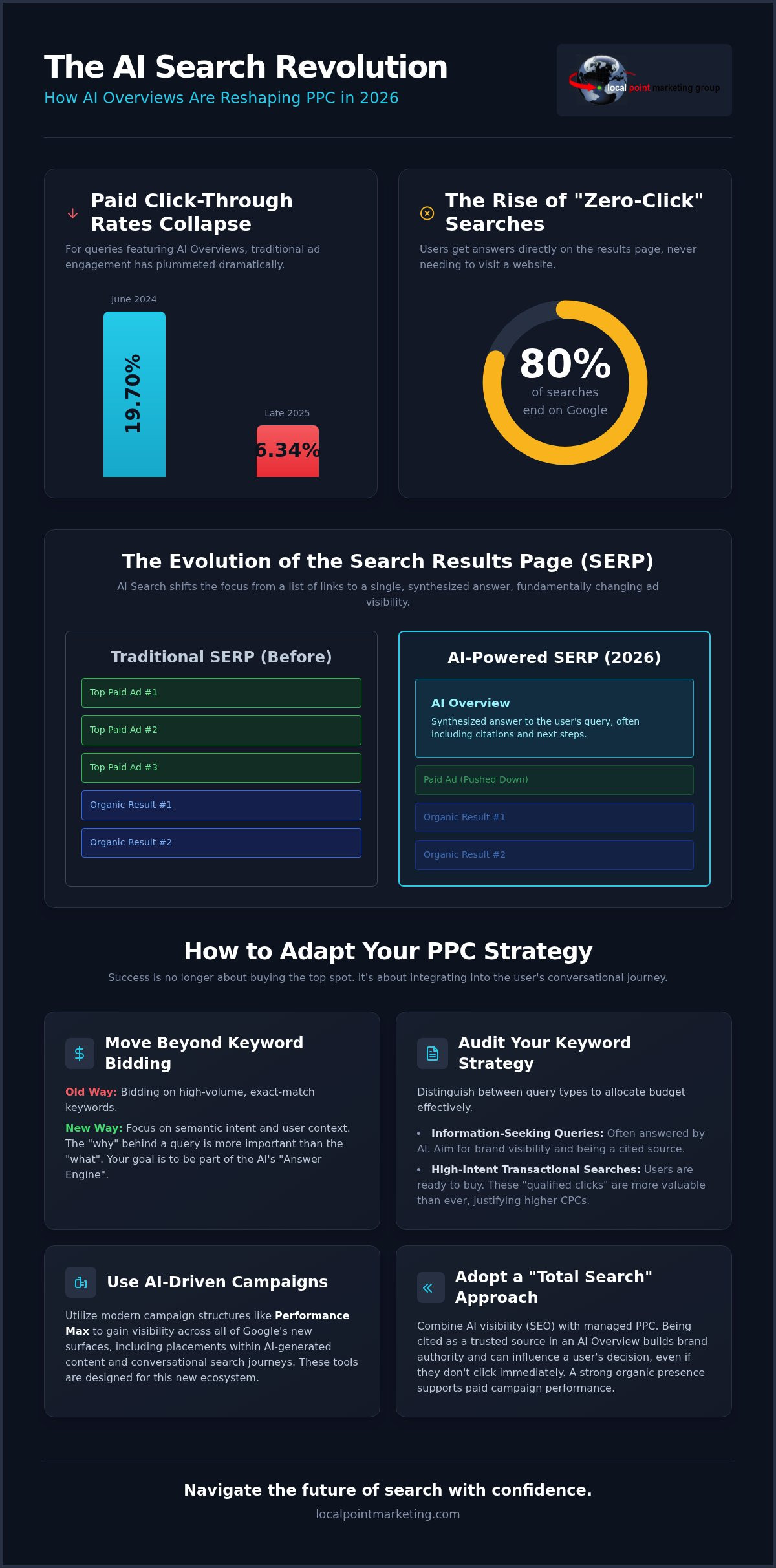
Between June 2024 and late 2025, paid click-through rates for queries featuring AI Overviews plummeted from 19.70% to just 6.34%. You’ve likely noticed your traditional search ads aren’t capturing the same attention they once did. It’s frustrating to see traffic patterns shift as Google increasingly answers user questions directly on the results page. Understanding how AI search impacts PPC campaigns is no longer a future concern; it’s a 2026 necessity for any growing business. You deserve a clear path forward that turns these disruptions into opportunities for growth.

We understand the pressure of maintaining lead volume when over 80% of searches now end without a click. This guide shows you exactly how to adapt your strategy to maintain a high ROI while navigating these technical shifts. We’ll explore new visibility metrics, the essential role of first-party data, and how to position your brand within conversational search journeys. You’ll gain the confidence to manage this transition and ensure your lead volume remains steady in an AI-dominated landscape. Success in this new era is about being the right answer at the right moment.

Key Takeaways

  • Understand why AI Overviews are replacing traditional ad slots and how this shift requires a move toward conversational context.
  • Discover exactly how AI search impacts PPC campaigns so you don’t lose ground to automated answers.
  • Audit your existing keyword strategy to distinguish between information-seeking queries and high-intent transactional searches.
  • Leverage Performance Max and AI-driven campaign structures to keep your brand visible across all of Google’s new surfaces.
  • Adopt a “Total Search” approach that combines AI visibility with managed PPC strategies to grow your South Florida footprint.

The digital landscape has fundamentally changed. In 2026, search engines like Google and Microsoft Copilot no longer just provide a list of blue links; they provide direct, synthesized answers. This shift to AI Overviews and conversational “Search Mode” means that users often find exactly what they need without ever leaving the results page. This “zero-click” phenomenon is a reality for over 80% of searches today. For advertisers, this means the traditional goal of simply buying the top spot has evolved into a more complex challenge of context and relevance. Search engine marketing (SEM) has expanded to include these synthesized environments where ads must feel like part of the conversation. Ultimately, AI Search Impact is the transition from keyword-matching to intent-synthesis.

The Evolution of the SERP Layout in 2026

The visual layout of the search results page has been completely reimagined. When an AI Overview dominates the screen, traditional search ads are often pushed below the initial view or integrated directly into the AI response. Google’s Gemini AI now manages campaign placements in real-time, selecting which ads appear based on the flow of a multi-step conversation. In this environment, visibility depends on being part of the synthesized answer rather than just sitting above it. Understanding how AI search impacts PPC campaigns involves recognizing that your ad might now appear as a cited source or a recommended next step in a chat-like interface. This new “fold” requires a strategy that prioritizes being featured within the AI’s generated response.

Why Traditional Keyword Bidding Is No Longer Enough

Bidding on exact-match keywords used to be the cornerstone of any successful campaign. Today, search engines interpret the “why” behind a query by analyzing semantic intent and user context. They look at the user’s previous questions and the specific nuances of their language to determine which business provides the best solution. If your strategy relies solely on high-volume keywords, you might miss the conversational journeys where high-intent buyers are making decisions. Your business needs to be recognized as an authoritative part of the “Answer Engine” to remain relevant. We help our South Florida partners move beyond basic bidding to focus on capturing these complex, intent-driven moments that lead to real conversions.

Analyzing the Impact: How AI Search Affects PPC Performance

The visibility gap is widening. When an AI Overview appears, it pushes traditional search ads further down the page, often displacing the top three slots that businesses have relied on for years. This displacement directly correlates with a significant drop in engagement. For queries where AI Overviews are present, the paid click-through rate (CTR) plummeted from 19.70% in June 2024 to just 6.34% by September 2025. Analyzing how AI search impacts PPC campaigns reveals that this isn’t just a minor dip; it’s a fundamental change in how users interact with the results page.

While these numbers might seem daunting, there’s a silver lining for advertisers who focus on quality over quantity. Users who click on an ad after interacting with an AI summary are often much further down the sales funnel. They’ve already received a basic answer and are now looking for a specific provider or a deeper level of service. This creates a “qualified click” upside where conversion rates can actually improve despite lower overall traffic. Understanding how AI is reshaping paid search helps us reposition your budget toward these high-value moments. As fewer ad slots remain at the top, competition intensifies, driving up CPCs for the most visible positions.

The Rise of Zero-Click Searches

Data from 2026 shows that over 80% of searches now end without a website visit. This zero-click behavior occurs because the AI provides a sufficiently helpful answer right on the screen. For your business, this makes “On-SERP” branding essential. Being cited by the AI as a trusted source builds authority even if the user doesn’t click through immediately. However, this shift complicates attribution and lead tracking. Traditional models that rely on a direct click-to-conversion path don’t capture the full influence of these AI-driven impressions, requiring a more sophisticated approach to measuring success. Small businesses navigating this challenge can benefit from reviewing AI SEO services for small business to understand how to position their brand as a preferred source within AI-generated answers.

Industry-Specific Volatility in South Florida

Local service industries in Miami and Fort Lauderdale are seeing varied levels of impact. Home services and quick-answer queries are hit hardest by AI summaries that provide immediate pricing or scheduling info. High-consideration sectors like legal and real estate still see strong engagement because users need to verify credentials and build trust. The competition for the remaining premium ad slots in South Florida is fierce, as local brands vie for a smaller piece of the visual real estate. We help you navigate this volatility with managed PPC strategies that prioritize ROI over vanity metrics. Success in 2026 depends on staying visible where it matters most and adapting your bidding to reflect these new auction dynamics.

How to Adapt Your PPC Strategy for the AI Era

Adaptation is the only path forward. To maintain a strong ROI, you must restructure your approach to align with the new ways users interact with search engines. A critical part of this transition involves understanding how AI search trends are changing PPC. It’s no longer about just being present; it’s about being relevant within a conversational flow. Knowing how AI search impacts PPC campaigns allows you to pivot from broad keyword targeting to specific intent-based strategies that capture high-value leads.

Follow these five steps to future-proof your campaigns:

  • Audit your keyword list: Separate “Question-Based” queries from “Transactional” ones. Since 37% of Google queries now feature AI Overviews, you need to know which terms trigger these summaries.
  • Leverage AI-driven campaigns: Use Performance Max and the AI Max campaigns launched in late 2025. These tools utilize Gemini AI for generative ad copy and autonomous audience discovery.
  • Update ad copy: Move toward a direct, conversational tone that matches the style of AI-generated responses.
  • Prioritize first-party data: With 78% of Google Ads spend now managed by Smart Bidding, your unique customer data provides the algorithm with its competitive edge.
  • Implement robust tracking: Measure value beyond the initial click. Focus on conversion signals that indicate lead quality and long-term customer value.

Conversational Ad Copywriting

Your ads should do more than just sell. They need to answer the “next question” a user might have after reading an AI summary. This requires a shift toward “Answer-First” headlines that provide immediate value. We recommend using the clear, professional style found in the Local Point Marketing brand voice. This approach builds trust through reassurance and authority. Since 92% of PPC managers now use AI tools for copy generation, the human element of strategic, conversational messaging is your biggest differentiator.

Leveraging First-Party Data and Audience Signals

Generic bidding is a race to the bottom. Your CRM data is the most powerful tool you have to guide machine learning. By using Customer Match lists, we can target high-value prospects in Miami and Palm Beach who mirror your best existing clients. This isn’t just about finding more traffic; it’s about feeding “success signals” back to the AI. When the system understands which leads actually turn into revenue, it optimizes for quality rather than just volume. This methodical focus on data-driven results ensures your budget is always working toward measurable growth.

How AI Search Impacts PPC Campaigns: The 2026 Guide to Paid Visibility

The “Total Search” strategy represents the future of digital visibility. In this model, AI search optimization acts as the foundation for all your paid efforts. Rather than treating SEO and PPC as separate silos, we use them as a unified engine for growth. By analyzing your PPC search term reports, we can identify exactly which high-intent queries trigger AI Overviews for your brand. This data allows you to prioritize organic content for those specific terms while using paid ads to capture the remaining visual real estate. Understanding how AI search impacts PPC campaigns means recognizing that paid visibility can bridge the gap while your organic AI presence climbs.

Optimizing your landing pages is now a two-fold task. These pages must provide a seamless conversion path for human visitors and clear, structured data for AI crawlers. When an AI search engine reads your site to generate a summary, it looks for the same authority signals that drive human trust. We ensure your blog content creation services align perfectly with your paid ad landing pages. This consistency ensures that whether a user sees an AI-generated answer or a paid placement, your brand messaging remains authoritative and steady.

Strategic Content for the AI SERP

High-value content is the currency of the AI-driven SERP. If you want AI search engines to cite your business in their summaries, your content must be structured to answer complex, multi-step questions. We help you create assets that serve as the definitive source for industry-specific queries. This strategic alignment ensures your paid ads and organic citations work together to dominate the screen. When your ad appears alongside an AI Overview that cites your own blog post, you establish an unmatched level of credibility. South Florida businesses looking to make this transition can explore AI visibility marketing strategies that compare SEO and AEO to understand how to become the synthesized answer that AI models trust and recommend.

Measuring ROAS in a Conversational World

Traditional metrics like click-through rate (CTR) only tell part of the story in 2026. As conversational search grows, we focus on “Assisted Conversion” metrics and AI referral traffic. These numbers reveal how AI-driven impressions influence the final decision, even if the user didn’t click your ad immediately. South Florida businesses need a data-driven marketing agency to interpret these complex signals. We provide the clarity you need to understand how AI search impacts PPC campaigns and overall revenue growth. Our managed budget fees ensure that every dollar is spent with a focus on long-term ROI.

Ready to unify your search strategy for the AI era? Contact our expert team today to start your transition.

Future-Proofing Your South Florida PPC with Local Point Marketing

The South Florida business environment is currently undergoing its most significant digital transformation. Competition in major hubs like Miami and Fort Lauderdale is intense, and the rise of AI search has made visibility more complex than ever. We take a methodical approach to managing your PPC budgets in this volatile market. Our “Managed Budget Fees” model ensures that our team is always incentivized by your ROI. We prioritize transparency and focus on the data-driven outcomes that actually grow your business. Understanding how AI search impacts PPC campaigns is the first step toward building a sustainable strategy that withstands these technological shifts.

We integrate AI visibility with traditional search to maximize your South Florida footprint. This “Total Search” approach ensures your brand remains the top choice even as SERP layouts evolve and traditional ad slots move. A local partner who understands the specific dynamics of Palm Beach and the surrounding counties provides a distinct advantage. We know the local nuances that global agencies often miss, allowing us to tailor your reach effectively across the region.

The Local Point Marketing Advantage

Our agency brings 10 years of experience navigating major search engine updates to every client relationship. We position ourselves as a steady, expert partner during times of rapid change. Our team provides customized strategies for businesses in Jupiter, Stuart, and throughout the Treasure Coast. This commitment to a professional and reassuring partnership means you always have a clear roadmap for success. We prioritize methodical trustworthiness by using evidence and metrics over hype. Your future looks brighter and more successful when you have a collaborator who values your outcomes as much as you do.

Take the Next Step Toward AI Mastery

You shouldn’t let your paid visibility decline as conversational search becomes the standard. We offer a comprehensive audit of your current PPC campaigns to evaluate their AI readiness. During this process, we analyze your keyword intent and attribution models to ensure you’re capturing high-value leads. You can also learn how our managed SEO services complement your paid strategy to create a unified online presence. This synergy is essential for maintaining your competitive edge in the 2026 digital landscape. We invite you to schedule your free AI search strategy consultation today.

The transformation of the digital landscape is well underway. You’ve seen that understanding how AI search impacts PPC campaigns is the key to maintaining a competitive edge in 2026. By prioritizing intent-driven content and leveraging Performance Max campaigns, you can ensure your brand remains visible where users are looking for answers. This shift isn’t just about surviving lower click-through rates; it’s about capturing higher-quality leads through a unified “Total Search” strategy. Your business has the potential to thrive in this conversational era by focusing on the metrics that drive real growth.

Local Point Marketing has delivered data-driven results since 2015. We bring deep expertise in the South Florida local markets to help you navigate these technical transitions with confidence. Our Managed Budget Fees provide the transparency you need to focus entirely on your ROI. We work as your steady partner to turn these industry shifts into measurable success for your brand. Secure your business’s future with an AI-ready PPC strategy from Local Point Marketing. Your most successful chapter is just beginning.

Frequently Asked Questions

How does AI search impact my PPC budget?

AI search shifts budget allocation toward high-intent queries and automated campaign types. Since AI Overviews can lower click-through rates by 18%, budgets must be managed methodically to avoid wasted spend on terms the AI now answers for free. We use managed budget fees to ensure your investment remains focused on bottom-line results. This approach provides the transparency needed to navigate a volatile and changing search market.

Will AI Overviews make my search ads disappear?

Your ads will not disappear, but their placement is changing significantly. Google has expanded ad eligibility to appear within AI Overviews and conversational modes through Performance Max and broad match. While traditional top-of-page slots may be displaced, your brand can now appear as a cited recommendation or a suggested next step within the AI’s synthesized response. This visibility ensures you stay relevant throughout the entire search journey.

Do I need to change my ad copy for AI search results?

Updating your ad copy to be more conversational and direct is essential. Since 92% of managers now use AI for copy generation, your messaging must stand out by answering the “next question” in a user’s journey. Use “Answer-First” headlines that mirror the style of AI Overviews to maintain authority. This helps your brand feel like a natural part of the conversation rather than a traditional interruption.

Is PPC still worth it for local Miami businesses in 2026?

PPC remains a highly effective tool for Miami businesses when integrated with an AI-ready strategy. While 37% of queries now feature AI results, paid ads provide the immediate visibility needed to bridge the gap while organic AI citations climb. Local competition in South Florida is fierce. Understanding how AI search impacts PPC campaigns is necessary for maintaining a steady and reliable lead volume in this new environment.

What is a zero-click search and how does it affect my ROI?

A zero-click search occurs when the user finds their answer directly on the results page without clicking to a website. Currently, over 80% of searches end this way. This affects your ROI by requiring a shift in how you measure success. Instead of just tracking clicks, we focus on “On-SERP” branding and assisted conversions. This ensures your brand builds trust and influence even when a visit doesn’t happen immediately.

Can AI help me improve my Google Ads performance?

AI-driven tools like Smart Bidding and Gemini-powered campaigns are now standard. About 78% of Google Ads spend is managed by automated bidding. These tools help discover new audiences and optimize ad copy in real-time. By feeding these algorithms your unique first-party data, you can significantly improve lead quality. This methodical use of technology ensures your campaigns always optimize for the best possible results.

How do I track conversions if users aren’t clicking through to my site?

Tracking in a conversational world requires more sophisticated attribution models. We focus on “Assisted Conversion” metrics and success signals from your CRM to measure value beyond the initial click. By monitoring brand lift and AI referral traffic, we can determine how AI-driven impressions influence your final sales. This data-driven approach provides a clear picture of your marketing performance even when direct clicks are declining.

What is the difference between AI visibility and traditional SEO?

Traditional SEO focuses on ranking for keywords in a list of links, while AI visibility is about being a cited source in a synthesized answer. AI search engines prioritize content that answers complex, multi-step questions. Understanding how AI search impacts PPC campaigns helps you align your paid strategy with these organic citations. This “Total Search” approach ensures your business dominates the visual real estate on the results page.