
Nearly half of your tracked email opens in 2026 are likely artificial data generated by privacy protections rather than genuine human interest. It’s a frustrating reality for many business owners who see their engagement metrics climb while their actual results remain stagnant. If you’re wondering how to improve email open rates in this new environment, you aren’t alone. You’ve likely spent hours crafting the perfect subject line only to find your messages buried in spam or ignored by sophisticated AI filters. We understand the confusion surrounding technical requirements like SPF and DKIM, especially when traditional tactics no longer move the needle.
The good news is that achieving consistent open rates above 25% is still possible when you pivot from guesswork to a methodical, data-driven approach. In this article, you’ll discover why your current strategy might be failing and how to implement a system that gets your messages seen. We’ll provide a clear path toward better brand visibility and measurable ROI. By dismantling five persistent myths that are currently killing your engagement, we’ll show you how to build a reliable email strategy that turns your inbox presence into a powerful engine for growth.
Key Takeaways
- Implement essential authentication protocols like SPF, DKIM, and DMARC to ensure your messages move past AI filters and into the primary inbox.
- Discover how to improve email open rates by shifting your focus from high-volume sending to segmented, data-driven campaigns that provide genuine value.
- Recognize that modern open rate metrics are often inflated by privacy protections, requiring a deeper look at engagement-adjusted data like click-to-open rates.
- Audit your sender reputation and re-segment your list based on recent activity to maintain a healthy engagement level below the 0.1% spam complaint threshold.
- Transition from a “set it and forget it” approach to a managed strategy that leverages professional copywriting for consistent brand visibility.
The 2026 Inbox Reality: Why Open Rates Are Changing
Understanding what an email open rate is has become more complex for business owners in recent years. In 2026, this metric is no longer a simple calculation of pixels loading in a recipient’s inbox. If you’re researching how to improve email open rates, you must first recognize that the data in your marketing dashboard might not reflect actual human behavior. Traditional tracking methods have been disrupted by privacy shifts and automated systems that “open” mail before a user ever sees it.
A common myth persists that a low open rate always points to a poor subject line. While your copy matters, technical deliverability and sender reputation have become the primary gatekeepers of the modern inbox. If your technical foundation is flawed, even the most compelling subject line won’t reach your audience. Real success in 2026 requires a shift in focus from creative “hacks” to a methodical, data-driven infrastructure that proves your value to mailbox providers.
The Impact of Apple Mail Privacy Protection
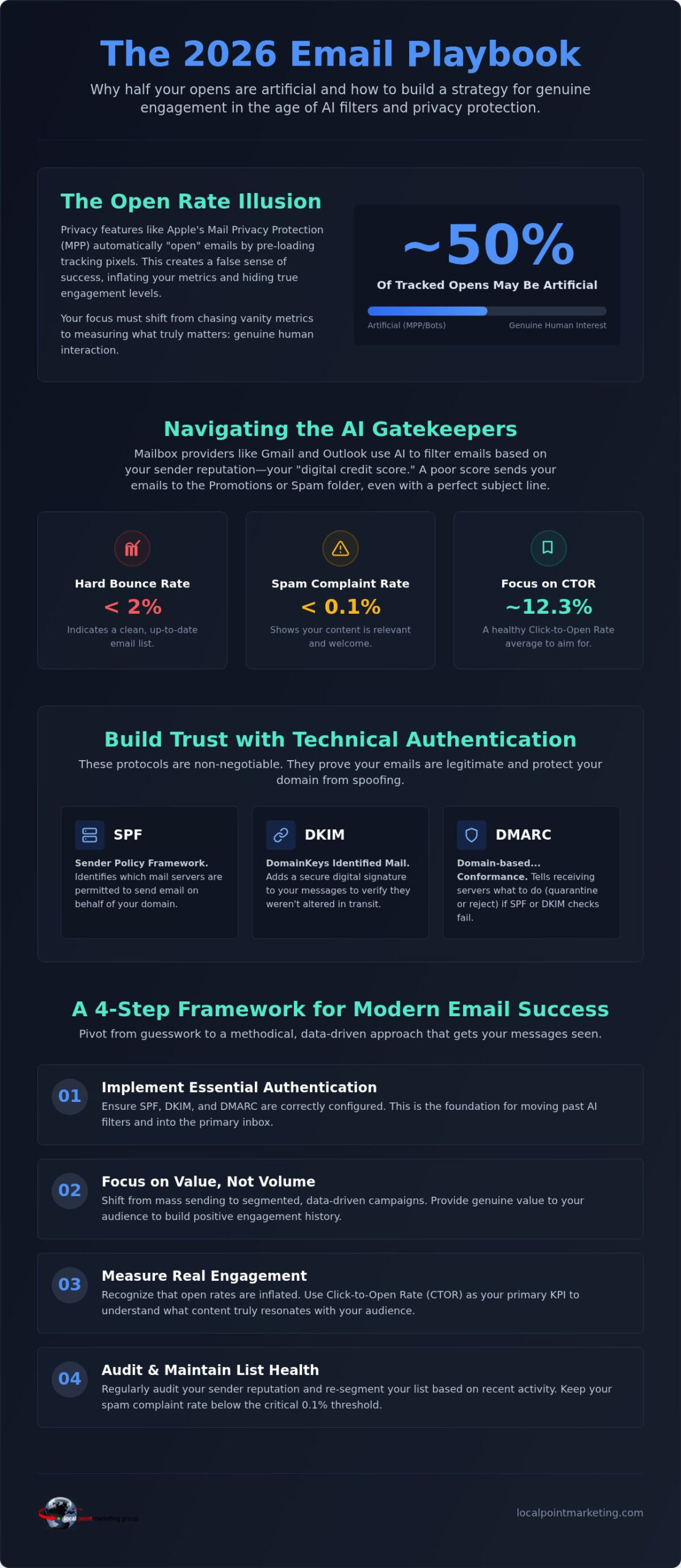
Apple’s Mail Privacy Protection (MPP) fundamentally changed the nature of email tracking in 2021 by masking user activity and pre-loading tracking pixels. Today, these “hidden” opens account for roughly half of all tracked activity. This often inflates reported rates by 15 to 20 points, creating a false sense of success. Because these metrics are skewed, we recommend looking at your Click-to-Open Rate (CTOR) for a truer picture of genuine engagement. A healthy CTOR, which currently averages around 12.3% across most industries, indicates that your content is actually resonating with real human readers rather than just triggering an automated script.
AI Filters: The New Secret Gatekeeper
Modern inboxes in Gmail and Outlook now use sophisticated AI to pre-sort incoming mail based on a recipient’s past behavior. This shift means your emails might bypass the spam folder but still end up in the “Promotions” tab or the “Other” category where they’re rarely seen. Your historical engagement as a sender dictates your future visibility. If users haven’t interacted with your previous messages, AI filters assume your content is low value and hide it accordingly. Learning how to improve email open rates now requires a focus on building a consistent record of high-quality, relevant interactions. These automated systems prioritize senders who maintain:
- A hard bounce rate consistently below 2%.
- A spam complaint rate lower than 0.1%.
- High levels of sustained, positive engagement from active segments.
By treating your sender reputation like a digital credit score, you can ensure your messages earn a spot in the primary inbox. We help our partners in South Florida navigate these technical hurdles to ensure their brand remains visible in an increasingly crowded digital landscape.
The Deliverability Myth: Why “Send” Does Not Mean “Seen”
Hitting “send” on a campaign doesn’t mean your audience actually sees your message. Many marketers assume that a clean list guarantees delivery, but that’s a costly misconception in 2026. Your domain carries a sender reputation that functions much like a personal credit score. Mailbox providers like Gmail and Yahoo look at this score before deciding where your message lands. If your reputation is poor, they’ll divert your mail to spam even if your content is perfect. Protecting this reputation is the first step in learning how to improve email open rates effectively.
Reputation is built on consistent, positive behavior. High hard bounce rates, which should stay below 2%, signal to providers that you are using outdated or low-quality data. Similarly, spam traps—old email addresses used by providers to catch irresponsible senders—can instantly tank your visibility. Maintaining a healthy sender profile requires a combination of technical precision and disciplined list management.
Technical Authentication 101
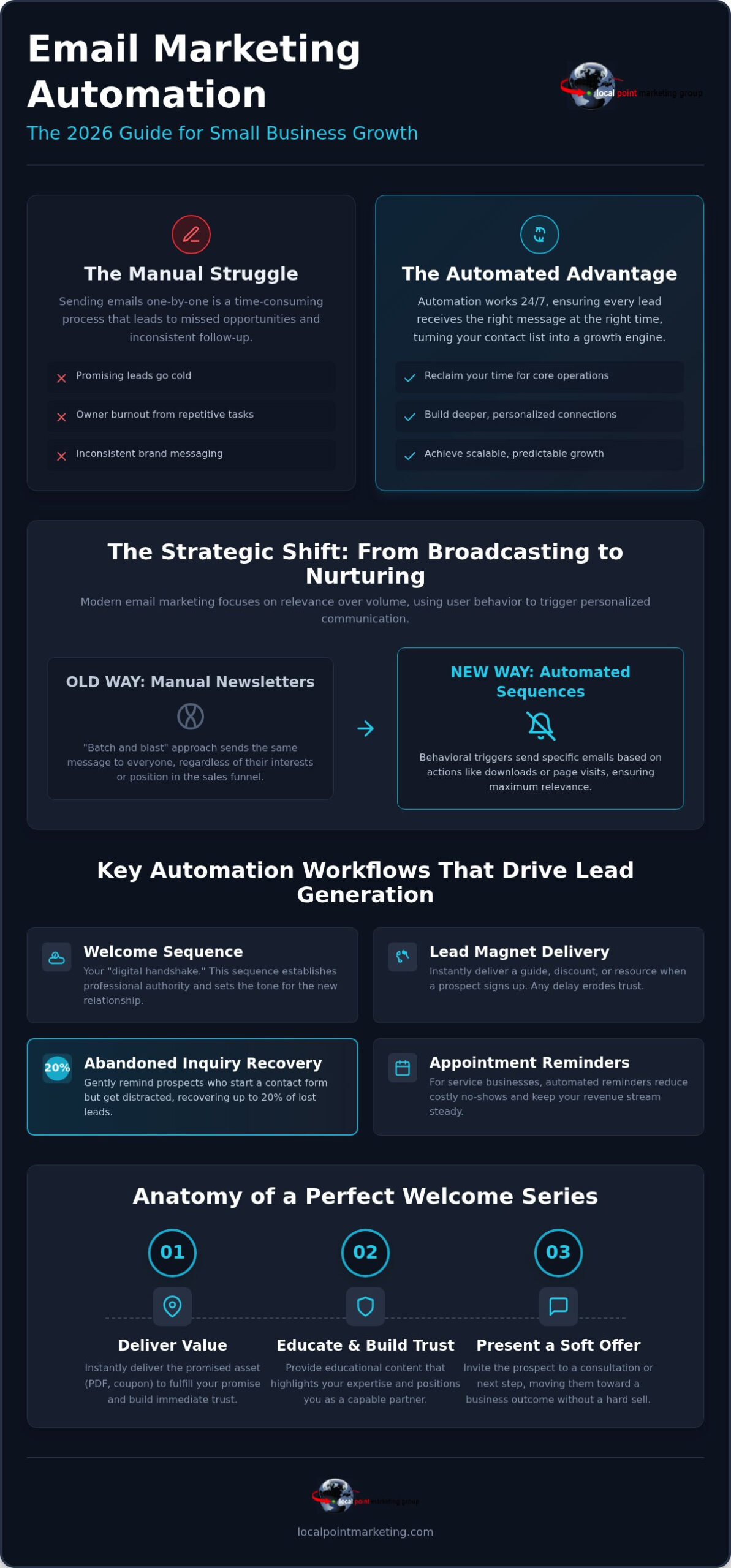
SPF, DKIM, and DMARC are no longer optional for small businesses. These technical signatures prove to the world that your domain hasn’t been spoofed by bad actors. SPF identifies which servers are allowed to send mail on your behalf. DKIM adds a digital signature to your messages, while DMARC tells receiving servers what to do if those checks fail. For a deeper dive into setting these up, our Email Marketing Automation Guide offers specific configuration tips.
You should also consider implementing BIMI (Brand Indicators for Message Identification). This protocol allows your verified brand logo to appear directly in the recipient’s inbox. It builds immediate trust and makes your brand more recognizable. Once you’ve secured the technical side, you can focus on creative elements like these 4 Subject Line Strategies to drive engagement. Domains with full authentication see average open rates of 34.2%, proving that technical foundations lead to measurable results.
Continuous List Hygiene
List hygiene is a continuous process. You shouldn’t wait until the end of the year to scrub your database. In 2026, inactive subscribers who haven’t opened an email in 90 days should be moved into a “sunsetting” campaign. This strategy involves sending a final, high-value re-engagement prompt. If they don’t respond, let them go. A smaller list of 5,000 engaged fans is far more valuable than a bloated list of 20,000 silent recipients. If you find these technical details overwhelming, our team at Local Point Marketing provides managed email marketing services to handle the complexity for you.
Volume vs. Value: Debunking the “More is Better” Strategy
Many businesses believe that increasing send volume is the fastest way to see more total opens. While this might provide a temporary spike in visibility, it often leads to long-term inbox fatigue and higher complaint rates. If your audience feels overwhelmed by your frequency, they’ll eventually stop looking for your name in their inbox. Learning how to improve email open rates in 2026 requires a shift toward radical relevance. Sending a targeted message to a segmented 10% of your list often generates better results than a generic blast to your entire database.
Over-sending doesn’t just annoy your subscribers; it also signals to mailbox providers that your content is low value. When users ignore your messages or mark them as spam, your sender reputation suffers. This makes it harder for your future emails to reach the primary inbox. We focus on helping South Florida businesses build a steady, predictable rhythm that prioritizes the recipient’s experience over sheer volume.
The Segmentation Framework
Effective segmentation goes beyond simple demographics like age or job title. You should group your audience based on their actual behavior, such as past purchases, specific link clicks, or website interactions. This allows you to speak directly to their current interests. Personalization 2.0 moves past the basic “Dear First_Name” tactic. It involves using behavioral data to provide content that feels tailor-made for the individual.
For our clients in Miami, Fort Lauderdale, and Palm Beach, we use local triggers to increase relevance. Referencing specific South Florida seasonal trends or local events makes your brand feel like a present, local partner. A message that acknowledges the local environment resonates far more deeply than a generic corporate update. This level of detail is a key component of how to improve email open rates for businesses looking to stand out in a crowded local market.
Timing and Frequency Optimization
The old rule of sending every Tuesday at 10 AM is no longer a universal standard for success. Modern audiences check their mail at all hours, and their habits are highly individual. We now use AI-driven Send Time Optimization to ensure your message hits the inbox exactly when a specific user is most likely to be active. This precision respects the recipient’s time and keeps your brand visible without being intrusive.
Quality over quantity is the new golden rule for maintaining long-term list health. Segmented campaigns achieve significantly higher engagement; for instance, research shows that segmented campaigns can achieve a 4.18% click-through rate compared to just 1.41% for non-segmented broadcasts. By focusing on value and timing, you build the trust necessary to maintain consistent engagement and measurable ROI.
A 4-Step Framework to Improve Your Open Rates
Implementing a structured framework is the most effective way to see measurable growth in your engagement. Rather than chasing temporary trends, you should follow a methodical process that prioritizes your technical health and your audience’s experience. This approach provides a clear roadmap for anyone looking for how to improve email open rates without resorting to aggressive tactics. By focusing on these four core steps, you can transform your email marketing from a guessing game into a reliable source of revenue.
Your first step is to audit your technical setup and sender reputation. This ensures your foundation is secure and your messages aren’t being blocked before they reach the inbox. Second, you must re-segment your list based on the last six months of activity. This window is a reliable indicator of who is still interested in your brand. Third, you should revitalize your preview text and sender name to build immediate trust. Finally, implement a dedicated re-engagement campaign to win back subscribers who have gone quiet. If you want a partner to handle this complex process for you, contact Local Point Marketing for managed email marketing services.
Optimizing the “Golden Trio”
The way your email appears in a crowded inbox determines whether it’s opened or ignored. You should focus on three specific elements that act as your digital storefront:
- The Sender Name: Using a real person’s name alongside your brand often outperforms a generic company name. It creates a human connection that builds trust.
- The Subject Line: Move away from “clickbait” that overpromises. Instead, use “value-bait” that clearly states the benefit of opening the message. Personalizing this line can increase open rates by as much as 31%.
- The Preview Text: This is your second subject line. Most businesses ignore this space, but it’s essential for providing context that encourages a click.
The Win-Back Campaign
Ghost subscribers can hurt your reputation even if they don’t mark your messages as spam. Their lack of engagement signals to providers that your content isn’t relevant to your audience. You should identify “sleeping” subscribers who haven’t opened an email in 90 to 180 days. Craft a specific “We Miss You” offer that provides high value to see if they’re still interested in your services. If they remain silent after three attempts, it’s time to stop sending to them. Protecting your domain from this dead weight is essential for maintaining long-term ROI and ensuring your active fans continue to see your mail. This disciplined approach is a key part of how to improve email open rates while maintaining a healthy, high-performing list.
Professional Email Campaign Management: Your Path to Growth
Managing an email program in-house often leads to a “set it and forget it” mentality. While this approach might save time initially, it usually results in a slow decline in engagement as technical requirements and consumer habits evolve. Business owners in South Florida are often too focused on daily operations to monitor the subtle shifts in AI-driven inbox filters or the technical nuances of sender reputation. A professional partner ensures your strategy remains proactive rather than reactive. This steady oversight is essential for anyone looking for how to improve email open rates while simultaneously driving measurable sales growth.
We move beyond simple vanity metrics to focus on the outcomes that actually impact your bottom line. While an open is a positive signal, the ultimate goal is the revenue generated from each campaign. Our methodical approach treats email as a core component of your digital ecosystem. We integrate your messaging with your Search Engine Optimization and Social Media Marketing to create a consistent brand experience across all channels. This level of coordination ensures your brand remains visible and trusted in an increasingly competitive digital landscape.
Why Local Expertise Matters in Miami and Beyond
The South Florida market has unique dynamics and consumer expectations that generic, national campaigns often miss. A strategy that works in other regions may not resonate with the diverse audience in Miami, Fort Lauderdale, or Palm Beach. We understand the local seasonal trends and regional events that influence when and why your customers open their mail. For instance, we helped a local service provider significantly increase their lead volume by aligning their campaign triggers with South Florida’s specific business cycles. This regional insight allows us to help your business stand out in a crowded inbox by providing radical relevance to your local audience.
Our Approach to Email Marketing for Lead Generation
Our managed email services are built on a foundation of data-driven optimization and professional content creation. We don’t rely on guesswork; we use evidence to refine every element of your campaign. Our team handles the heavy lifting of deployment and optimization so you can focus on running your business. Our comprehensive approach includes:
- Customized copywriting: We craft messages that speak directly to your audience’s needs and aspirations.
- Continuous A/B testing: We test subject lines, preview text, and layouts to identify what drives the best results.
- Performance reporting: We provide clear, structured reports that connect email activity to your lead-generation goals.
By combining technical precision with professional storytelling, we provide a reliable path toward better visibility and higher ROI. This structured process is the most effective way to learn how to improve email open rates and turn your subscriber list into a loyal customer base. If you’re ready to see better results from your marketing efforts, Schedule a strategy session with Local Point Marketing to discover how we can elevate your brand.
Building a High-Performing Email Strategy for 2026
Achieving success in today’s inbox requires a shift from outdated hacks to a methodical, technical foundation. You now understand that your sender reputation acts like a digital credit score; technical authentication is the non-negotiable entry fee for the primary inbox. By prioritizing value over volume and utilizing behavioral segmentation, you’ll build a list that genuinely looks forward to your messages. We’ve explored how to improve email open rates by moving beyond vanity metrics and focusing on the radical relevance your audience expects.
Local Point Marketing brings over 10 years of digital marketing experience to help South Florida businesses navigate these complexities. Our data-driven strategies are designed for measurable ROI, supported by transparent reporting that shows exactly how your campaigns contribute to growth. Ready to fix your open rates? Explore our Email Campaign Management Services. Your path to more consistent engagement and higher revenue starts with a single, data-backed step forward. We’re here to help you turn your email list into your most powerful asset for success.
Frequently Asked Questions
What is a good email open rate for a small business in 2026?
A healthy email open rate for a small business in 2026 typically falls between 21% and 27%. It’s important to remember that these figures often include Apple’s Mail Privacy Protection (MPP) data, which can inflate numbers by 15 to 20 points. For a more accurate measure of success, you should aim for a click-to-open rate (CTOR) of 10% to 20%. This ensures your content is driving genuine engagement rather than just triggering automated tracking pixels.
How often should I clean my email list to maintain high open rates?
You should perform list hygiene every 90 days to ensure your sender reputation remains strong. Waiting a year to remove inactive subscribers allows dead weight to accumulate, which signals to mailbox providers that your content is irrelevant. By identifying “ghost” subscribers who haven’t opened an email in three months, you can implement a win-back campaign or remove them entirely. This disciplined approach is essential for anyone learning how to improve email open rates.
Do subject lines with emojis still improve open rates?
Emojis can still improve open rates when used sparingly and strategically to stand out in a crowded inbox. They work best when they complement the subject line’s “value-bait” rather than replacing professional language. However, overusing them can trigger spam filters or appear unprofessional to B2B audiences. We recommend A/B testing emojis with a small segment of your list to see if they resonate with your specific South Florida customer base.
How does Apple’s Mail Privacy Protection affect my open rate data?
Apple’s Mail Privacy Protection (MPP) artificially inflates your data by pre-loading tracking pixels before a user even opens the message. As of early 2026, this technology accounts for roughly half of all tracked opens. This means your dashboard might show a higher rate than what is actually occurring. Marketers must now look at downstream metrics like link clicks and conversions to understand the true impact of their email campaigns and lead-generation efforts.
Can I improve my open rates without buying new software?
Yes, you can significantly improve your metrics by focusing on technical authentication and list hygiene without purchasing new tools. Ensuring your SPF, DKIM, and DMARC records are correctly configured in your DNS settings is a free way to boost deliverability. Additionally, refining your sender name and preview text costs nothing but time. These fundamental adjustments are often more effective than software “hacks” for those looking for how to improve email open rates.
Why are my emails going to the Promotions tab instead of the Primary inbox?
Your emails land in the Promotions tab because AI-driven filters in Gmail and Outlook analyze your engagement history. If subscribers rarely interact with your messages, or if your content contains heavy promotional language and too many images, these filters pre-sort your mail accordingly. Maintaining a spam complaint rate below 0.1% and a hard bounce rate under 2% helps signal to providers that your messages belong in the primary inbox where they’re seen.
What is the best day and time to send emails for local South Florida customers?
There is no longer a universal “best time” because modern consumers check their phones throughout the day. For South Florida audiences, we find that mid-morning or early evening often performs well, but this varies by industry. Instead of following rigid rules, you should use AI-driven send time optimization. This ensures your message arrives when each individual recipient is most active, whether they’re in Miami, Fort Lauderdale, or Palm Beach.
Is it worth hiring an email campaign management service for a small list?
Hiring a professional service is often worth the investment because it prevents costly technical errors that damage your domain’s reputation. Even with a small list, the expertise in copywriting and data-driven optimization ensures you maximize the value of every lead. Our managed services provide transparent reporting and measurable ROI, allowing you to focus on running your business while we handle the complexities of deliverability and engagement for your growing audience.