
When to Switch SEO Agencies: A 2026 Performance Checklist

An SEO agency that only delivers traditional keyword rankings in 2026 is actually costing your business money. You’ve likely felt the growing frustration of watching your organic traffic plateau while your monthly retainer remains unchanged. Knowing exactly when to switch SEO agencies is the difference between a stagnant brand and a market leader. It’s common to feel like a small fish in a big pond, especially when reports lack the transparency you need to justify the investment. You deserve a partner who views your success as their own and prioritizes measurable growth over vanity metrics.

This guide will empower you to identify the critical warning signs that your current partner is holding you back and show you how to transition to a strategy focused on ROI and AI visibility. We will walk through a comprehensive 2026 performance checklist, covering everything from reporting red flags to the technical essentials of Generative Engine Optimization. You will learn how to protect your existing rankings during a transition while positioning your brand for long term success in an evolving digital environment. By the end of this article, you’ll have a clear roadmap for choosing a partner that delivers the clarity and results your business requires.

Key Takeaways

  • Recognize structural red flags like reactive management and transparency gaps that indicate it’s time for a more proactive approach.
  • Analyze the difference between vanity metrics and revenue-driving traffic to ensure your investment produces a tangible return.
  • Assess whether your agency is prepared for the shift toward AI Search and Generative Engine Optimization to keep your brand visible.
  • Use our 2026 performance checklist to decide when to switch SEO agencies without risking your site’s technical health.
  • Learn how a methodical transition plan can uncover growth opportunities that your previous partner might’ve missed.

Identifying the Structural Red Flags in Your SEO Relationship

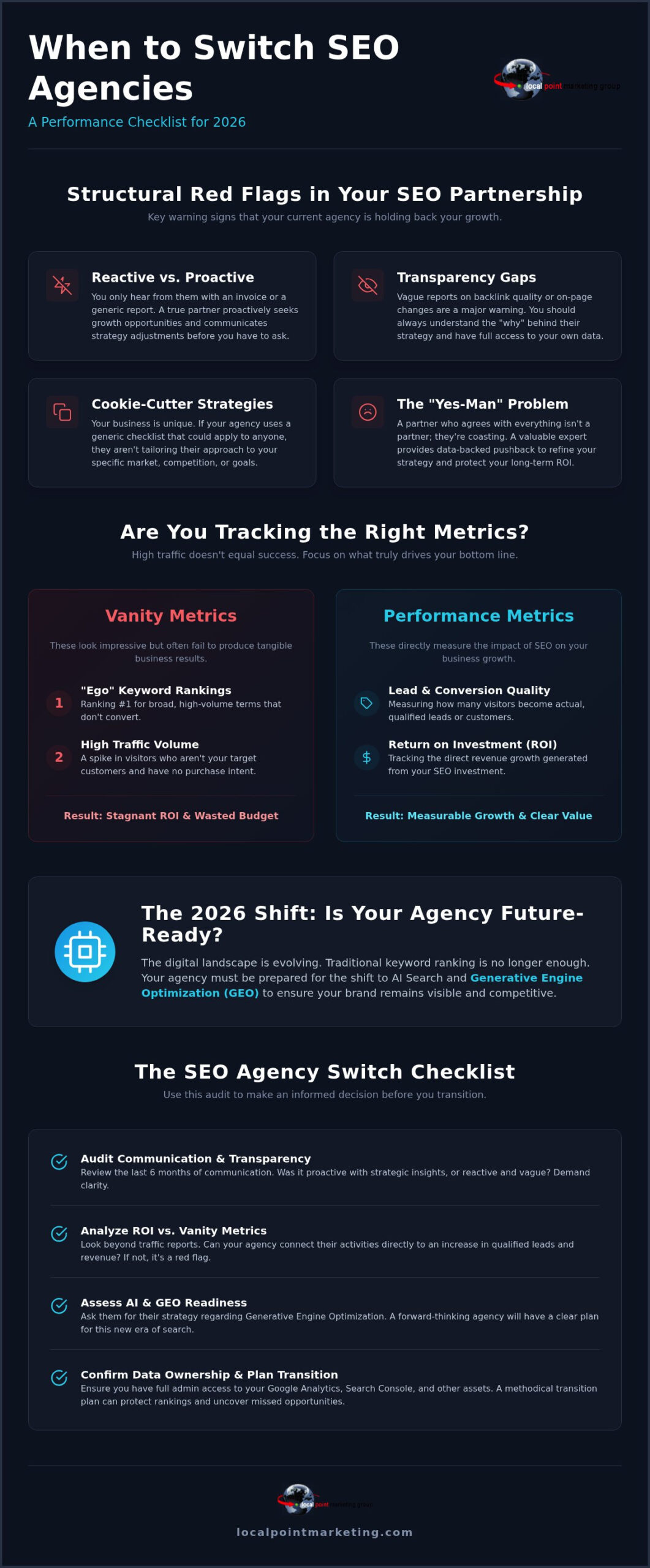
A healthy partnership with a marketing firm should feel like an extension of your own team. If you find yourself questioning when to switch SEO agencies, the first place to look is the foundation of your communication. The “ghosting” effect is one of the most common signs of a failing relationship. This occurs when the only regular contact you receive is an automated invoice or a generic, monthly PDF. Reactive management suggests that your agency is merely maintaining a status quo rather than actively seeking new growth opportunities. A reliable partner stays ahead of trends and reaches out with adjustments before you have to ask for them.

Transparency is another non-negotiable standard. Effective Search Engine Optimization (SEO) requires a clear trail of activity that you can verify. If your current provider is vague about the quality of backlinks they are building or hides the specific on-page changes they make, they might be using outdated or risky tactics. You should never be left in the dark about the “why” behind a technical recommendation. An expert partner explains their strategy in plain English, ensuring you understand how each task connects to your broader business goals.

In South Florida, the competitive landscape in cities like Miami and Fort Lauderdale requires a nuanced approach. Cookie-cutter strategies that ignore local market dynamics often lead to stagnant results. If your agency uses a generic checklist that could apply to any business in any state, they aren’t prioritizing your specific success. You need a strategy that reflects the unique search behaviors and high competition levels of the South Florida region. Businesses across the broader region, including those seeking a digital marketing agency Palm Beach solution, face these same challenges of finding a partner with genuine local expertise.

Communication and Transparency Standards

Your agency should prioritize proactive strategy calls over automated email reports. These sessions are vital for aligning marketing efforts with your shifting business needs. Accountability is equally important; a trustworthy partner takes ownership when targets are missed and presents a clear plan to pivot. You must also maintain full access to your own data. If you are restricted from viewing your Google Analytics or Search Console accounts, the agency is creating an unhealthy dependency that limits your visibility into your own digital assets.

The “Yes-Man” Problem

It might seem pleasant to have an agency that agrees with every idea you propose, but this is often a sign of a partner who is coasting. A reliable expert partner provides data-backed pushback when a proposed direction might harm your long term rankings or ROI. They value integrity over easy approval. When an agency stops challenging your assumptions, they have likely shifted into a box-checking mindset. True growth comes from a collaborator who uses evidence to refine your strategy and pushes your brand toward its highest potential.

Performance Metrics vs. Vanity Metrics: Is Your ROI Stagnant?

Many business owners feel a sense of pride when they see their website at the top of search results for broad, high-volume terms. However, ranking for these “ego keywords” often fails to translate into actual revenue growth. If your agency highlights these vanity metrics while your bottom line remains unchanged, it is time to reassess your partnership. High traffic volume is meaningless if it consists of visitors who have no intention of purchasing your services. Transitioning to ROI-driven digital marketing ensures that every search term targeted aligns with your specific business goals. Understanding when to switch SEO agencies becomes critical when you realize your current partner is optimizing for traffic rather than transactions.

Differentiating Leads from Clicks

A professional performance measurement program looks beyond simple click counts to analyze user behavior. You should evaluate the specific quality of leads generated from your organic landing pages. Are these visitors your target customers, or are they just looking for free information? If you notice a widening gap between traffic growth and actual lead generation, it’s a clear signal regarding when to switch SEO agencies. You can use our guide on how to measure SEO success to audit your current monthly reports and identify these discrepancies. A partner who prioritizes conversion rates over raw clicks demonstrates a commitment to your long term profitability.

Market Share and Competitive Benchmarking

Stagnation is a significant risk in the fast-paced South Florida digital landscape. Even if your rankings remain stable, your “Share of Voice” might be shrinking as more aggressive competitors emerge in Miami and Fort Lauderdale. Digital markets are not static; they require constant adaptation to maintain visibility. Staying with a stagnant provider carries a high opportunity cost, as you lose the revenue that a more proactive partner could have captured. A reliable expert partner will benchmark your performance against local leaders to ensure you are gaining ground rather than just holding steady. If you feel your current strategy has flatlined, partnering with a team focused on measurable outcomes can revitalize your digital presence. This methodical approach replaces guesswork with data, providing a clearer path toward sustainable growth and market leadership.

The 2026 Shift: Is Your Agency Prepared for AI Search and GEO?

The digital landscape has changed fundamentally. If your agency is only focusing on traditional keyword rankings, you’re likely missing the largest shift in search history. Modern consumer discovery now happens through AI-driven interfaces that prioritize direct answers over a simple list of links. Generative Engine Optimization (GEO) is now a requirement for business survival. Many traditional firms struggle with these concepts because they rely on outdated playbooks designed for a previous era of the web. A critical sign of when to switch SEO agencies is their inability to explain how they will keep you visible in an answer-based search environment. You can explore our guide on AI search optimization to understand how these technologies impact your brand’s reach in Miami, Fort Lauderdale, and beyond.

AEO and Generative Visibility

Answer Engine Optimization (AEO) focuses on providing direct, authoritative responses that AI systems can easily ingest and display. Your business needs a clear strategy for appearing in AI-generated summaries on platforms like Google’s search snapshots or specialized AI agents. This requires a deep focus on structured data and entity-based SEO to help machines understand the context of your services. AI Visibility is the ability to be cited by LLMs. Without this citation, your brand essentially becomes invisible to the growing number of users who rely on AI for quick recommendations. If your partner isn’t talking about knowledge graphs or entity relationships, they’re likely falling behind the curve.

Content Quality in the AI Era

The rise of generative tools has led to a flood of high-volume, low-value blog posts that provide little actual insight. While these might have worked for a short time, search engines now prioritize Experience, Expertise, Authoritativeness, and Trustworthiness (E-E-A-T). Mass-produced content often lacks the unique perspectives and local expertise that human experts provide. We believe in a “Human-in-the-loop” approach to content creation. This methodology ensures that every piece of writing is grounded in real world experience and provides genuine value to your target audience. If your current agency’s strategy relies on unedited AI output, your rankings and reputation are at risk. A reliable expert partner knows that quality always beats quantity. This shift in content philosophy is a primary reason to consider when to switch SEO agencies to a team that values integrity and measurable impact.
When to Switch SEO Agencies: A 2026 Performance Checklist

The SEO Agency Switch Checklist: Audit Before You Exit

Deciding when to switch SEO agencies requires a methodical evaluation of your current standing. Before you send a termination notice, you must ensure your digital assets are protected. Research indicates that most SEO agency contracts in 2026 require a commitment of 6 to 12 months, while enterprise-level agreements often extend to 24 months. You should verify your specific notice period to avoid unexpected fees. Securing your properties is the most critical step; you must have primary ownership of your Google Analytics, Search Console, and Google Business Profile. Losing access to these during a transition can result in a loss of historical data that’s vital for your next partner’s success.

Asset Ownership and Access

You must confirm that you own your domain, hosting, and all content created during the partnership. Some agencies use proprietary platforms that make it difficult to migrate your site if you leave. This creates an unhealthy “lock-in” effect that limits your flexibility. Ensure you have full administrative access to your site’s backend and all creative assets. A clean break allows your new partner to audit historical data and find hidden growth opportunities that your previous agency might’ve overlooked.

Strategic Alignment Check

A potential new partner should demonstrate a deep understanding of your specific revenue drivers. It isn’t enough to just rank; the strategy must align with your bottom line. You should also evaluate your local SEO footprint in your specific South Florida city. Miami and Fort Lauderdale are highly competitive markets that require localized expertise to maintain visibility. Compare your current deliverables against 2026 industry benchmarks, such as the inclusion of AI-assisted deliverables, which are now standard in 73% of agency packages. Understanding how to choose a digital marketing agency that meets these modern standards is essential before committing to a new partnership.

Finally, conduct a technical audit to assess your site’s current health. This identifies the “minimum viable strategy” needed to maintain your current rankings during the move. Many businesses fear ranking volatility during a switch, but a structured transition plan mitigates this risk. If your current agency can’t justify their technical recommendations with clear data, it’s a strong indicator of when to switch SEO agencies. Protecting your site’s integrity ensures you can move forward with confidence. If you’re ready for a partner who prioritizes your ownership and long term growth, contact us for a transparent strategy review to secure your digital future.

Transitioning Without Turbulence: The Local Point Marketing Approach

Moving to a new partner is a significant step toward reclaiming your brand’s digital potential. We understand that the fear of ranking volatility often delays the decision of when to switch SEO agencies. Our methodical 30-day transition plan is designed to eliminate that turbulence through careful data preservation and site health monitoring. We start by auditing your historical data to uncover hidden growth opportunities that your previous partner likely missed. This evidence-based approach ensures we aren’t just guessing; we’re building on a foundation of verified facts. We act as a warm-professional extension of your team, replacing silence with a data-driven roadmap that prioritizes both immediate quick wins and long term ROI. Our goal is to make the transition feel like a seamless upgrade rather than a disruptive change.

The First 90 Days

Our initial focus centers on technical cleanup and baseline performance stabilization. We ensure your site’s health is robust enough to support new growth without technical debt holding it back. We immediately align your content strategy with 2026 AI search requirements to maintain visibility in generative results. This involves optimizing for entity-based search and structured data to ensure LLMs cite your brand as an authority. Our monthly retainer for analytics and reporting establishes a transparent rhythm that keeps you informed. We focus on the metrics that actually impact your bottom line, ensuring you always know the “why” behind our strategic choices. This period is dedicated to building a steady foundation for the aspirational growth we plan to achieve together.

Local Expertise in South Florida

Local businesses in Miami and Fort Lauderdale face unique competitive pressures that national firms often overlook. A generic strategy isn’t enough to stand out in the vibrant South Florida market. We leverage our ten years of experience to navigate these local landscapes with precision. Knowing when to switch SEO agencies means recognizing when your current partner lacks the local nuance required for your success. We provide the methodical trustworthiness you need to grow your presence in your specific city. We understand the local search intent of South Florida consumers and how to position your brand as the obvious choice. If you are ready for a partner who prioritizes your outcomes, schedule a strategy call with Local Point Marketing to begin your transition toward measurable growth.

Securing Your Brand’s Digital Future

Choosing when to switch SEO agencies is a strategic decision that impacts your company’s trajectory for years to come. By identifying structural red flags and prioritizing actual ROI over vanity metrics, you position your business to thrive in an increasingly complex landscape. The rapid shift toward AI-driven discovery requires a partner who understands the technical nuances of Generative Engine Optimization. You deserve a collaborator who values transparency and takes full ownership of your digital growth.

Local Point Marketing brings over 10 years of excellence to every partnership. We specialize in the unique search dynamics of the Miami and Fort Lauderdale markets, ensuring your brand remains visible to your most valuable local customers. Our commitment to data-driven transparency means you’ll always have a clear, honest view of your performance and progress. We invite you to Get a Free SEO Audit and Migration Strategy Session to explore how our methodical approach can revitalize your search presence. Your brand’s most successful chapter is ready to begin.

Frequently Asked Questions

How long should I give an SEO agency before deciding to switch?

Most SEO campaigns require 6 to 18 months to demonstrate a strong return on investment. This timeframe allows for technical improvements to settle and for search engines to recognize your content authority. If you are wondering when to switch SEO agencies, evaluate the progress made during the first six months. By this stage, you should see clear indicators of growth in organic visibility or lead quality, even if full revenue targets are still ahead.

Will my rankings drop if I change SEO companies mid-campaign?

Ranking volatility is avoidable with a methodical transition plan. While some minor fluctuations are normal during a strategy shift, a professional partner works to protect your existing authority. We focus on auditing historical data and maintaining technical health to ensure continuity. The goal is to stabilize your baseline performance within the first 30 days of the handover, preventing the turbulence that businesses often fear when changing their digital marketing providers.

What questions should I ask my current agency to see if they are underdelivering?

Ask your agency to explain the specific link between their monthly activities and your revenue growth. Request a detailed breakdown of how they are preparing your site for AI-generated search results and answer engine optimization. If they can’t provide a clear, data-backed “why” for their technical recommendations, it suggests a reactive management style. A reliable partner will welcome these questions and provide transparent, client-centric answers that align with your business objectives.

Do I own the content and backlinks my current agency created?

Ownership depends entirely on your specific service agreement. Most professional agencies ensure you own your domain, hosting, and all content created during the retainer. However, some providers use proprietary platforms that can lock you into their ecosystem. You should verify that you have full administrative access to your Google Analytics and Search Console accounts. Securing these assets is a critical step when you decide when to switch SEO agencies.

What is the most common mistake businesses make when switching agencies?

Rushing the transition without securing access to historical data is a frequent error. Businesses often terminate their current contract before confirming they have full ownership of their creative assets and tracking properties. This oversight can lead to a loss of valuable insights that a new partner needs to find growth opportunities. A structured 30-day handover period ensures that all logins and technical documentation are transferred safely to prevent any gaps in your digital strategy.

How does AI search optimization change who I should hire for SEO in 2026?

In 2026, you must hire a partner who specializes in Generative Engine Optimization (GEO). Traditional SEO is no longer sufficient; your agency must understand how to get your brand cited within AI-generated summaries. Look for experts who prioritize structured data, entity-based search, and high-quality “human-in-the-loop” content. This shift ensures your business remains visible as search engines transition toward answer-based results that prioritize authority and user intent over simple keyword matching. Businesses throughout the region, from Miami to those working with a digital marketing agency Palm Beach specialists trust, must all adapt to these same AI-driven standards to remain competitive.

Can a new agency fix technical SEO mistakes made by a previous provider?

A competent new partner can identify and resolve technical errors through a comprehensive site audit. This process involves cleaning up broken links, improving page load speeds, and correcting crawlability issues that may have been overlooked. Technical cleanup is often the first priority during the baseline stabilization phase of a new partnership. By fixing these foundational mistakes, a new agency can often unlock rapid improvements in your site’s visibility and overall user experience.

Measuring SEO Success: 2026 Analytics & Reporting Guide

Your monthly SEO report might be full of impressive green arrows, but if your South Florida phone isn’t ringing, those numbers are effectively meaningless. Many business owners in Miami and Fort Lauderdale feel like search marketing is a black box where budgets disappear into a fog of technical jargon. You’ve likely felt the frustration of staring at stats like “impressions” while wondering if any of it actually impacts your bottom line. Understanding how to measure SEO success shouldn’t feel like decoding a foreign language, especially when your company’s growth is on the line.

We’ve designed this 2026 guide to help you move beyond vanity metrics and focus on the data that drives revenue. You’ll learn how to distinguish between surface-level activity and genuine growth metrics that satisfy stakeholders. We’ll explore the latest GA4 event-based models and the reality of visibility following the May 2026 Google AI updates. Our team provides the clarity you need to stop wasting budget on reports that lack substance. By the end, you’ll have a clear framework for evaluating performance and the confidence to discuss marketing ROI with authority.

Key Takeaways

  • Learn why modern SEO success requires a three-tiered approach that balances visibility with actual revenue generation.
  • Discover how to measure SEO success by distinguishing between vanity metrics and the high-impact data that drives growth.
  • Identify the specific visibility markers that matter for South Florida businesses, including Local Map Pack performance in Miami and Fort Lauderdale.
  • Learn to evaluate content quality using engagement metrics that prove your marketing efforts are delivering real value to your audience.
  • Establish a structured reporting framework using GA4 and Google Search Console to confidently track and report on your marketing ROI.

What Does SEO Success Look Like in 2026?

Defining success in search marketing has evolved significantly. It’s no longer just about technical optimization or keyword density. To understand What is SEO? in a modern context, you must view it as a holistic strategy that blends brand visibility, user engagement, and revenue growth. A successful campaign ensures your business is the most visible and trusted option when a local customer has a search need.

Many agencies still focus on raw data that looks good on paper but fails to impact your bank account. Real success is measured by how effectively your search presence translates into qualified leads. For South Florida companies, this means your strategy must align with the unique demands of the Miami and Fort Lauderdale markets. We prioritize metrics that signal business health rather than just digital noise.

The Problem with Vanity Metrics

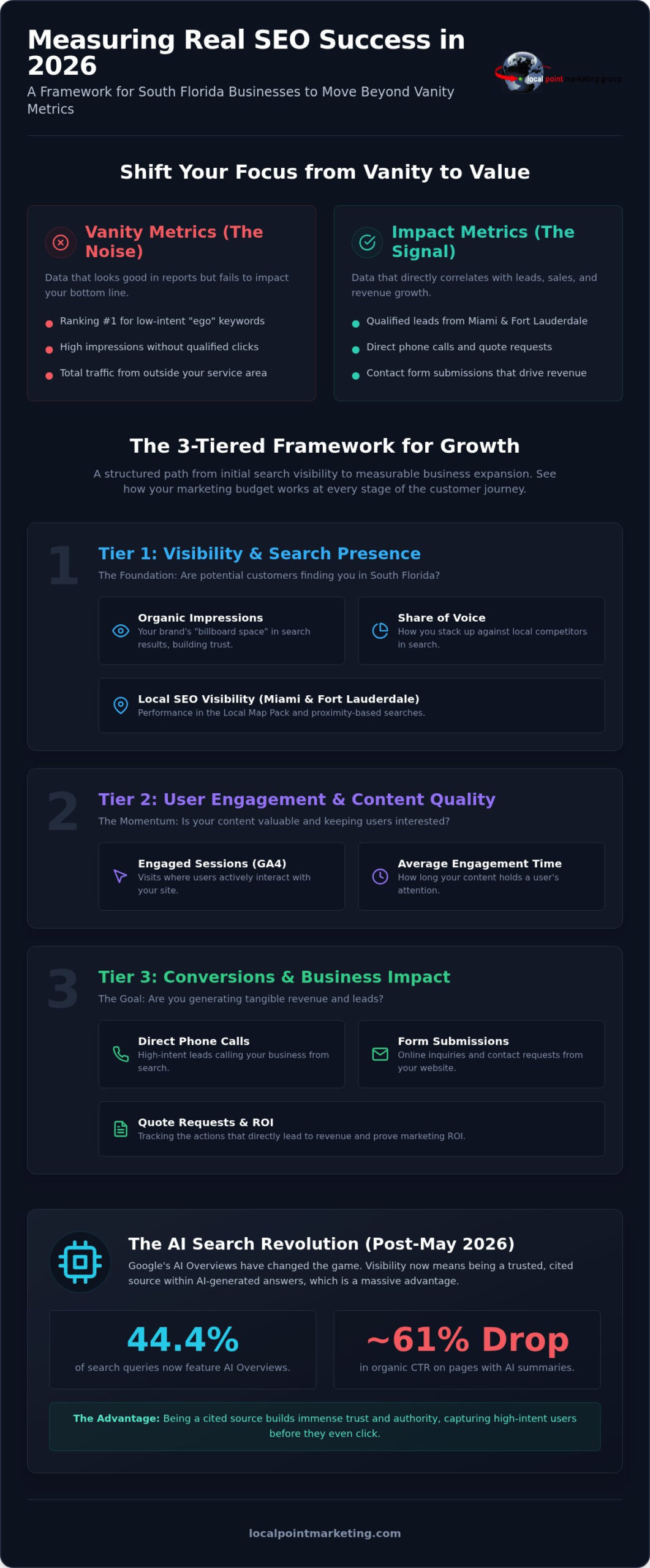
Vanity metrics are data points that make you feel good but don’t provide actionable insights. Ranking #1 for a low-intent keyword is a prime example. While it looks impressive in a report, it’s essentially an “ego ranking” if it doesn’t lead to a transaction. High impressions without clicks often signal a disconnect in your content strategy. It usually means your titles aren’t compelling or you’re appearing for the wrong searches.

Total traffic is another metric that can be misleading. A massive spike in visitors from outside your service area won’t help a local business grow. You need qualified traffic from South Florida. Focus on the data that leads to phone calls, form fills, and quote requests. This shift in perspective is the first step in learning how to measure SEO success accurately. If your current partner is delivering reports full of these hollow numbers, it may be time to review our checklist for knowing when to switch SEO agencies.

The Tiered Framework for Measuring Growth

To truly understand how to measure SEO success, you need a hierarchy. We simplify the reporting process by using a tiered framework. This structure allows you to see the progress of your campaign at every stage of the customer journey. It moves from foundational visibility to the final conversion.

  • Tier 1: Visibility. This is your foundation. We track if you’re being found in local searches and how often your brand appears in the Local Map Pack for Miami or Fort Lauderdale queries.
  • Tier 2: Engagement. This measures momentum. We analyze if users are staying on your site, reading your content, and interacting with your brand.
  • Tier 3: Conversion. This is the ultimate goal. We track the specific actions that drive revenue, such as direct phone calls and contact submissions.

By following this structure, you can see exactly where your budget is working. It provides a clear path from search visibility to business expansion.

Tier 1: Measuring Visibility and Search Presence

Visibility is the foundation of any successful digital strategy. If your brand isn’t appearing in front of potential customers, the rest of your marketing funnel won’t function. We start by tracking Organic Impressions. This metric reveals how often your website or local listing shows up in search results. It represents your brand’s “billboard” space in the digital world. Even if a user doesn’t click immediately, repeated exposure builds trust. We also analyze your Share of Voice to see how you stack up against local competitors in South Florida. Knowing these key metrics for measuring SEO success allows you to pivot your strategy as market conditions change. Mastering these concepts is fundamental to learning how to measure SEO success effectively.

Local SEO Visibility in South Florida

For businesses serving Miami and Fort Lauderdale, local presence is everything. Local SEO visibility is your digital storefront presence in regional search results. We focus heavily on Google Business Profile interactions, such as direct phone calls and direction requests. Proximity-based rankings are also a core focus. Your visibility for a search like “SEO agency Miami” can change significantly if the user is in Boca Raton versus Jupiter. We track these fluctuations to ensure you’re capturing the most relevant local traffic. Our team helps you maintain a steady presence across the entire region to ensure you aren’t losing ground to nearby competitors. Businesses expanding their reach northward can also benefit from working with a digital marketing agency Palm Beach specialists understand to capture the distinct search behaviors of that market.

The Rise of AI Search Optimization Metrics

The search landscape changed forever on May 6, 2026. Google’s structural update to AI Overviews introduced inline source links and hover previews. These AI summaries now appear in roughly 44.4% of queries. While organic click-through rates on these pages have dropped by as much as 61%, being a cited source offers a massive advantage. We use advanced AI search optimization tools to track these mentions. The focus has shifted from simple ranking positions to brand citations. Research indicates that citation clicks increase by 15-20% for businesses that appear in these summaries. This is the new “Position Zero” for 2026. If you want to master these new visibility markers, our Managed SEO experts can guide your strategy.

Tier 2: Evaluating User Engagement and Content Quality

Visibility gets users to the door, but engagement determines if they stay. Once you’ve established a presence in South Florida search results, the next phase of understanding how to measure SEO success involves analyzing user behavior. High traffic numbers are hollow if visitors leave your site within seconds. We look at specific interaction signals to determine if your content truly resonates with your audience. This data allows us to move beyond guesswork and make methodical improvements to your digital footprint.

A primary metric in this tier is Average Engagement Time. This tells us if our blog content creation services are delivering the specific value your customers expect. We also track Key Events, which represent mid-funnel interest. These include newsletter signups, whitepaper downloads, or video views. In 2026, top-performing GA4 properties track a median of 74 custom events per session, according to Heap Analytics. This granular level of tracking ensures every interaction is accounted for in your growth strategy.

CTR and the Importance of Search Intent

Organic Click-Through Rate (CTR) is a vital indicator of how well your brand matches searcher intent. If your site ranks highly for Miami-based queries but suffers from a low CTR, your titles and descriptions likely don’t answer the user’s immediate question. We optimize meta tags specifically to attract local clicks. Using structured data is also essential. It helps you win “rich snippets” that occupy more screen real estate and naturally boost engagement. When your search listing clearly addresses a pain point, users are far more likely to choose your business over a competitor.

Using Analytics to Refine Content Strategy

Data should always dictate your next move. We identify “high-exit” pages to find where you’re losing potential leads. If a page has a high bounce rate but significant traffic, it usually requires a better call to action or more relevant internal links. We use these engagement insights to build your 90-day content roadmap. This ensures we’re expanding on topics that already prove successful with your target audience. Linking these engagement metrics back to your broader ROI-driven digital marketing strategy is the most reliable way to ensure long-term growth. We also monitor Scroll Depth for long-form pieces. This confirms whether users are actually consuming your educational content or just skimming the surface. This methodical approach is the only way to truly master how to measure SEO success in a competitive market.

Measuring SEO Success: 2026 Analytics & Reporting Guide

Tier 3: Tracking Conversions and Real Business Impact

The final tier of our framework addresses the most critical question: is your investment generating profit? While visibility and engagement are necessary precursors, they don’t pay the bills. Tracking conversions is the only definitive way to understand how to measure SEO success. We focus on primary actions such as direct phone calls, contact form completions, and specific quote requests. According to a 2026 Salesforce report, marketers using GA4’s event-based model now track an average of 18.7 distinct conversion types. This granular data led to a reported 26% increase in ROAS accuracy, providing the evidence needed to justify your marketing spend.

Monitoring lead quality is just as important as tracking volume. We analyze which specific keywords result in your highest-value clients. This level of detail allows us to attribute revenue directly to organic search. It provides clear justification for your monthly SEO retainer services. By calculating your Cost Per Lead (CPL), you can compare the efficiency of SEO against your paid advertising channels. This methodical approach is the most reliable way to demonstrate how to measure SEO success to your stakeholders. If your agency cannot provide this level of conversion clarity, our 2026 performance checklist for when to switch SEO agencies can help you evaluate whether it’s time for a change.

Call Tracking for Local Service Businesses

Fort Lauderdale and West Palm Beach businesses rely heavily on voice communication. Call tracking is essential for these local service providers. We don’t just count every ring. Our system distinguishes between new customer inquiries and existing client calls. This ensures your data isn’t skewed by non-revenue-generating interactions. Integrating this call data into your analytics and reporting digital marketing dashboard creates a complete picture of your search performance.

Calculating SEO ROI and Lifetime Value

Understanding the lifetime value (LTV) of an organic lead is vital for long-term planning. The formula involves multiplying the average profit per customer by the average frequency of purchase and the typical customer lifespan. Organic leads often possess higher intent and trust compared to social media or PPC leads. SEO is a compounding investment that reduces CPL over time. As your authority grows, you’ll earn more leads for the same level of effort. This growth allows you to scale your business with confidence.

Ready to see the real impact of your search strategy? Let our team manage your Analytics and Reporting to uncover your true ROI.

Setting Up Your SEO Reporting Dashboard

A robust reporting dashboard turns raw data into a strategic roadmap. Setting this up correctly is the final piece of the puzzle when learning how to measure SEO success. It moves your business from reactive guessing to proactive growth by centralizing your most important metrics. A well-organized dashboard ensures you aren’t digging through multiple platforms just to see if your marketing is working. It provides a clear, real-time view of your digital health and return on investment.

The implementation process follows five methodical steps:

  • Step 1: Connect Google Analytics 4 (GA4) and Google Search Console (GSC). These platforms provide the baseline data for impressions and user behavior.
  • Step 2: Implement a local rank tracker. This tool must monitor specific zip codes in South Florida to account for regional search variations.
  • Step 3: Integrate a CRM or lead tracking tool. This step is vital to bridge the gap between digital “clicks” and actual “sales.”
  • Step 4: Create a simplified monthly report. This document should highlight Tier 3 conversion success while monitoring the foundational health of Tiers 1 and 2.
  • Step 5: Schedule a regular review with your digital marketing agency. These sessions turn data into a specific action plan for the next 90 days.

Essential Tools for Local SEO Reporting

Google Search Console remains the primary “source of truth” for organic search performance. It reveals exactly which queries bring users to your site and how Google perceives your pages. We also recommend using heatmaps to understand user behavior. These tools show how South Florida users interact with your landing pages, identifying exactly where they click or lose interest. When selecting a reporting platform, prioritize at-a-glance clarity over complexity. Busy business owners need to see their growth trends without navigating technical jargon. A January 2026 update to GA4 introduced cross-channel budget planning, which can help you see how SEO fits into your broader spend.

The Local Point Marketing Approach to Reporting

Our team provides transparent, data-driven insights focused entirely on your growth. We believe a managed retainer should include continuous performance monitoring rather than just a monthly check-in. This proactive approach ensures your strategy stays ahead of major algorithm shifts. We don’t just send reports; we provide a partnership built on evidence and methodical trustworthiness. This is the most effective way to master how to measure SEO success in a competitive market like Miami or Fort Lauderdale.

Ready for results you can actually measure? Contact Local Point Marketing today.

Elevating Your Business with Data-Driven SEO

Modern search marketing isn’t a guessing game. By implementing a tiered framework, you can move away from surface-level stats and focus on the metrics that actually impact your bottom line. You now have the tools to distinguish between simple impressions and the high-intent conversions that drive revenue. Understanding how to measure SEO success is the fundamental difference between a wasted marketing budget and a compounding business asset. This methodical approach provides the clarity needed to scale your operations with total confidence.

Local Point Marketing brings 10+ years of data-driven experience to every partnership. We specialize in South Florida lead generation and provide custom analytics dashboards for every client. Our team ensures your strategy remains transparent and focused on measurable growth. It’s time to stop wondering if your SEO is working and start seeing the results in your revenue reports. We’re here to help you navigate the evolving search landscape and secure your brand’s future.

Get a Transparent SEO Strategy for Your Business and take the first step toward a more successful future.

Frequently Asked Questions

How long does it take to see measurable SEO results in 2026?

Measurable SEO results typically appear within four to six months. However, the structural changes implemented on May 6, 2026, to Google’s AI Overviews mean some businesses see visibility shifts in just weeks. Long-term authority takes time to build in competitive South Florida markets. We focus on early indicators like impression growth and local map pack movements to ensure your strategy is moving in the right direction before final conversions peak.

Is organic traffic more valuable than paid traffic for local businesses?

Organic traffic often provides higher lifetime value because it stems from established trust. While paid traffic offers immediate visibility, it stops the moment your budget ends. Organic search is a compounding investment that reduces your cost per lead over time. For local businesses in Miami or Fort Lauderdale, a dominant organic presence in the Local Map Pack creates a level of credibility that paid advertisements simply cannot replicate.

What is a good conversion rate for a local service-based website?

A healthy conversion rate for a local service-based website typically ranges between 3% and 7%. This varies based on your specific industry and the urgency of the service. For example, emergency services often see higher rates than luxury home remodeling. We focus on optimizing your site’s user experience to ensure you’re capturing every possible lead from your South Florida audience. Tracking these figures is essential when learning how to measure SEO success.

Can I track SEO success without using expensive software tools?

You don’t need expensive software to start tracking your progress. Google Analytics 4 (GA4) and Google Search Console (GSC) are free, industry-standard tools that provide the most accurate data directly from the source. These platforms allow you to monitor impressions, clicks, and custom events without additional overhead. While third-party tools offer niche insights, your primary “source of truth” for search performance is already available at no cost to your business.

How often should I receive an SEO performance report from my agency?

You should receive a comprehensive SEO performance report every month. This frequency allows enough time for data trends to emerge while keeping your strategy agile. In addition to monthly deep dives, your agency should provide a real-time dashboard for “at-a-glance” health checks. Regular reviews ensure you’re turning raw data into actionable steps for the next quarter, keeping your South Florida business ahead of local competitors and algorithm shifts.

What happens if my keyword rankings go up but my leads stay the same?

If your rankings are climbing but leads remain stagnant, you likely have a disconnect in search intent. You might be ranking for “informational” keywords rather than “transactional” ones that drive phone calls. It could also signal friction on your landing pages, such as a broken contact form or a slow mobile load time. We analyze your user engagement data to find exactly where potential customers are dropping off in your sales funnel.

Does social media engagement affect my SEO success metrics?

Social media doesn’t directly influence your organic ranking positions, but it plays a vital role in brand visibility. High engagement levels can drive direct traffic and increase brand-name searches, which are positive signals to search engines. When users see your brand across multiple platforms, they’re more likely to click your listing in search results. This indirect benefit makes social media a valuable component of a holistic digital marketing and lead generation strategy.

How do I measure my visibility in AI search engine results?

Measuring visibility in AI search results requires tracking brand citations and mentions in generative summaries. As of 2026, AI Overviews appear in roughly 44.4% of queries. You can monitor this by checking Google Search Console for impressions on pages that are frequently cited in AI answers. We also track citation clicks, which have been observed to increase by 15% to 20% for businesses appearing in these expert advice blocks on the search results page.

ROI-Driven Digital Marketing: The Definitive Guide for 2026

What if you could stop guessing which marketing platforms actually drive sales and start treating your digital spend as a high-yield investment? Many business owners feel frustrated by high ad spend that only produces low-quality leads. It’s difficult to communicate the value of your efforts to stakeholders when the data feels disconnected from your bank account. You deserve a strategy that replaces confusion with clarity and provides a sense of steady progress. Mastering ROI-driven digital marketing is the key to moving beyond surface-level metrics like clicks or impressions.

We’ll help you bridge the gap between marketing activity and actual revenue. This guide provides a roadmap to transform your digital presence into a measurable profit engine by focusing on the metrics that truly impact your bottom line. We’ll explore a clear framework for selecting high-impact channels, calculating precise ROI, and building the reporting structures you need to maintain long-term confidence in your strategy. By the end, you’ll have the tools to ensure every dollar spent contributes directly to your success and professional growth.

Key Takeaways

  • Learn how to implement ROI-driven digital marketing by shifting your focus from broad awareness to high-intent data that captures ready-to-buy customers.
  • Discover why the synergy between Search Engine Optimization and Managed PPC creates a sustainable foundation for long-term growth and immediate lead generation.
  • Identify the critical difference between vanity metrics like “likes” and the bottom-line figures that actually matter; such as Customer Acquisition Cost (CAC) and lead-to-close ratios.
  • Gain a clear, step-by-step framework for auditing your current digital presence to find hidden ROI gaps and reallocate your budget toward your highest-performing channels.
  • Understand how a reliable expert partner like Local Point Marketing, with deep local knowledge in South Florida, can help you scale your results through methodical reporting and AI integration.

What is ROI-Driven Digital Marketing in 2026?

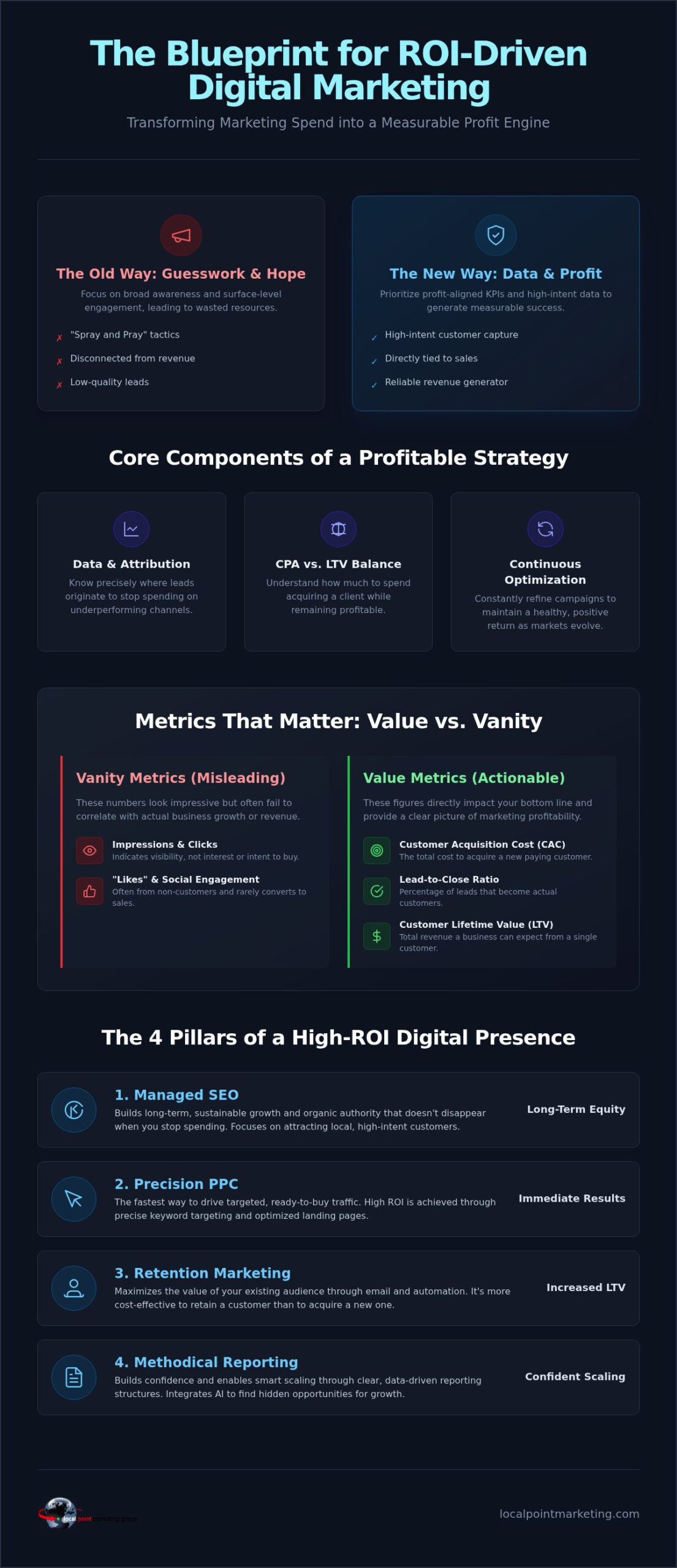
Business growth happens at the intersection of marketing spend and tangible results. In the past, companies often focused on general brand awareness. Today, that approach often leads to wasted resources and missed opportunities. ROI-driven digital marketing is a methodology prioritizing profit-aligned KPIs over surface-level engagement. It moves your business beyond the “hope for the best” mindset and provides a clear path to measurable success.

The year 2026 marks a total shift toward intent-based data. We no longer just look at who saw an ad; we look at who is ready to take action. Tactical execution involves performing tasks like writing blogs or running ads because they’re standard practice. An ROI-driven strategy ensures those tasks serve a specific financial goal. It’s about working smarter with the data you already have to ensure your digital presence acts as a reliable revenue generator.

The Core Components of a Profitable Strategy

A reliable strategy isn’t built on luck. It’s built on three steady pillars. First, you need precise data collection and attribution. You must know exactly where your leads originate so you can stop spending on underperforming channels. Second, we balance your cost-per-acquisition (CPA) against your customer lifetime value (LTV). This balance helps you understand how much you can safely spend to acquire a new client while remaining profitable. Finally, continuous optimization ensures your campaigns stay efficient. We constantly refine your approach to maintain a healthy, positive return as market conditions evolve. This methodical focus gives you the confidence to scale your budget as your results improve.

Why Traditional Marketing Models Are Failing Locally

Generic advertising is becoming less effective in competitive markets like Miami and Berlin. These areas are saturated with digital noise, and “spray and pray” tactics often drain local business budgets without producing quality leads. Traditional models often ignore the nuances of local culture and search behavior. High-intent capture is the better path for sustainable growth. This is where local SEO becomes your most valuable asset. It places your business in front of customers at the exact moment they need your services in your specific community. By targeting local intent, you stop competing with global giants and start winning in your own neighborhood.

The 4 Pillars of a High-ROI Digital Presence

Building a successful online presence requires more than just being visible. It requires a strategic combination of channels that work together to capture and convert demand. A truly ROI-driven digital marketing strategy treats every channel as a specific tool in a larger financial engine. By balancing long-term equity with immediate results, businesses can create a steady stream of high-quality leads that grow more cost-effective over time.

Managed SEO for Sustainable Growth

SEO provides the organic foundation for your business. Unlike paid ads, organic rankings build long-term equity that doesn’t disappear when you stop spending. A smart keyword strategy focuses on the bottom line rather than just vanity rankings. In competitive South Florida niches, authority is earned through strategic link building and high-quality content. Utilizing professional blog content services is a proven way to drive organic leads by answering the specific questions your potential customers are asking. This approach ensures your business remains the steady choice for local searchers.

Precision PPC and Ad Spend Management

Pay-Per-Click advertising is the fastest way to drive targeted traffic to your site. The key to high ROI is precision. We target high-intent search phrases to ensure your budget isn’t wasted on casual browsers. Managed budgets are far superior to set-and-forget campaigns because they allow for constant refinement based on real-time data. We also focus heavily on landing page optimization. If your page doesn’t convert, your ad spend is lost. By aligning your ads with specific, high-converting pages, we maximize the impact of every dollar. You can partner with an experienced agency to ensure your campaigns are always optimized for profit.

Retention Marketing through Email and Automation

Maximizing the value of your existing audience is one of the most efficient ways to improve your margins. It’s often more affordable to retain a customer than to acquire a new one. Implementing email marketing automation allows you to nurture leads and stay top-of-mind without manual oversight. By segmenting your lists, you can deliver personalized offers that resonate with specific customer needs. This targeted approach reduces churn and significantly increases the lifetime value of every lead you capture. Effective automation turns your database into a predictable source of recurring revenue.

Metrics That Matter: Value vs. Vanity

Many business owners feel a sense of accomplishment when they see a surge in social media engagement or website traffic. While these numbers look impressive on a monthly report, they don’t always translate to actual revenue. For South Florida SMBs, relying on surface-level data can lead to expensive mistakes and a lack of clarity regarding growth. A truly ROI-driven digital marketing strategy requires looking beneath the surface to identify the metrics that actually move the needle. We focus on the data that reflects your business growth rather than just your online popularity.

Distinguishing between value and vanity is essential for maintaining a healthy, sustainable marketing budget. When you prioritize the right data, you gain a clearer picture of your real return on investment. This clarity allows you to make informed decisions about where to allocate your resources for the best results. It’s about moving from a “hopeful” mindset to a methodical, data-backed approach that ensures every campaign serves your bottom line. We believe that tracking conversion rates and lead-to-close ratios provides a much more accurate reflection of your success than simple clicks. Understanding how to measure SEO success through the right analytics framework is essential for ensuring your organic efforts translate into real revenue rather than just impressive-looking reports.

Vanity Metrics to De-Prioritize

Vanity metrics often provide an ego boost but rarely offer a direct link to profit. We encourage our partners to focus on quality over quantity in these areas. A small, engaged audience in Berlin or Miami is worth more than a massive, passive global following that will never buy from you.

  • Total follower count: A large audience often provides less value than a small group of highly engaged potential customers. We prioritize reach among people who actually need your services.
  • Raw page views: High traffic is meaningless if the visitors aren’t “qualified.” We distinguish between random clicks and potential leads who match your ideal customer profile.
  • Social shares: While shares increase visibility, they don’t always signal an intent to purchase. We look for engagement that leads directly to a conversion or a sales inquiry.

Profit Metrics to Track Daily

To achieve successful ROI-driven digital marketing, you must track the metrics that represent real money entering your business. We help you implement advanced analytics and reporting to monitor these figures consistently. Using Google Analytics 4, we track the entire user journey from the first click to the final cash transaction. This level of detail ensures you’re never in the dark about your marketing performance and helps you communicate value to your stakeholders with confidence.

  • Sales Qualified Leads (SQLs): We measure how many leads from each channel are actually ready for a sales conversation. This ensures your sales team spends time on the most promising opportunities.
  • Average Order Value (AOV): Tracking the spend of customers sourced through digital channels helps determine your most profitable audience segments and informs future ad spend.
  • Marketing Originating Revenue: This metric provides the direct link between your marketing spend and your total sales. It’s the ultimate proof of your strategy’s effectiveness.

ROI-Driven Digital Marketing: The Definitive Guide for 2026

How to Audit Your Current Digital Marketing for ROI Gaps

Performing a thorough audit is the only way to stop budget leaks and refocus your efforts on profit. Many businesses continue to fund underperforming channels simply because they’ve always done so. A methodical ROI-driven digital marketing audit provides the clarity you need to make confident decisions. This process identifies exactly where your money is working and where it’s being wasted.

  • Step 1: Calculate your current Customer Acquisition Cost (CAC). Divide your total marketing spend by the number of new customers acquired. Do this for each individual channel to see which ones are truly cost-effective.
  • Step 2: Identify your highest-performing traffic sources. Use attribution data to see which platforms lead to actual sales rather than just clicks. This helps you double down on what works.
  • Step 3: Evaluate your conversion funnel. Look for “leaks” where potential customers drop off. Even a small improvement in your conversion rate can significantly boost your overall ROI.
  • Step 4: Review your ad spend for waste. Check your PPC campaigns for negative keywords and impressions that don’t lead to high-quality traffic. Eliminating these saves your budget for high-intent searches.
  • Step 5: Set measurable KPIs for the next 90 days. Establish clear, time-bound goals for growth. This ensures your team remains focused on the metrics that impact your bottom line.

Identifying Friction in the Conversion Funnel

Friction in your funnel is a silent ROI killer. If your website is slow or difficult to navigate on mobile, you’re losing money every second. We recommend testing your mobile responsiveness and page load speeds across different devices. Ensure your calls-to-action are clear and value-driven so users know exactly what to do next. Analyzing why users drop off before completing a lead form allows you to refine the user experience and capture more demand without increasing your spend.

Leveraging AI for ROI Optimization

AI tools now allow businesses to predict customer behavior and intent with surprising accuracy. By automating repetitive data tasks, you can free up your time to focus on high-level strategy and creative growth. You can explore our guide on AI search optimization to stay ahead of emerging trends and maintain your visibility. This technology helps you anticipate what your customers need before they even search for it. If you’re ready to stop the guesswork, contact us for a professional audit to uncover your hidden growth opportunities.

Partnering with a Data-Driven Agency for Scale

Scaling your business requires a shift from managing tasks to managing outcomes. While many businesses start by handling their own marketing or hiring a basic vendor, reaching the next level of growth often requires a more sophisticated approach. A vendor simply executes requests; a reliable expert partner works alongside you to align every campaign with your financial goals. This distinction is the foundation of successful ROI-driven digital marketing. By choosing a partner who understands your specific market, you ensure that your strategy isn’t just active, but profitable.

Local expertise in hubs like Berlin and South Florida provides a significant advantage that global agencies often miss. Every city has unique search behaviors, seasonal trends, and cultural nuances that impact how customers engage with brands. We use our 10 years of experience to navigate these local complexities, ensuring your budget is spent where it has the highest impact. Our approach focuses on Managed SEO and Managed PPC budgets to maximize efficiency and prevent waste. We believe that monthly analytics and reporting should be the core of any retainer service, providing you with the transparency needed to track your progress with total confidence.

The Advantage of a Managed Retainer

A managed retainer relationship provides the stability and focus necessary for long-term success. Unlike one-off projects, a retainer allows for continuous testing and refining of your SEO and PPC strategies. We make proactive adjustments based on shifting market data in Miami or Fort Lauderdale, ensuring your business stays ahead of the competition. This methodical approach results in predictable costs and transparent, results-oriented reporting. You’ll always know exactly how your investment is performing and where your next lead is coming from. It’s about building a steady engine for growth rather than chasing short-term wins.

Next Steps: Elevating Your Business Growth

The first step toward a more profitable future is evaluating your current agency performance against industry ROI benchmarks. If you aren’t seeing a clear link between your marketing spend and your revenue, it’s time to reconsider your strategy. Understanding when to switch SEO agencies is a critical skill that can save your business from months of stagnant results and wasted budget. We recommend requesting a data-driven audit of your digital presence to identify hidden opportunities for improvement. Local Point Marketing structures every campaign for measurable lead generation, focusing on the metrics that actually impact your bottom line. We invite you to consult with one of our specialists today to bridge the gap between simple visibility and genuine profit.

Building Your Future on Measurable Success

Transforming your digital presence into a profit engine requires a shift in perspective. You’ve seen how moving away from vanity metrics like likes and impressions allows you to focus on the data that actually impacts your bottom line. By integrating managed SEO with precision PPC, you create a sustainable foundation for growth that captures high-intent demand. Mastering ROI-driven digital marketing is about more than just visibility; it’s about building a dependable system for long-term revenue generation. Our 10 years of digital marketing expertise in the South Florida and Berlin local markets ensures your strategy is tailored to your specific community.

We provide transparent reporting and analytics focused entirely on lead generation. This methodical approach removes the guesswork from your marketing spend and gives you the confidence to scale effectively. Your business deserves a partner that values evidence over hype and works alongside you toward shared goals. Ready to see measurable growth? Contact Local Point Marketing for a data-driven strategy today. We’re here to help you bridge the gap between simple online activity and tangible business success. Your path to a brighter, more profitable future starts with a single, data-backed step.

Frequently Asked Questions

What is a good ROI for digital marketing in 2026?

A healthy benchmark for digital marketing is typically a 5:1 ratio, meaning five dollars in revenue for every one dollar spent. While some high-performing campaigns reach 10:1, your specific target depends on your industry and profit margins. We focus on achieving a sustainable return that allows for consistent reinvestment. It’s essential to look at net profit rather than just top-line revenue to ensure your growth remains healthy and scalable over time.

How do I calculate digital marketing ROI for a local business?

You calculate ROI by subtracting your total marketing costs from your generated revenue, then dividing that number by the marketing costs. For local businesses in Miami or Berlin, it’s vital to include offline conversions like phone calls or in-person visits. Using call tracking and CRM integration helps capture these data points accurately. This formula ensures your ROI-driven digital marketing efforts are grounded in real financial outcomes rather than estimated guesses or vanity metrics.

How long does it take to see a positive ROI from SEO?

SEO is a long-term investment that typically requires six to twelve months to deliver a significant positive return. Unlike paid ads, organic search builds equity over time, making it more cost-effective as your authority grows. You’ll likely see early indicators like improved rankings and traffic within the first few months. However, the most substantial ROI occurs when your content begins to consistently capture high-intent searchers without additional per-click costs.

Can I achieve a high ROI with a small marketing budget?

You can definitely achieve a high return with a smaller budget by prioritizing precision over broad reach. Focus on localized keywords and high-intent niches where competition is lower but purchase intent is high. Managed SEO and targeted email campaigns are excellent ways to maximize efficiency without overspending. By concentrating your resources on the most profitable segments of your audience, you can build a steady foundation that funds future expansion.

What are the most common ROI killers in digital advertising?

The most frequent ROI killers include poor landing page experiences, broad keyword targeting, and a lack of conversion tracking. If your website is slow or difficult to navigate, you’ll lose potential leads regardless of your ad quality. Additionally, failing to use negative keywords in PPC campaigns leads to wasted impressions and clicks from unqualified users. Regular audits and methodical adjustments are necessary to identify these leaks and keep your strategy performing at its peak.

How does social media contribute to overall marketing ROI?

Social media marketing contributes to ROI by nurturing leads and building the trust necessary for high-value conversions. While it often serves as an “assisted conversion” touchpoint, it keeps your brand top-of-mind during the customer’s decision-making process. We track how social engagement influences the overall user journey using advanced attribution. This ensures you understand its value in driving long-term loyalty and increasing the lifetime value of every customer you acquire through digital channels.

Is PPC better than SEO for short-term return on investment?

PPC is generally better for short-term returns because it generates immediate traffic and lead opportunities. It’s an excellent tool for testing new offers or quickly boosting visibility in competitive markets. However, SEO provides a more sustainable long-term ROI because the cost-per-lead decreases as your organic presence strengthens. We often recommend a balanced approach that uses PPC for instant impact while SEO builds the steady, low-cost equity your business needs for future stability.

Why is attribution modeling important for measuring ROI?

Attribution modeling is critical because it identifies which touchpoints actually lead to a sale. Customers rarely convert on their first interaction; they might see an ad, read a blog post, and then receive an email before buying. Without proper attribution, you might undervalue the channels that start the journey. This data-driven approach allows for better budget allocation in your ROI-driven digital marketing strategy, ensuring you invest in the platforms that truly drive results. Our comprehensive 2026 analytics and reporting guide on measuring SEO success provides a deeper look at how to build attribution models that accurately reflect your organic channel’s contribution to revenue.

5 Social Media Management Pricing Myths Debunked for South Florida SMBs

The cheapest quote you receive for digital growth is often the most expensive mistake your business can make. When you analyze social media management pricing in the current Florida market, it’s easy to feel overwhelmed by wildly different figures that claim to offer the same results. You’ve likely felt the frustration of paying for “fluff” content that looks nice but fails to generate a single lead. It’s natural to worry about overpaying for vanity metrics while your competitors seem to have found a secret formula for success.

We believe you deserve a steady, capable partner who values evidence over hype and focuses on your specific business outcomes. This guide will help you discover the truth behind service costs and teach you how to budget for measurable growth in the 2026 South Florida market. We’ll examine the specific drivers of local ROI, debunk five common pricing myths, and provide a clear framework for evaluating agency proposals with confidence. By the end, you’ll know exactly how to align your social media investment with your long-term business goals.

Key Takeaways

  • Understand why low-cost automation can undermine your brand and why modern algorithms prioritize meaningful community engagement over high post volume.
  • Calculate the true cost of in-house management by accounting for the significant time investment and the expense of professional-grade software.
  • Learn how the competitive South Florida market landscape influences social media management pricing and why local expertise is vital for sustainable growth.
  • Shift your focus from vanity metrics like likes and follows to measurable business outcomes that drive actual inquiries and sales for your business.

Myth 1: The $200 Monthly Retainer is a ‘Great Deal’

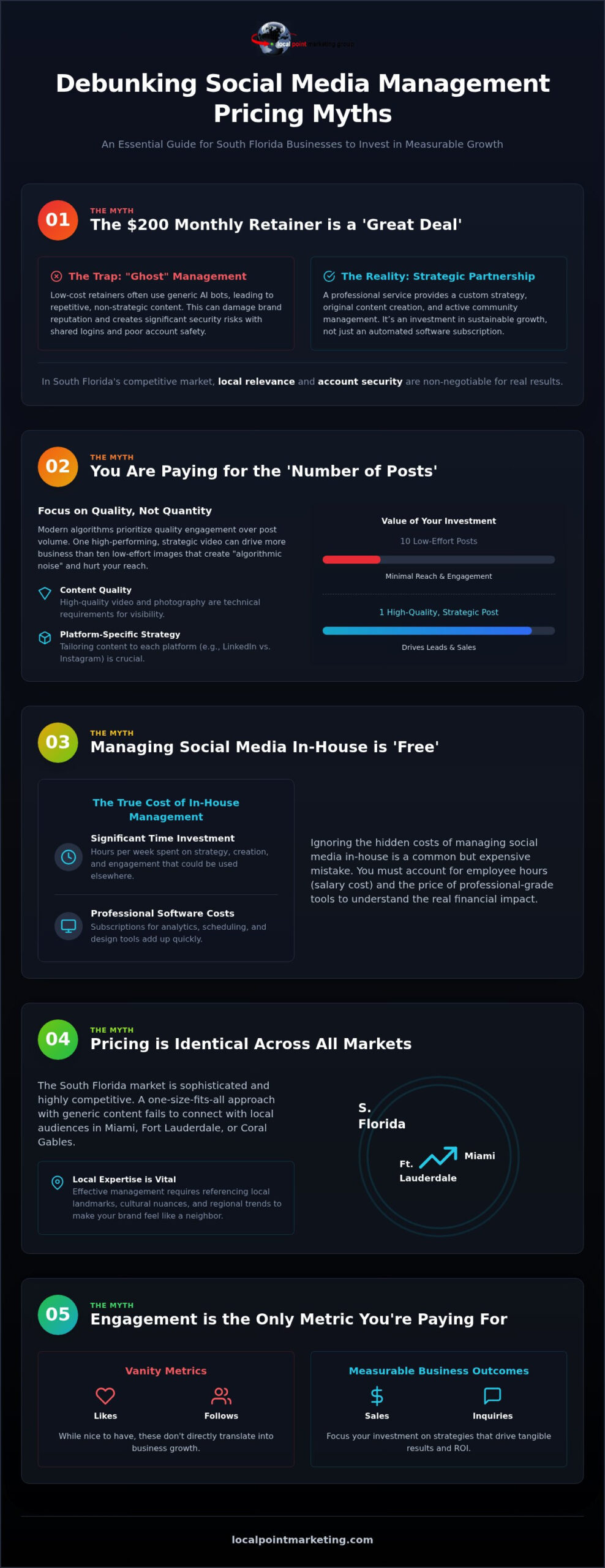
Accepting a quote for $200 a month might feel like a win for your budget, but it’s often the start of a “ghost” management cycle. These low-cost services typically rely on generic, automated AI bots that churn out repetitive content without any human oversight or strategic direction. This approach ignores the fundamental components of professional social media management pricing. A legitimate partnership includes custom strategy, original content creation, and active community management to ensure your brand remains relevant. When you evaluate social media marketing options, it’s vital to understand that true growth requires more than just a software subscription.

Cheap services can actually damage your brand reputation in a competitive market like Miami. If your profiles look like automated billboards, local customers will quickly lose interest. This leads to the hidden cost of low engagement. Saving money on your social media management pricing in the short term often results in invisible profiles. Platforms prioritize content that sparks conversation; if your posts are ignored, the algorithm stops showing them to potential customers entirely.

The Danger of Generic, Non-Local Content

South Florida audiences are sophisticated and expect content that reflects their unique community. “Cookie-cutter” posts that could apply to any city fail to resonate with people in Fort Lauderdale or Coral Gables. Effective management requires referencing local landmarks, cultural nuances, and regional trends that make your brand feel like a neighbor rather than a distant corporation. When your content feels irrelevant, it triggers platform algorithms to hide your posts. This creates a downward spiral where your “affordable” service provides zero visibility to the people who matter most.

Security and Account Safety Risks

Outsourcing your digital presence to unvetted, low-cost individuals creates significant security vulnerabilities. Common pitfalls include shared logins and a total lack of two-factor authentication, which leaves your business pages open to hackers and malicious actors. Recovering a compromised account is a costly, stressful process that can permanently harm your credibility. Professional account security in 2026 serves as a foundational shield that protects your digital assets and maintains the trust you’ve built with your audience.

Myth 2: You Are Paying Primarily for the ‘Number of Posts’

Many business owners assume that social media management pricing is a simple calculation of post count. In the 2026 digital environment, this logic no longer applies. Algorithms on every major platform now prioritize quality over quantity to combat digital noise. They reward content that generates genuine interaction, not just consistent activity. Shifting your focus from broadcasting to community building changes the value of your investment. One high-performing, professionally produced Reel can drive more engagement and leads than ten low-effort static images. Developing an effective social media strategy requires deep competitive analysis and a clear understanding of your audience’s behavior.

Strategic depth is the true driver of cost in a professional retainer. You aren’t just paying for the final upload; you are paying for the research that informs it. A professional agency performs several critical tasks behind the scenes to ensure your brand stands out:

  • Monitoring competitor movements in the South Florida market.
  • Identifying trending topics before they peak.
  • Analyzing platform data to refine your monthly approach.
  • Ensuring every post serves a specific purpose in your sales funnel.

This methodical process justifies the investment in social media management pricing by turning passive followers into active customers.

Content Quality vs. Algorithmic Noise

High-quality video and photography are no longer optional. They are technical requirements for visibility. Platforms like Instagram and TikTok use sophisticated AI to evaluate the aesthetic value and relevance of your media. If you post just to fill a calendar, you are actually hurting your reach. The algorithm flags low-engagement content as uninteresting, which reduces the visibility of your future posts. We use AI-assisted tools to enhance our creative output. These tools help us maintain high production standards while focusing on the human touch that builds trust with your audience.

The Real Value of Platform-Specific Strategy

Cross-posting the exact same content to Facebook, LinkedIn, and Instagram is a missed opportunity. Each platform attracts a different demographic with unique expectations. LinkedIn users look for professional insights, while Instagram users crave visual inspiration. Pricing reflects the expertise required to navigate these differences effectively. Local Point Marketing tailors content specifically for South Florida industries, from luxury real estate to local hospitality. This methodical approach ensures your message resonates with the right people in the right place. If you are ready to move beyond basic posting, you can explore our data-driven social media management services to see how strategy elevates your brand.

Myth 3: Managing Social Media In-House is ‘Free’

Believing that in-house management costs nothing is a common misconception that can quietly stall your business growth. While you aren’t writing a check to an outside vendor, the actual impact on your bottom line is often higher than you expect. When you evaluate the true social media management pricing for your business, you must account for the time and resources diverted from your core operations. A professional agency provides a complete team of strategists, designers, and analysts for roughly the same cost as a single junior-level employee. This collaborative approach ensures your brand benefits from diverse expertise without the overhead of multiple full-time salaries.

The “Knowledge Gap” is another hidden expense of the DIY model. The digital landscape in 2026 moves at a relentless pace. Staying updated on shifting algorithms and new local compliance rules requires constant research and training. As highlighted in the SBA’s social media guide, small businesses succeed when they maintain a consistent and strategic presence. Attempting to manage this in-house often leads to a reactive strategy where you’re constantly playing catch-up rather than leading your market.

Calculating the Opportunity Cost of Your Time

You can determine your personal “SMM hourly rate” by multiplying the value of your time by the hours you spend on social tasks each week. If you value your time at $150 per hour and spend five hours weekly on content, your “free” social media is costing you $3,000 every month. This time is better spent on high-level leadership, closing major leads, or improving your service delivery. DIY social media often results in fragmented messaging and inconsistent visual branding that can confuse potential customers and weaken your market position.

The Software and Tool Tax

Professional results require professional tools. Subscriptions for advanced analytics, premium scheduling platforms, and AI-driven design suites like Sprout Social or Canva Pro quickly add up. These tools are essential for the data-driven approach we use to ensure your content reaches the right audience. Agencies distribute these software costs across multiple clients, providing you with high-end technology at a fraction of the individual subscription price. Investing in a managed social media strategy for local business allows you to leverage these professional resources while keeping your social media management pricing predictable and efficient.

5 Social Media Management Pricing Myths Debunked for South Florida SMBs

Myth 4: Pricing is Identical Across All Markets

Market dynamics play a decisive role in determining social media management pricing. Managing a brand in a global hub like Miami requires a significantly different investment than a business in a less competitive rural area. In high-density markets, the digital noise is intense. You aren’t just competing with local shops; you are fighting for attention against international brands with massive budgets. This environment demands a “Local Authority” premium. Local knowledge is a billable asset because it allows an agency to navigate these complexities without wasting your ad spend on trial and error. We focus on providing this specialized expertise to ensure your message doesn’t get lost in the crowd.

South Florida’s unique seasonal patterns also influence your management costs. The influx of tourists and “snowbirds” creates specific windows of opportunity that require rapid strategy shifts. A local partner understands when to ramp up visibility and when to focus on retention based on regional migration patterns. This specialized insight ensures your budget is always working toward the highest possible ROI. Local competition also impacts social media advertising (PPC) management fees. In crowded markets, bidding for attention is more expensive, requiring a more skilled professional to manage your campaigns effectively and maintain a low cost-per-acquisition.

Miami to Vero Beach: A Competitive Spectrum

The competitive spectrum from Miami to Vero Beach is vast. A business in Fort Lauderdale faces a much higher noise level than one in Stuart. Higher competition requires more sophisticated ad strategies and more frequent content adjustments to maintain reach. Finding a local SEO partner who understands Florida’s specific geography is essential for success. This geographic awareness allows for better targeting and more relevant content that speaks directly to the local community’s interests and needs.

Vetting an Agency’s Local Knowledge

Vetting an agency’s local knowledge is a critical step in your selection process. Ask potential partners if they can attend local events or capture original footage of your storefront. An agency working from a remote bunker cannot replicate the authenticity of a local team. Local Point Marketing focuses on the specific needs of Palm Beach and Jupiter businesses to provide this boots-on-the-ground advantage. We believe that being part of the community we serve makes our strategies more effective and our results more measurable. If you want a partner who truly understands the Florida landscape, you can explore our local social media services to see how we drive regional growth.

Myth 5: Engagement is the Only Metric You Are Paying For

Falling into the “Vanity Metric” trap is a common pitfall for business owners who focus solely on likes and follows. While 1,000 likes might look impressive on a screen, they are meaningless if they result in zero sales. Professional social media management pricing reflects a shift toward conversion-centric management that prioritizes clicks, inquiries, and genuine lead generation. You aren’t just paying for someone to post content; you are investing in a strategy that guides potential customers through a deliberate sales funnel. High-level reporting and data analysis justify a higher fee by demonstrating how social activity contributes to your bottom line.

Social media also plays a critical role in the modern search journey. In 2026, platforms function as secondary search engines where AI-driven tools evaluate your brand’s authority based on social signals. This means your social presence directly impacts your overall visibility across the web. For growing businesses trying to determine where to focus their marketing budget, understanding the nuances of SEO vs social media for startups can clarify which channel will deliver the strongest compounding returns. A data-driven approach ensures your content is optimized for both human engagement and AI discovery. By focusing on these deeper metrics, we help you build a digital footprint that attracts high-value prospects rather than passive observers. This methodical focus on measurable outcomes ensures your social media management pricing is an investment in your company’s future value.

Shifting Focus to Lead Generation

The difference between a standard social media manager and a growth partner lies in their ultimate objective. A growth partner focuses on the entire customer journey, tracking the path from an initial social post to a final phone call or inquiry. This level of detail requires sophisticated tracking pixels and CRM integration to attribute success accurately. ROI in 2026 social media marketing is defined as the measurable increase in high-quality inquiries and closed sales directly attributable to strategic digital touchpoints. This methodical focus ensures your marketing spend is an investment in future revenue rather than a sunk cost.

How Local Point Marketing Aligns Pricing with Growth

We believe in transparent, results-oriented pricing that aligns with your specific growth goals. Our methodical approach ensures that analytics and deep-dive reporting are bundled into every retainer, providing you with clear evidence of your progress. We don’t just report on engagement; we analyze the data to refine your strategy and improve your conversion rates over time. This commitment to client-centricity makes us a dependable collaborator for businesses looking to scale. If you are ready to stop guessing about your digital impact, get a custom quote for your South Florida business today and see how we can elevate your brand.

Building a Sustainable Digital Future in South Florida

Success in the South Florida market requires moving beyond outdated myths and embracing a strategy rooted in data and local authority. You’ve seen how quality content outperforms sheer volume and why the “free” in-house model often hides significant opportunity costs. Understanding the nuances of social media management pricing allows you to make informed decisions that protect your brand and drive actual growth. Investing in professional management is about more than just maintaining a profile; it is about building a reliable engine for lead generation and community trust. A strong foundation begins with social media content planning that moves your brand away from reactive posting and toward a system designed to generate consistent local growth.

Local Point Marketing brings 10+ years of South Florida expertise to every partnership. Our measurable ROI-focused strategies and dedicated local account managers ensure your business remains a leader in your industry. We prioritize your long-term success by aligning our efforts with your specific growth objectives. You don’t have to navigate the complexities of digital growth alone. Elevate your brand with data-driven social media management and start seeing the impact of a methodical, expert approach. Your business’s most successful chapter is waiting to be written.

Frequently Asked Questions

How much should a small business in South Florida spend on social media management?

Investment levels depend on your growth goals and the intensity of competition in your specific city. A local shop in Jupiter has different needs than a high-volume real estate firm in Miami. Most successful SMBs allocate a specific portion of their marketing budget to ensure consistent visibility. This investment covers the essential strategy, content creation, and community management required to stay ahead of regional competitors.

What is included in a typical monthly social media management retainer?

A standard retainer provides a comprehensive suite of services including content calendar development, original graphic design, and active community engagement. It also features technical tasks like hashtag research, caption writing, and platform-specific optimization. Most professional packages include monthly performance reporting to track your progress toward specific business outcomes and lead generation targets. You aren’t just buying posts; you’re buying a managed growth process.

Can I just pay for social media advertising without a management fee?

You can run ads independently, but most agencies charge a separate management fee to oversee paid campaigns. This fee covers the technical expertise required for audience targeting, A/B testing, and ongoing budget optimization. Managing ads without professional oversight often leads to wasted spend. Campaigns lack the strategic refinement needed to convert passive viewers into actual customers without a dedicated manager watching the data.

Is there a difference in pricing between B2B and B2C social media management?

Pricing structures often vary because the content requirements and platform focuses differ between these two models. B2B strategies frequently prioritize LinkedIn and professional thought leadership, which requires technical copywriting and industry research. B2C campaigns often lean heavily on high-volume visual content and rapid community response times. These differences in labor and creative production influence the final cost of your monthly service agreement.

How long does it take to see an ROI from social media management services?

Most businesses begin to see measurable shifts in engagement and brand sentiment within the first 90 days of a new strategy. Sustainable lead generation and sales conversion typically require four to six months of consistent activity. This timeframe allows the algorithm to learn your audience’s preferences. It also gives your brand enough time to build a trustworthy presence in the competitive South Florida market.

What happens if I want to cancel my social media management contract?

Cancellation policies depend on the specific terms of your service agreement, which usually requires a 30 to 60-day notice period. This window allows the agency to wrap up current projects and transition account access back to your team smoothly. We recommend choosing a partner that offers clear, transparent exit terms. This ensures your digital assets remain protected and your online presence stays stable throughout the transition.

Are there additional costs for content creation like professional video or photography?

Many agencies include basic content creation in their standard social media management pricing, but specialized production often incurs extra fees. High-end video shoots, professional drone footage, or on-site photography sessions require additional equipment and labor. It is important to clarify whether your monthly retainer covers these high-production elements. Knowing these details upfront helps you budget accurately for premium visual assets that make your brand stand out.

Why does pricing vary so much between freelancers and agencies in Miami?

The gap in social media management pricing usually reflects the depth of resources and the level of accountability provided. A solo freelancer offers a personal touch but has limited bandwidth for complex data analysis or multi-platform scaling. Agencies provide a full team of specialists, including designers and strategists. This structure ensures your brand remains active and secure even if one person is unavailable, providing a more reliable long-term partnership.