
Your monthly SEO report might be full of impressive green arrows, but if your South Florida phone isn’t ringing, those numbers are effectively meaningless. Many business owners in Miami and Fort Lauderdale feel like search marketing is a black box where budgets disappear into a fog of technical jargon. You’ve likely felt the frustration of staring at stats like “impressions” while wondering if any of it actually impacts your bottom line. Understanding how to measure SEO success shouldn’t feel like decoding a foreign language, especially when your company’s growth is on the line.
We’ve designed this 2026 guide to help you move beyond vanity metrics and focus on the data that drives revenue. You’ll learn how to distinguish between surface-level activity and genuine growth metrics that satisfy stakeholders. We’ll explore the latest GA4 event-based models and the reality of visibility following the May 2026 Google AI updates. Our team provides the clarity you need to stop wasting budget on reports that lack substance. By the end, you’ll have a clear framework for evaluating performance and the confidence to discuss marketing ROI with authority.
Key Takeaways
- Learn why modern SEO success requires a three-tiered approach that balances visibility with actual revenue generation.
- Discover how to measure SEO success by distinguishing between vanity metrics and the high-impact data that drives growth.
- Identify the specific visibility markers that matter for South Florida businesses, including Local Map Pack performance in Miami and Fort Lauderdale.
- Learn to evaluate content quality using engagement metrics that prove your marketing efforts are delivering real value to your audience.
- Establish a structured reporting framework using GA4 and Google Search Console to confidently track and report on your marketing ROI.
What Does SEO Success Look Like in 2026?
Defining success in search marketing has evolved significantly. It’s no longer just about technical optimization or keyword density. To understand What is SEO? in a modern context, you must view it as a holistic strategy that blends brand visibility, user engagement, and revenue growth. A successful campaign ensures your business is the most visible and trusted option when a local customer has a search need.
Many agencies still focus on raw data that looks good on paper but fails to impact your bank account. Real success is measured by how effectively your search presence translates into qualified leads. For South Florida companies, this means your strategy must align with the unique demands of the Miami and Fort Lauderdale markets. We prioritize metrics that signal business health rather than just digital noise.
The Problem with Vanity Metrics
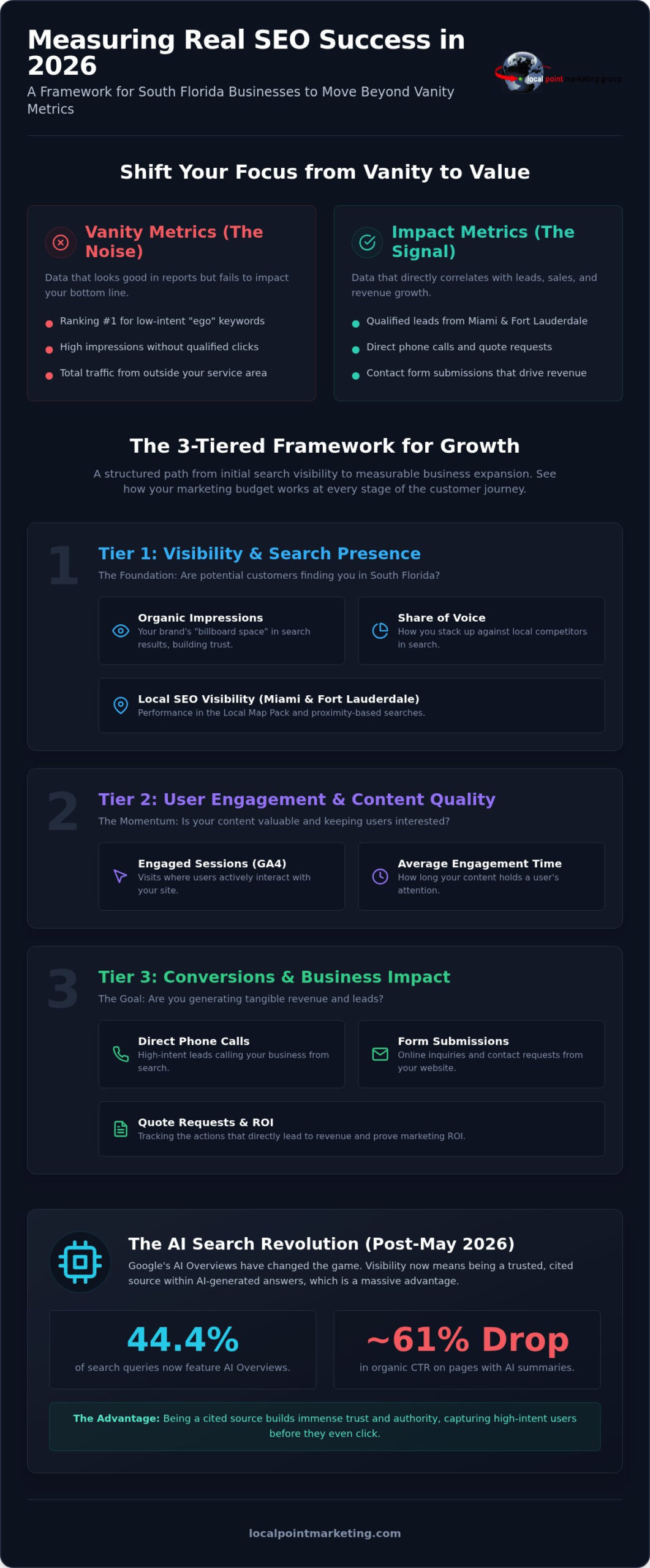
Vanity metrics are data points that make you feel good but don’t provide actionable insights. Ranking #1 for a low-intent keyword is a prime example. While it looks impressive in a report, it’s essentially an “ego ranking” if it doesn’t lead to a transaction. High impressions without clicks often signal a disconnect in your content strategy. It usually means your titles aren’t compelling or you’re appearing for the wrong searches.
Total traffic is another metric that can be misleading. A massive spike in visitors from outside your service area won’t help a local business grow. You need qualified traffic from South Florida. Focus on the data that leads to phone calls, form fills, and quote requests. This shift in perspective is the first step in learning how to measure SEO success accurately. If your current partner is delivering reports full of these hollow numbers, it may be time to review our checklist for knowing when to switch SEO agencies.
The Tiered Framework for Measuring Growth
To truly understand how to measure SEO success, you need a hierarchy. We simplify the reporting process by using a tiered framework. This structure allows you to see the progress of your campaign at every stage of the customer journey. It moves from foundational visibility to the final conversion.
- Tier 1: Visibility. This is your foundation. We track if you’re being found in local searches and how often your brand appears in the Local Map Pack for Miami or Fort Lauderdale queries.
- Tier 2: Engagement. This measures momentum. We analyze if users are staying on your site, reading your content, and interacting with your brand.
- Tier 3: Conversion. This is the ultimate goal. We track the specific actions that drive revenue, such as direct phone calls and contact submissions.
By following this structure, you can see exactly where your budget is working. It provides a clear path from search visibility to business expansion.
Tier 1: Measuring Visibility and Search Presence
Visibility is the foundation of any successful digital strategy. If your brand isn’t appearing in front of potential customers, the rest of your marketing funnel won’t function. We start by tracking Organic Impressions. This metric reveals how often your website or local listing shows up in search results. It represents your brand’s “billboard” space in the digital world. Even if a user doesn’t click immediately, repeated exposure builds trust. We also analyze your Share of Voice to see how you stack up against local competitors in South Florida. Knowing these key metrics for measuring SEO success allows you to pivot your strategy as market conditions change. Mastering these concepts is fundamental to learning how to measure SEO success effectively.
Local SEO Visibility in South Florida
For businesses serving Miami and Fort Lauderdale, local presence is everything. Local SEO visibility is your digital storefront presence in regional search results. We focus heavily on Google Business Profile interactions, such as direct phone calls and direction requests. Proximity-based rankings are also a core focus. Your visibility for a search like “SEO agency Miami” can change significantly if the user is in Boca Raton versus Jupiter. We track these fluctuations to ensure you’re capturing the most relevant local traffic. Our team helps you maintain a steady presence across the entire region to ensure you aren’t losing ground to nearby competitors. Businesses expanding their reach northward can also benefit from working with a digital marketing agency Palm Beach specialists understand to capture the distinct search behaviors of that market.
The Rise of AI Search Optimization Metrics
The search landscape changed forever on May 6, 2026. Google’s structural update to AI Overviews introduced inline source links and hover previews. These AI summaries now appear in roughly 44.4% of queries. While organic click-through rates on these pages have dropped by as much as 61%, being a cited source offers a massive advantage. We use advanced AI search optimization tools to track these mentions. The focus has shifted from simple ranking positions to brand citations. Research indicates that citation clicks increase by 15-20% for businesses that appear in these summaries. This is the new “Position Zero” for 2026. If you want to master these new visibility markers, our Managed SEO experts can guide your strategy.
Tier 2: Evaluating User Engagement and Content Quality
Visibility gets users to the door, but engagement determines if they stay. Once you’ve established a presence in South Florida search results, the next phase of understanding how to measure SEO success involves analyzing user behavior. High traffic numbers are hollow if visitors leave your site within seconds. We look at specific interaction signals to determine if your content truly resonates with your audience. This data allows us to move beyond guesswork and make methodical improvements to your digital footprint.
A primary metric in this tier is Average Engagement Time. This tells us if our blog content creation services are delivering the specific value your customers expect. We also track Key Events, which represent mid-funnel interest. These include newsletter signups, whitepaper downloads, or video views. In 2026, top-performing GA4 properties track a median of 74 custom events per session, according to Heap Analytics. This granular level of tracking ensures every interaction is accounted for in your growth strategy.
CTR and the Importance of Search Intent
Organic Click-Through Rate (CTR) is a vital indicator of how well your brand matches searcher intent. If your site ranks highly for Miami-based queries but suffers from a low CTR, your titles and descriptions likely don’t answer the user’s immediate question. We optimize meta tags specifically to attract local clicks. Using structured data is also essential. It helps you win “rich snippets” that occupy more screen real estate and naturally boost engagement. When your search listing clearly addresses a pain point, users are far more likely to choose your business over a competitor.
Using Analytics to Refine Content Strategy
Data should always dictate your next move. We identify “high-exit” pages to find where you’re losing potential leads. If a page has a high bounce rate but significant traffic, it usually requires a better call to action or more relevant internal links. We use these engagement insights to build your 90-day content roadmap. This ensures we’re expanding on topics that already prove successful with your target audience. Linking these engagement metrics back to your broader ROI-driven digital marketing strategy is the most reliable way to ensure long-term growth. We also monitor Scroll Depth for long-form pieces. This confirms whether users are actually consuming your educational content or just skimming the surface. This methodical approach is the only way to truly master how to measure SEO success in a competitive market.
Tier 3: Tracking Conversions and Real Business Impact
The final tier of our framework addresses the most critical question: is your investment generating profit? While visibility and engagement are necessary precursors, they don’t pay the bills. Tracking conversions is the only definitive way to understand how to measure SEO success. We focus on primary actions such as direct phone calls, contact form completions, and specific quote requests. According to a 2026 Salesforce report, marketers using GA4’s event-based model now track an average of 18.7 distinct conversion types. This granular data led to a reported 26% increase in ROAS accuracy, providing the evidence needed to justify your marketing spend.
Monitoring lead quality is just as important as tracking volume. We analyze which specific keywords result in your highest-value clients. This level of detail allows us to attribute revenue directly to organic search. It provides clear justification for your monthly SEO retainer services. By calculating your Cost Per Lead (CPL), you can compare the efficiency of SEO against your paid advertising channels. This methodical approach is the most reliable way to demonstrate how to measure SEO success to your stakeholders. If your agency cannot provide this level of conversion clarity, our 2026 performance checklist for when to switch SEO agencies can help you evaluate whether it’s time for a change.
Call Tracking for Local Service Businesses
Fort Lauderdale and West Palm Beach businesses rely heavily on voice communication. Call tracking is essential for these local service providers. We don’t just count every ring. Our system distinguishes between new customer inquiries and existing client calls. This ensures your data isn’t skewed by non-revenue-generating interactions. Integrating this call data into your analytics and reporting digital marketing dashboard creates a complete picture of your search performance.
Calculating SEO ROI and Lifetime Value
Understanding the lifetime value (LTV) of an organic lead is vital for long-term planning. The formula involves multiplying the average profit per customer by the average frequency of purchase and the typical customer lifespan. Organic leads often possess higher intent and trust compared to social media or PPC leads. SEO is a compounding investment that reduces CPL over time. As your authority grows, you’ll earn more leads for the same level of effort. This growth allows you to scale your business with confidence.
Ready to see the real impact of your search strategy? Let our team manage your Analytics and Reporting to uncover your true ROI.
Setting Up Your SEO Reporting Dashboard
A robust reporting dashboard turns raw data into a strategic roadmap. Setting this up correctly is the final piece of the puzzle when learning how to measure SEO success. It moves your business from reactive guessing to proactive growth by centralizing your most important metrics. A well-organized dashboard ensures you aren’t digging through multiple platforms just to see if your marketing is working. It provides a clear, real-time view of your digital health and return on investment.
The implementation process follows five methodical steps:
- Step 1: Connect Google Analytics 4 (GA4) and Google Search Console (GSC). These platforms provide the baseline data for impressions and user behavior.
- Step 2: Implement a local rank tracker. This tool must monitor specific zip codes in South Florida to account for regional search variations.
- Step 3: Integrate a CRM or lead tracking tool. This step is vital to bridge the gap between digital “clicks” and actual “sales.”
- Step 4: Create a simplified monthly report. This document should highlight Tier 3 conversion success while monitoring the foundational health of Tiers 1 and 2.
- Step 5: Schedule a regular review with your digital marketing agency. These sessions turn data into a specific action plan for the next 90 days.
Essential Tools for Local SEO Reporting
Google Search Console remains the primary “source of truth” for organic search performance. It reveals exactly which queries bring users to your site and how Google perceives your pages. We also recommend using heatmaps to understand user behavior. These tools show how South Florida users interact with your landing pages, identifying exactly where they click or lose interest. When selecting a reporting platform, prioritize at-a-glance clarity over complexity. Busy business owners need to see their growth trends without navigating technical jargon. A January 2026 update to GA4 introduced cross-channel budget planning, which can help you see how SEO fits into your broader spend.
The Local Point Marketing Approach to Reporting
Our team provides transparent, data-driven insights focused entirely on your growth. We believe a managed retainer should include continuous performance monitoring rather than just a monthly check-in. This proactive approach ensures your strategy stays ahead of major algorithm shifts. We don’t just send reports; we provide a partnership built on evidence and methodical trustworthiness. This is the most effective way to master how to measure SEO success in a competitive market like Miami or Fort Lauderdale.
Ready for results you can actually measure? Contact Local Point Marketing today.
Elevating Your Business with Data-Driven SEO
Modern search marketing isn’t a guessing game. By implementing a tiered framework, you can move away from surface-level stats and focus on the metrics that actually impact your bottom line. You now have the tools to distinguish between simple impressions and the high-intent conversions that drive revenue. Understanding how to measure SEO success is the fundamental difference between a wasted marketing budget and a compounding business asset. This methodical approach provides the clarity needed to scale your operations with total confidence.
Local Point Marketing brings 10+ years of data-driven experience to every partnership. We specialize in South Florida lead generation and provide custom analytics dashboards for every client. Our team ensures your strategy remains transparent and focused on measurable growth. It’s time to stop wondering if your SEO is working and start seeing the results in your revenue reports. We’re here to help you navigate the evolving search landscape and secure your brand’s future.
Get a Transparent SEO Strategy for Your Business and take the first step toward a more successful future.
Frequently Asked Questions
How long does it take to see measurable SEO results in 2026?
Measurable SEO results typically appear within four to six months. However, the structural changes implemented on May 6, 2026, to Google’s AI Overviews mean some businesses see visibility shifts in just weeks. Long-term authority takes time to build in competitive South Florida markets. We focus on early indicators like impression growth and local map pack movements to ensure your strategy is moving in the right direction before final conversions peak.
Is organic traffic more valuable than paid traffic for local businesses?
Organic traffic often provides higher lifetime value because it stems from established trust. While paid traffic offers immediate visibility, it stops the moment your budget ends. Organic search is a compounding investment that reduces your cost per lead over time. For local businesses in Miami or Fort Lauderdale, a dominant organic presence in the Local Map Pack creates a level of credibility that paid advertisements simply cannot replicate.
What is a good conversion rate for a local service-based website?
A healthy conversion rate for a local service-based website typically ranges between 3% and 7%. This varies based on your specific industry and the urgency of the service. For example, emergency services often see higher rates than luxury home remodeling. We focus on optimizing your site’s user experience to ensure you’re capturing every possible lead from your South Florida audience. Tracking these figures is essential when learning how to measure SEO success.
Can I track SEO success without using expensive software tools?
You don’t need expensive software to start tracking your progress. Google Analytics 4 (GA4) and Google Search Console (GSC) are free, industry-standard tools that provide the most accurate data directly from the source. These platforms allow you to monitor impressions, clicks, and custom events without additional overhead. While third-party tools offer niche insights, your primary “source of truth” for search performance is already available at no cost to your business.
How often should I receive an SEO performance report from my agency?
You should receive a comprehensive SEO performance report every month. This frequency allows enough time for data trends to emerge while keeping your strategy agile. In addition to monthly deep dives, your agency should provide a real-time dashboard for “at-a-glance” health checks. Regular reviews ensure you’re turning raw data into actionable steps for the next quarter, keeping your South Florida business ahead of local competitors and algorithm shifts.
What happens if my keyword rankings go up but my leads stay the same?
If your rankings are climbing but leads remain stagnant, you likely have a disconnect in search intent. You might be ranking for “informational” keywords rather than “transactional” ones that drive phone calls. It could also signal friction on your landing pages, such as a broken contact form or a slow mobile load time. We analyze your user engagement data to find exactly where potential customers are dropping off in your sales funnel.
Does social media engagement affect my SEO success metrics?
Social media doesn’t directly influence your organic ranking positions, but it plays a vital role in brand visibility. High engagement levels can drive direct traffic and increase brand-name searches, which are positive signals to search engines. When users see your brand across multiple platforms, they’re more likely to click your listing in search results. This indirect benefit makes social media a valuable component of a holistic digital marketing and lead generation strategy.
How do I measure my visibility in AI search engine results?
Measuring visibility in AI search results requires tracking brand citations and mentions in generative summaries. As of 2026, AI Overviews appear in roughly 44.4% of queries. You can monitor this by checking Google Search Console for impressions on pages that are frequently cited in AI answers. We also track citation clicks, which have been observed to increase by 15% to 20% for businesses appearing in these expert advice blocks on the search results page.