
5 Social Media Management Pricing Myths Debunked for South Florida SMBs

The cheapest quote you receive for digital growth is often the most expensive mistake your business can make. When you analyze social media management pricing in the current Florida market, it’s easy to feel overwhelmed by wildly different figures that claim to offer the same results. You’ve likely felt the frustration of paying for “fluff” content that looks nice but fails to generate a single lead. It’s natural to worry about overpaying for vanity metrics while your competitors seem to have found a secret formula for success.

We believe you deserve a steady, capable partner who values evidence over hype and focuses on your specific business outcomes. This guide will help you discover the truth behind service costs and teach you how to budget for measurable growth in the 2026 South Florida market. We’ll examine the specific drivers of local ROI, debunk five common pricing myths, and provide a clear framework for evaluating agency proposals with confidence. By the end, you’ll know exactly how to align your social media investment with your long-term business goals.

Key Takeaways

  • Understand why low-cost automation can undermine your brand and why modern algorithms prioritize meaningful community engagement over high post volume.
  • Calculate the true cost of in-house management by accounting for the significant time investment and the expense of professional-grade software.
  • Learn how the competitive South Florida market landscape influences social media management pricing and why local expertise is vital for sustainable growth.
  • Shift your focus from vanity metrics like likes and follows to measurable business outcomes that drive actual inquiries and sales for your business.

Myth 1: The $200 Monthly Retainer is a ‘Great Deal’

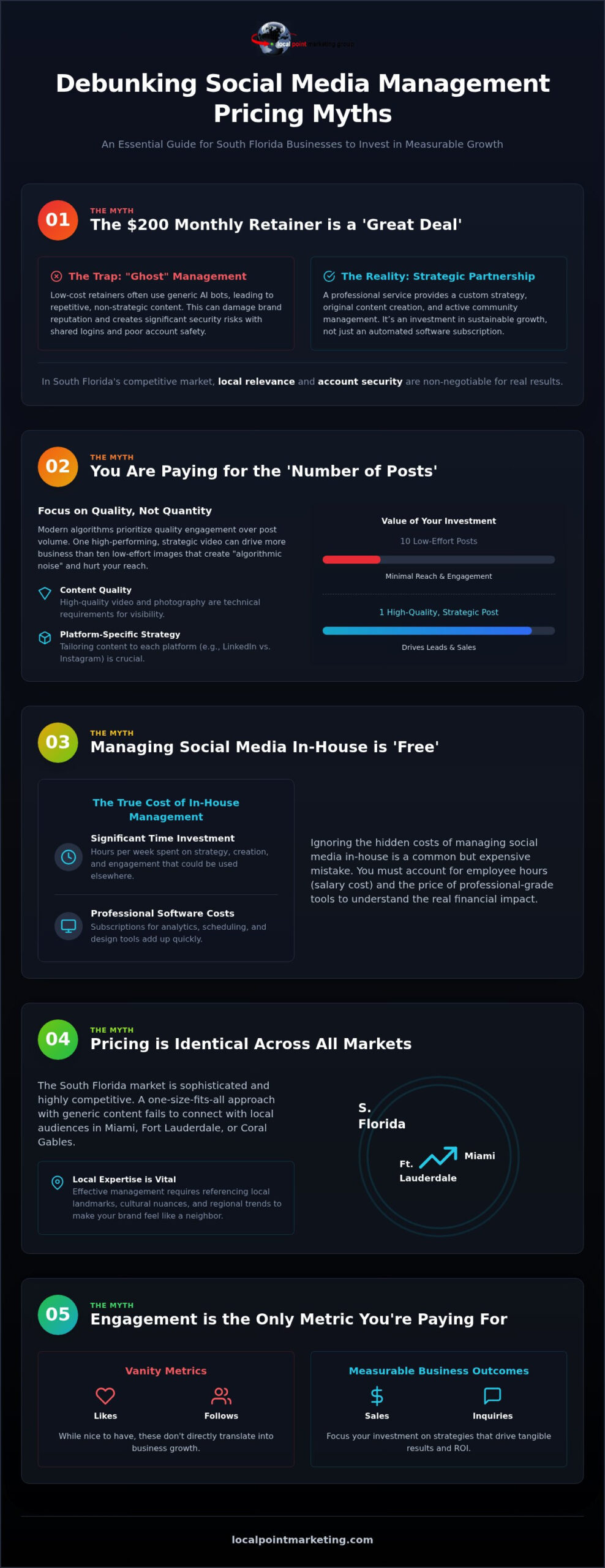
Accepting a quote for $200 a month might feel like a win for your budget, but it’s often the start of a “ghost” management cycle. These low-cost services typically rely on generic, automated AI bots that churn out repetitive content without any human oversight or strategic direction. This approach ignores the fundamental components of professional social media management pricing. A legitimate partnership includes custom strategy, original content creation, and active community management to ensure your brand remains relevant. When you evaluate social media marketing options, it’s vital to understand that true growth requires more than just a software subscription.

Cheap services can actually damage your brand reputation in a competitive market like Miami. If your profiles look like automated billboards, local customers will quickly lose interest. This leads to the hidden cost of low engagement. Saving money on your social media management pricing in the short term often results in invisible profiles. Platforms prioritize content that sparks conversation; if your posts are ignored, the algorithm stops showing them to potential customers entirely.

The Danger of Generic, Non-Local Content

South Florida audiences are sophisticated and expect content that reflects their unique community. “Cookie-cutter” posts that could apply to any city fail to resonate with people in Fort Lauderdale or Coral Gables. Effective management requires referencing local landmarks, cultural nuances, and regional trends that make your brand feel like a neighbor rather than a distant corporation. When your content feels irrelevant, it triggers platform algorithms to hide your posts. This creates a downward spiral where your “affordable” service provides zero visibility to the people who matter most.

Security and Account Safety Risks

Outsourcing your digital presence to unvetted, low-cost individuals creates significant security vulnerabilities. Common pitfalls include shared logins and a total lack of two-factor authentication, which leaves your business pages open to hackers and malicious actors. Recovering a compromised account is a costly, stressful process that can permanently harm your credibility. Professional account security in 2026 serves as a foundational shield that protects your digital assets and maintains the trust you’ve built with your audience.

Myth 2: You Are Paying Primarily for the ‘Number of Posts’

Many business owners assume that social media management pricing is a simple calculation of post count. In the 2026 digital environment, this logic no longer applies. Algorithms on every major platform now prioritize quality over quantity to combat digital noise. They reward content that generates genuine interaction, not just consistent activity. Shifting your focus from broadcasting to community building changes the value of your investment. One high-performing, professionally produced Reel can drive more engagement and leads than ten low-effort static images. Developing an effective social media strategy requires deep competitive analysis and a clear understanding of your audience’s behavior.

Strategic depth is the true driver of cost in a professional retainer. You aren’t just paying for the final upload; you are paying for the research that informs it. A professional agency performs several critical tasks behind the scenes to ensure your brand stands out:

  • Monitoring competitor movements in the South Florida market.
  • Identifying trending topics before they peak.
  • Analyzing platform data to refine your monthly approach.
  • Ensuring every post serves a specific purpose in your sales funnel.

This methodical process justifies the investment in social media management pricing by turning passive followers into active customers.

Content Quality vs. Algorithmic Noise

High-quality video and photography are no longer optional. They are technical requirements for visibility. Platforms like Instagram and TikTok use sophisticated AI to evaluate the aesthetic value and relevance of your media. If you post just to fill a calendar, you are actually hurting your reach. The algorithm flags low-engagement content as uninteresting, which reduces the visibility of your future posts. We use AI-assisted tools to enhance our creative output. These tools help us maintain high production standards while focusing on the human touch that builds trust with your audience.

The Real Value of Platform-Specific Strategy

Cross-posting the exact same content to Facebook, LinkedIn, and Instagram is a missed opportunity. Each platform attracts a different demographic with unique expectations. LinkedIn users look for professional insights, while Instagram users crave visual inspiration. Pricing reflects the expertise required to navigate these differences effectively. Local Point Marketing tailors content specifically for South Florida industries, from luxury real estate to local hospitality. This methodical approach ensures your message resonates with the right people in the right place. If you are ready to move beyond basic posting, you can explore our data-driven social media management services to see how strategy elevates your brand.

Myth 3: Managing Social Media In-House is ‘Free’

Believing that in-house management costs nothing is a common misconception that can quietly stall your business growth. While you aren’t writing a check to an outside vendor, the actual impact on your bottom line is often higher than you expect. When you evaluate the true social media management pricing for your business, you must account for the time and resources diverted from your core operations. A professional agency provides a complete team of strategists, designers, and analysts for roughly the same cost as a single junior-level employee. This collaborative approach ensures your brand benefits from diverse expertise without the overhead of multiple full-time salaries.

The “Knowledge Gap” is another hidden expense of the DIY model. The digital landscape in 2026 moves at a relentless pace. Staying updated on shifting algorithms and new local compliance rules requires constant research and training. As highlighted in the SBA’s social media guide, small businesses succeed when they maintain a consistent and strategic presence. Attempting to manage this in-house often leads to a reactive strategy where you’re constantly playing catch-up rather than leading your market.

Calculating the Opportunity Cost of Your Time

You can determine your personal “SMM hourly rate” by multiplying the value of your time by the hours you spend on social tasks each week. If you value your time at $150 per hour and spend five hours weekly on content, your “free” social media is costing you $3,000 every month. This time is better spent on high-level leadership, closing major leads, or improving your service delivery. DIY social media often results in fragmented messaging and inconsistent visual branding that can confuse potential customers and weaken your market position.

The Software and Tool Tax

Professional results require professional tools. Subscriptions for advanced analytics, premium scheduling platforms, and AI-driven design suites like Sprout Social or Canva Pro quickly add up. These tools are essential for the data-driven approach we use to ensure your content reaches the right audience. Agencies distribute these software costs across multiple clients, providing you with high-end technology at a fraction of the individual subscription price. Investing in a managed social media strategy for local business allows you to leverage these professional resources while keeping your social media management pricing predictable and efficient.
5 Social Media Management Pricing Myths Debunked for South Florida SMBs

Myth 4: Pricing is Identical Across All Markets

Market dynamics play a decisive role in determining social media management pricing. Managing a brand in a global hub like Miami requires a significantly different investment than a business in a less competitive rural area. In high-density markets, the digital noise is intense. You aren’t just competing with local shops; you are fighting for attention against international brands with massive budgets. This environment demands a “Local Authority” premium. Local knowledge is a billable asset because it allows an agency to navigate these complexities without wasting your ad spend on trial and error. We focus on providing this specialized expertise to ensure your message doesn’t get lost in the crowd.

South Florida’s unique seasonal patterns also influence your management costs. The influx of tourists and “snowbirds” creates specific windows of opportunity that require rapid strategy shifts. A local partner understands when to ramp up visibility and when to focus on retention based on regional migration patterns. This specialized insight ensures your budget is always working toward the highest possible ROI. Local competition also impacts social media advertising (PPC) management fees. In crowded markets, bidding for attention is more expensive, requiring a more skilled professional to manage your campaigns effectively and maintain a low cost-per-acquisition.

Miami to Vero Beach: A Competitive Spectrum

The competitive spectrum from Miami to Vero Beach is vast. A business in Fort Lauderdale faces a much higher noise level than one in Stuart. Higher competition requires more sophisticated ad strategies and more frequent content adjustments to maintain reach. Finding a local SEO partner who understands Florida’s specific geography is essential for success. This geographic awareness allows for better targeting and more relevant content that speaks directly to the local community’s interests and needs.

Vetting an Agency’s Local Knowledge

Vetting an agency’s local knowledge is a critical step in your selection process. Ask potential partners if they can attend local events or capture original footage of your storefront. An agency working from a remote bunker cannot replicate the authenticity of a local team. Local Point Marketing focuses on the specific needs of Palm Beach and Jupiter businesses to provide this boots-on-the-ground advantage. We believe that being part of the community we serve makes our strategies more effective and our results more measurable. If you want a partner who truly understands the Florida landscape, you can explore our local social media services to see how we drive regional growth.

Myth 5: Engagement is the Only Metric You Are Paying For

Falling into the “Vanity Metric” trap is a common pitfall for business owners who focus solely on likes and follows. While 1,000 likes might look impressive on a screen, they are meaningless if they result in zero sales. Professional social media management pricing reflects a shift toward conversion-centric management that prioritizes clicks, inquiries, and genuine lead generation. You aren’t just paying for someone to post content; you are investing in a strategy that guides potential customers through a deliberate sales funnel. High-level reporting and data analysis justify a higher fee by demonstrating how social activity contributes to your bottom line.

Social media also plays a critical role in the modern search journey. In 2026, platforms function as secondary search engines where AI-driven tools evaluate your brand’s authority based on social signals. This means your social presence directly impacts your overall visibility across the web. For growing businesses trying to determine where to focus their marketing budget, understanding the nuances of SEO vs social media for startups can clarify which channel will deliver the strongest compounding returns. A data-driven approach ensures your content is optimized for both human engagement and AI discovery. By focusing on these deeper metrics, we help you build a digital footprint that attracts high-value prospects rather than passive observers. This methodical focus on measurable outcomes ensures your social media management pricing is an investment in your company’s future value.

Shifting Focus to Lead Generation

The difference between a standard social media manager and a growth partner lies in their ultimate objective. A growth partner focuses on the entire customer journey, tracking the path from an initial social post to a final phone call or inquiry. This level of detail requires sophisticated tracking pixels and CRM integration to attribute success accurately. ROI in 2026 social media marketing is defined as the measurable increase in high-quality inquiries and closed sales directly attributable to strategic digital touchpoints. This methodical focus ensures your marketing spend is an investment in future revenue rather than a sunk cost.

How Local Point Marketing Aligns Pricing with Growth

We believe in transparent, results-oriented pricing that aligns with your specific growth goals. Our methodical approach ensures that analytics and deep-dive reporting are bundled into every retainer, providing you with clear evidence of your progress. We don’t just report on engagement; we analyze the data to refine your strategy and improve your conversion rates over time. This commitment to client-centricity makes us a dependable collaborator for businesses looking to scale. If you are ready to stop guessing about your digital impact, get a custom quote for your South Florida business today and see how we can elevate your brand.

Building a Sustainable Digital Future in South Florida

Success in the South Florida market requires moving beyond outdated myths and embracing a strategy rooted in data and local authority. You’ve seen how quality content outperforms sheer volume and why the “free” in-house model often hides significant opportunity costs. Understanding the nuances of social media management pricing allows you to make informed decisions that protect your brand and drive actual growth. Investing in professional management is about more than just maintaining a profile; it is about building a reliable engine for lead generation and community trust. A strong foundation begins with social media content planning that moves your brand away from reactive posting and toward a system designed to generate consistent local growth.

Local Point Marketing brings 10+ years of South Florida expertise to every partnership. Our measurable ROI-focused strategies and dedicated local account managers ensure your business remains a leader in your industry. We prioritize your long-term success by aligning our efforts with your specific growth objectives. You don’t have to navigate the complexities of digital growth alone. Elevate your brand with data-driven social media management and start seeing the impact of a methodical, expert approach. Your business’s most successful chapter is waiting to be written.

Frequently Asked Questions

How much should a small business in South Florida spend on social media management?

Investment levels depend on your growth goals and the intensity of competition in your specific city. A local shop in Jupiter has different needs than a high-volume real estate firm in Miami. Most successful SMBs allocate a specific portion of their marketing budget to ensure consistent visibility. This investment covers the essential strategy, content creation, and community management required to stay ahead of regional competitors.

What is included in a typical monthly social media management retainer?

A standard retainer provides a comprehensive suite of services including content calendar development, original graphic design, and active community engagement. It also features technical tasks like hashtag research, caption writing, and platform-specific optimization. Most professional packages include monthly performance reporting to track your progress toward specific business outcomes and lead generation targets. You aren’t just buying posts; you’re buying a managed growth process.

Can I just pay for social media advertising without a management fee?

You can run ads independently, but most agencies charge a separate management fee to oversee paid campaigns. This fee covers the technical expertise required for audience targeting, A/B testing, and ongoing budget optimization. Managing ads without professional oversight often leads to wasted spend. Campaigns lack the strategic refinement needed to convert passive viewers into actual customers without a dedicated manager watching the data.

Is there a difference in pricing between B2B and B2C social media management?

Pricing structures often vary because the content requirements and platform focuses differ between these two models. B2B strategies frequently prioritize LinkedIn and professional thought leadership, which requires technical copywriting and industry research. B2C campaigns often lean heavily on high-volume visual content and rapid community response times. These differences in labor and creative production influence the final cost of your monthly service agreement.

How long does it take to see an ROI from social media management services?

Most businesses begin to see measurable shifts in engagement and brand sentiment within the first 90 days of a new strategy. Sustainable lead generation and sales conversion typically require four to six months of consistent activity. This timeframe allows the algorithm to learn your audience’s preferences. It also gives your brand enough time to build a trustworthy presence in the competitive South Florida market.

What happens if I want to cancel my social media management contract?

Cancellation policies depend on the specific terms of your service agreement, which usually requires a 30 to 60-day notice period. This window allows the agency to wrap up current projects and transition account access back to your team smoothly. We recommend choosing a partner that offers clear, transparent exit terms. This ensures your digital assets remain protected and your online presence stays stable throughout the transition.

Are there additional costs for content creation like professional video or photography?

Many agencies include basic content creation in their standard social media management pricing, but specialized production often incurs extra fees. High-end video shoots, professional drone footage, or on-site photography sessions require additional equipment and labor. It is important to clarify whether your monthly retainer covers these high-production elements. Knowing these details upfront helps you budget accurately for premium visual assets that make your brand stand out.

Why does pricing vary so much between freelancers and agencies in Miami?

The gap in social media management pricing usually reflects the depth of resources and the level of accountability provided. A solo freelancer offers a personal touch but has limited bandwidth for complex data analysis or multi-platform scaling. Agencies provide a full team of specialists, including designers and strategists. This structure ensures your brand remains active and secure even if one person is unavailable, providing a more reliable long-term partnership.

AI Visibility Marketing: SEO vs. AEO for South Florida Businesses in 2026

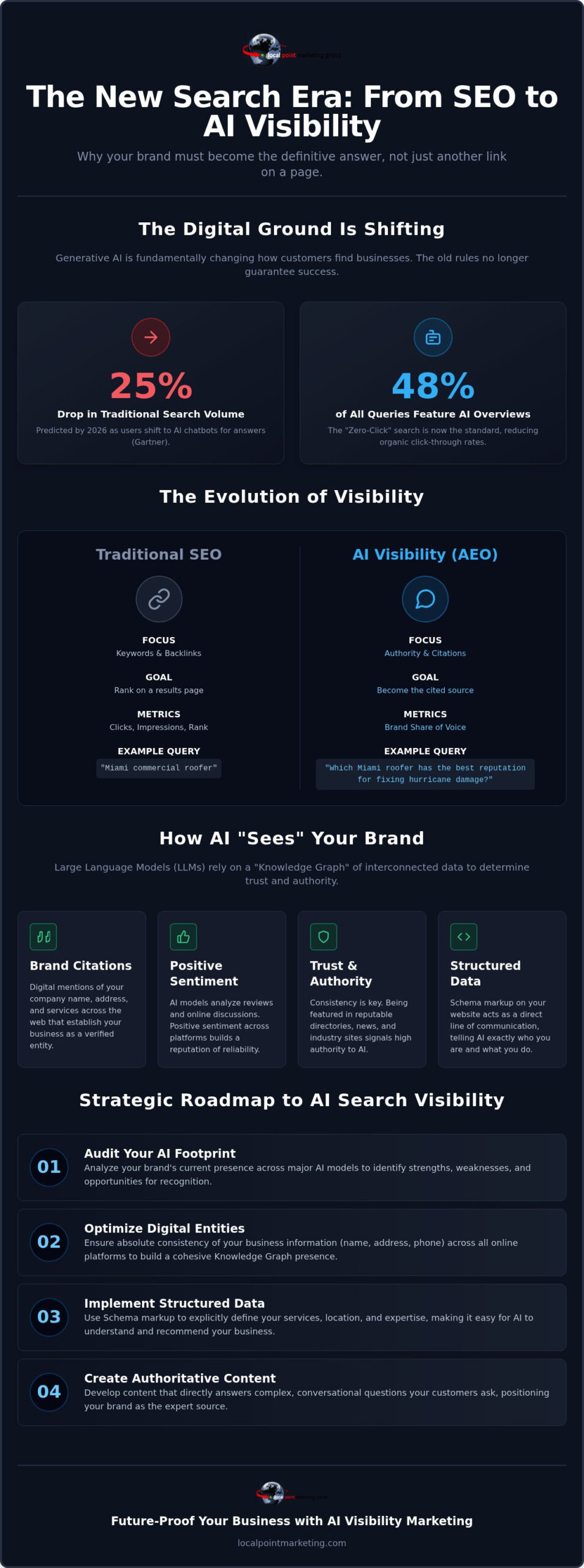
Gartner predicts that traditional search engine volume will drop by 25% in 2026 as users shift toward AI chatbots and virtual agents. For South Florida business owners, this change often feels like the ground is shifting beneath your feet. You’ve likely noticed that even when you rank well, organic click-through rates are declining because Google’s AI Overviews now appear on 48% of all search queries. Success in this new era requires a strategic pivot toward AI visibility marketing. It’s no longer enough to be a link on a page. Your brand must become the synthesized answer that AI models trust and recommend.

We understand the frustration of seeing your hard-earned search rankings yield fewer visitors than they used to. It’s confusing to watch AI generate answers without knowing how to influence those results. This guide provides a clear framework to help you transition from traditional SEO to Answer Engine Optimization. You’ll discover how to secure your brand’s place in AI-driven results and understand the measurable ROI of these technical shifts. We provide actionable steps to improve your brand citations so your business remains the primary choice for customers from Miami to Vero Beach.

Key Takeaways

  • Move beyond traditional search rankings. You’ll learn to become the primary answer in AI-driven search results.
  • Discover how AI visibility marketing shifts your focus from link clicks to winning brand share of voice in generative responses.
  • Learn how Large Language Models interpret your brand sentiment and digital citations to establish authority and trust.
  • Audit your business’s current footprint across major AI models. You’ll then learn to optimize your digital entities for better recognition.
  • Implement a data-driven strategy that combines managed SEO with new AI integration tactics for measurable local growth.

Beyond the Search Bar: The Shift to AI Visibility Marketing

The digital landscape is moving beyond the era of simple link lists. For over two decades, Search engine optimization (SEO) served as the primary blueprint for online success. However, the rise of generative search has introduced a new priority: AI visibility marketing. This strategy shifts the focus from winning a spot on a results page to becoming the literal answer provided by an AI agent. By 2026, Gartner predicts search engine volume will drop by 25% as users embrace AI chatbots. For businesses in South Florida, this means the “Zero-Click” reality is no longer a future threat; it is the current standard for customer discovery.

This transition from SEO to Answer Engine Optimization (AEO) changes how we measure success. In the past, we tracked clicks and impressions. Today, the most valuable metric is being the “cited source” within a Gemini or ChatGPT response. When an AI model synthesizes information to answer a user, it selects the most authoritative and trustworthy brands. If your business isn’t part of that synthesis, you don’t just lose a ranking; you lose the entire customer journey before it even begins. This shift impacts every stage of the funnel, from the moment a user asks a question to the final conversion.

The Evolution from Keywords to Conversations

Natural language processing (NLP) has fundamentally changed how people interact with the web. A traditional search query often looks like “Miami commercial roofer.” In contrast, a conversational prompt is more specific and nuanced, such as “Which Miami roofer has the best reputation for fixing hurricane damage on warehouse roofs?” AI models don’t just look for keyword matches. They look for context, authority, and trust. Your business needs to “talk” back to these algorithms by providing structured, authoritative data that AI can easily synthesize into a helpful response. We focus on creating content that answers these complex prompts directly, ensuring your brand remains the primary solution in the conversation.

Why Local Businesses in Miami and Fort Lauderdale Must Adapt

High-competition markets like Miami and Fort Lauderdale are the first to feel the impact of these shifts. AI tools now handle local service recommendations by pulling from a vast Knowledge Graph of citations and reviews. If your business relies on 2010-era SEO tactics like keyword stuffing or low-quality backlinks, you risk becoming invisible. AI agents prioritize brands that demonstrate consistent reliability across multiple digital platforms. Adapting to this change ensures you remain the primary recommendation when a local customer asks their phone for a nearby expert. We help you bridge this gap by aligning your digital presence with the way modern AI models evaluate local authority.

How AI Models “See” Your Brand: Citations, Sentiment, and Trust

AI models interpret your business differently than traditional search engines. While Google once relied heavily on simple link counts, Large Language Models (LLMs) now focus on the “Knowledge Graph.” This is a complex map where AI connects your brand to specific problems, locations, and solutions. To succeed in AI visibility marketing, your business must be recognized as a distinct entity with verified attributes. This recognition comes from structured data, or Schema markup, which acts as a direct line of communication between your website and the AI’s understanding of your services.

Citations have replaced traditional backlinks as the primary indicator of trust. When an AI model generates an answer, it cross-references multiple digital touchpoints to ensure accuracy. If your Miami law firm is mentioned favorably across legal directories, social media, and local news outlets, the AI views you as a reliable source. These multi-channel references build the authority necessary to be featured in generative responses. You can gain more expert insights on AI visibility to understand how these technical connections influence your brand’s reach.

The New Backlink: Earned Media and Third-Party Citations

Verification is the core of AI trust. AI models prioritize reviews on local South Florida platforms because they provide geographically relevant social proof. For instance, a consistent presence on the Greater Miami Chamber of Commerce website or a local niche directory carries significant weight. Brand Citations are the digital mentions of your company name, address, or services across the web that establish your business as a verified entity in the eyes of an LLM. Unlike traditional SEO, where any link might help, AI visibility requires high-quality, relevant mentions that confirm your expertise. Our team specializes in AI Integration and Visibility to help you secure these critical digital footprints.

Sentiment Analysis and Brand Reputation

Brand sentiment is now a technical requirement for ranking. AI models use sentiment analysis to interpret customer feedback and determine which providers are truly the “best” in a category. If your digital footprint contains unresolved complaints or negative press, AI agents will likely omit your business from their recommendations. This process goes beyond simple star ratings; the models analyze the language used in reviews to gauge your reliability. Maintaining a reputable status in LLM training sets requires a proactive approach to digital PR. We help you build a positive narrative that ensures AI models see your brand as a safe and helpful recommendation for local users.

Comparison: Traditional SEO vs. AI Visibility Marketing

The fundamental difference between these two approaches lies in the end goal for the user. Traditional SEO aims to place your website within a list of options on a results page. In contrast, AI visibility marketing strives to make your business the primary recommendation within a single, synthesized response. This shift changes everything from how we measure success to how we build content for your brand. While search engines once prioritized the best-optimized page, AI models prioritize the most authoritative and trustworthy answer.

Metrics have evolved from tracking “Position 1” to measuring “Brand Share of Voice” in AI responses. While a top ranking on Google is still valuable, it doesn’t guarantee you’ll be the source an AI model chooses to cite. Success now depends on how often an LLM selects your brand as the definitive answer for a user’s prompt. This requires a transition from targeting high-volume keywords to providing high-authority answers that satisfy complex intent. You aren’t just building a page for humans to read; you’re building a data source for machines to ingest.

Technically, the focus has expanded to include deeper data integration. Traditional SEO emphasizes meta tags, site speed, and mobile responsiveness. While these remain essential, AI-first strategies prioritize API connectivity and structured data. These tools help machines understand the relationships between your services and the problems they solve. This technical evolution ensures that your business doesn’t just appear in a list of links but becomes part of a helpful, synthesized answer that guides the user toward a conversion.

AEO: The Next Frontier of Search

Answer Engine Optimization (AEO) is the tactical process of preparing your content for generative search environments. It doesn’t replace your current marketing. Instead, AEO complements your existing local SEO efforts by ensuring your business information is clear and authoritative enough for AI to use. Long-term, this strategy reduces your cost of acquisition. You’ll spend less on fighting for individual clicks and more on being the trusted solution that AI agents naturally recommend to their users.

When to Use Traditional SEO vs. AI-First Tactics

A successful marketing program uses both approaches to capture the widest possible audience. Traditional search remains vital for transactional “near me” queries where users want to browse a map or a list of nearby providers. For example, someone looking for an “Italian restaurant near me” will likely use a standard search bar. However, AI visibility is superior for top-of-funnel brand awareness and complex decision-making. If a user asks for “the most family-friendly Italian restaurant in Coral Gables with outdoor seating,” you want to be the AI’s first choice. Creating a hybrid strategy ensures you win in both Gemini and traditional Google Search results.

AI Visibility Marketing: SEO vs. AEO for South Florida Businesses in 2026

Strategic Roadmap to Generative AI Search Visibility

Transitioning to a modern search strategy requires a methodical approach. While traditional rankings still offer value, your long-term success depends on how effectively you manage your brand’s presence within Large Language Models (LLMs). This process, known as AI visibility marketing, involves moving beyond simple keyword targets to focus on entity verification and authoritative citations. By following a structured roadmap, you can ensure your South Florida business remains the primary answer for local customers.

  • Audit your AI footprint: Start by querying major models like ChatGPT, Gemini, and Perplexity about your business. Identify inaccuracies or gaps in what the AI “knows” about your services.
  • Optimize digital entities: Ensure your Google Business Profile, social media accounts, and industry directories are perfectly aligned. Consistency across these platforms helps AI models verify your business as a trustworthy entity.
  • Create answer-first content: Develop blog posts and landing pages that directly address specific customer pain points. Use clear, declarative language that AI agents can easily extract and summarize.
  • Leverage local authority: Focus on securing mentions from reputable South Florida sources. Local relevance acts as a trust signal for AI models by providing geographically specific verification of your business’s presence and impact.
  • Monitor brand sentiment: Regularly check how AI models describe your brand. Shifts in sentiment can impact whether an AI tool recommends you or a competitor.

Building Local Authority in South Florida

AI models prioritize information that is verified by multiple reputable sources. For businesses in Miami, Fort Lauderdale, and Palm Beach, this means earned media is more important than ever. Getting mentioned by local influencers or featured in regional news outlets triggers the citations AI models need to establish your authority. Listings in city-specific directories also provide the necessary data points for AI to connect your brand to local service prompts. We help you build these connections through targeted AI Integration and Visibility strategies that solidify your local standing.

Content Architecture for AI Consumption

Structuring your website for AI extraction requires a focus on Expertise, Authoritativeness, and Trustworthiness (E-A-T). Use clear headings, bulleted lists, and concise summaries to make your content easy for LLMs to ingest. This technical order signals to the AI that your site is a reliable source of information. You can see our Generative AI Search Visibility Trend Report for specific content formats that perform best in generative search. By refining your content architecture, you ensure that your AI visibility marketing efforts lead to measurable growth and higher brand share of voice.

Future-Proofing Your Business with Local Point Marketing

The shift toward generative search requires more than just a one-time adjustment. It demands a steady, expert hand to guide your brand through continuous technical changes. We specialize in AI Integration and Visibility services that bridge the gap for local businesses in South Florida. Our team ensures that your brand doesn’t just exist online but thrives as a trusted authority within the AI ecosystems that customers use every day. Moving from digital invisibility to recognized authority allows you to secure a competitive advantage that lasts from Miami to Vero Beach.

We understand that the transition to AI visibility marketing can feel overwhelming for many business owners. That’s why our approach is built on methodical, data-driven strategies that prioritize stability. We don’t rely on hype or temporary trends. Instead, we use our 10 years of digital marketing experience to implement systems that deliver measurable results. A managed retainer with Local Point Marketing provides the ongoing oversight needed to maintain your presence as AI models like Gemini and ChatGPT update their training sets. This consistent management ensures your brand remains a primary answer even as algorithms evolve.

Our Proven Methodology for AI Visibility

Our process combines the foundational strength of technical SEO with advanced AEO tactics to enhance your overall AI visibility marketing results. We ensure your website is structurally sound while optimizing your content for direct extraction by AI agents. This dual approach maximizes your reach across both traditional and generative search platforms. We track and report on AI mentions and brand sentiment to provide a clear picture of your digital reputation. This holistic view allows us to adjust your strategy in real-time based on how machines interpret your brand. You should also understand how AI search impacts PPC campaigns to ensure your paid and organic efforts work in perfect synergy.

Partnering for Long-Term Success

The tech landscape moves quickly, but your business doesn’t have to struggle to keep up. We position ourselves as your reliable expert partner, handling the complexities of AI integration so you can focus on running your company. Our team works alongside you to achieve shared goals, providing the reassurance that your marketing is in capable hands. We value integrity and measurable success over flashy promises. We invite you to take the first step toward securing your future in the generative search era. You can Schedule your AI Visibility Audit with Local Point Marketing today to discover where your brand stands and how we can elevate your presence across the South Florida market.

Mastering Your Digital Presence in the AI Era

The transition from traditional search to generative answers is a significant milestone for South Florida businesses. Success in 2026 requires more than just ranking on a page; it requires becoming the trusted source that AI models synthesize for their users. By focusing on entity verification and brand sentiment, you position your company to capture the growing market of conversational search. Implementing a structured roadmap for AI visibility marketing ensures your brand stays relevant and authoritative as the digital landscape continues to evolve.

Local Point Marketing is ready to help you navigate these technical shifts with confidence. With over 10 years of local marketing expertise, we provide a specialized AI search optimization framework designed for the competitive landscape of Miami, Fort Lauderdale, and the Palm Beaches. We invite you to request a custom AI Visibility Strategy for your South Florida business today. Our team looks forward to working alongside you to elevate your brand and achieve measurable growth in this new era. Your business has a bright future, and the right strategic pivots today will ensure you reach your long-term goals.

Frequently Asked Questions

What is AI visibility marketing and why does it matter in 2026?

AI visibility marketing is the process of ensuring your brand is recognized and recommended by Large Language Models. It’s essential in 2026 because search behavior is shifting from clicking links to receiving direct answers. As traditional search volume declines, your business must be the synthesized answer that AI tools provide. This strategy ensures you don’t lose the audience that has moved away from traditional search results.

How is AI visibility different from traditional SEO?

Traditional SEO focuses on ranking a specific web page for a keyword. AI visibility focuses on your entire brand’s authority as an “entity” across the web. While SEO aims for clicks to your website, AI optimization seeks to make your brand the primary source for a generated answer. It prioritizes verified citations and digital sentiment over simple backlink counts or keyword frequency.

Can a small business in Miami realistically compete for AI search results?

Small businesses in Miami can absolutely compete by focusing on local relevance. AI models prioritize geographically verified data when answering specific local prompts. By maintaining accurate listings in South Florida directories and earning mentions from local organizations, you provide the trust signals AI needs. A boutique brand often has a stronger local footprint than a national competitor that lacks specific Miami based authority.

Does my business need to use AI tools to have AI visibility?

You don’t have to use AI tools internally to achieve AI visibility. This strategy is about how external Large Language Models perceive your brand based on the information available online. While using AI for content creation can improve your efficiency, the most important factor is the quality and structure of your data. AI agents need to find clear, authoritative information about your services to recommend you.

How long does it take to see results from AI search optimization?

Most businesses see measurable shifts within three to six months as AI models update their data sets. Unlike traditional SEO, which shows incremental ranking changes, AI visibility often feels like a milestone. Once a model verifies your brand as an authority, you’ll appear more frequently in synthesized answers. Consistent optimization helps speed up this process by providing the clear signals these models require for verification.

Will AI search visibility replace Google Maps for local businesses?

AI search won’t replace Google Maps, but it will change how customers find local businesses. Google’s AI Overviews already synthesize map data into conversational recommendations. Your business still needs a strong local profile, but you must also ensure AI models understand your specific expertise. Being visible means your business is highlighted as the best option within the AI’s conversational response, not just a pin on a map.

What are the best ways to track if AI is recommending my brand?

The best way to track success is by monitoring your brand’s share of voice within major AI models. You can perform manual audits or use specialized tools to see how often your business is cited. Tracking these mentions is a core part of AI visibility marketing. We provide detailed reporting that shows exactly how AI agents are recommending your brand compared to your local South Florida competitors.

How does social media impact my brand’s visibility in AI search?

Social media serves as a vital source of real-time citations and sentiment data for AI models. LLMs crawl social platforms to verify that your business is active and respected by the community. Positive engagement and customer feedback on these platforms build the reputation that AI agents look for when selecting which brands to trust. Active social profiles help confirm your business is a reliable and current authority.

Get More Google Leads: South Florida Business Guide

High search rankings in the competitive South Florida market mean very little if your phone stays silent. You’ve likely invested significant resources into digital marketing only to find that visibility doesn’t always equal growth. It’s a common challenge for businesses from Miami to Vero Beach, especially as shifting algorithms and AI Overviews in 2026 make the search landscape feel more complex than ever before.

You deserve a marketing strategy that focuses on measurable outcomes rather than just impressions. We’ve developed a framework that clarifies exactly how to get more leads from Google by aligning your digital presence with the specific needs of local customers. This approach moves beyond basic SEO to create a steady, predictable flow of high-quality inquiries for your business.

In this guide, we’ll walk through the essential steps to dominate local search results and improve your return on investment. You’ll discover how to refine your content and leverage AI integration to turn searchers into long-term clients.

Key Takeaways

  • Understand how 2026 AI Overviews change the search journey and why providing direct answers is now essential for visibility.
  • Learn the specific requirements for a Verified Google Business Profile to ensure your South Florida location stands out.
  • Discover how to get more leads from Google by identifying high-conversion keywords that signal a ready buyer.
  • Identify the critical landing page elements that turn search traffic into measurable local inquiries and consistent business growth.
  • Explore the advantages of a managed marketing strategy that combines SEO and PPC to maintain dominance in local search results.

Understanding the Google Lead Generation Ecosystem in 2026

Google lead generation is no longer a simple matter of ranking first and waiting for a website click. It’s a multi-touchpoint journey that often begins and ends right on the search results page. Understanding how to get more leads from Google starts with recognizing that the search engine has evolved into a comprehensive lead engine. By 2026, AI Overviews have become the primary way users interact with local data. These summaries prioritize direct answers, often providing the phone number, service list, or business hours a customer needs before they ever visit your website.

This shift means your digital presence must be optimized for both organic search and AI-driven summaries. While organic search leads provide long-term authority and trust, paid lead generation via Google Ads remains a vital tool for capturing immediate demand. For Florida small businesses, the most valuable leads come from local intent. When someone searches for a service “near me” or in a specific city, they aren’t just browsing; they’re looking for a solution. Capturing this intent requires a strategy that balances visibility across every part of the Google ecosystem.

The Shift from Clicks to High-Intent Inquiries

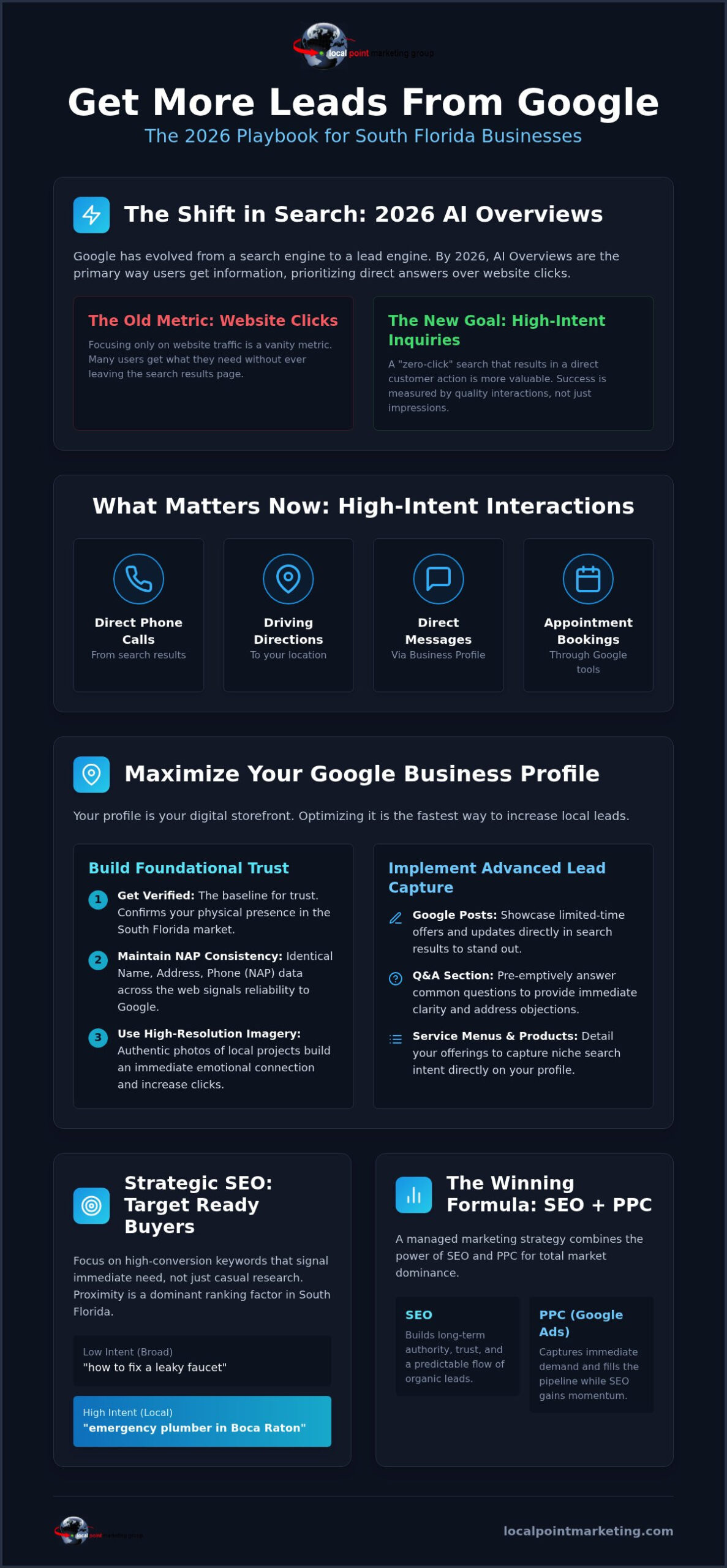
Total website traffic is becoming a vanity metric. In the current environment, a “zero-click” search, where a user finds your information in an AI Overview or a local map pack, is just as valuable as a site visit. True lead potential in 2026 is measured by high-intent interactions. These include:

  • Direct phone calls from the search results.
  • Requests for driving directions to your office.
  • Direct messages sent through your business profile.
  • Appointment bookings made via integrated Google tools.

Focusing on these metrics ensures you’re attracting qualified traffic rather than just casual searchers. It’s about being present when the buyer is ready to commit, not just when they’re starting their research.

Why Local Visibility Beats Global Traffic

For businesses in the Miami-Fort Lauderdale corridor, proximity is a dominant ranking factor. Google’s algorithms are designed to connect users with the most relevant, nearby experts. This is why a Local SEO Guide for South Florida Businesses is an essential anchor for your marketing efforts. In high-competition areas like Boca Raton and Jupiter, appearing in the top three local results is more impactful than ranking nationally for a broad term.

The geographic proximity factor means your strategy must be hyper-local. You aren’t just competing with every business in your industry; you’re competing for dominance in specific zip codes. This focused approach allows you to achieve a better ROI by targeting the exact customers who are most likely to convert into paying clients.

Maximizing Your Local Presence with Google Business Profile

Your Google Business Profile is the digital storefront for your local customers. In 2026, a “Verified” status is the baseline for building trust. This verification confirms your physical presence in the South Florida market and ensures your data is accurate across all Google services. A common hurdle for many business owners is asking “why is my business not showing on Google,” which often stems from incomplete verification or inconsistent NAP (Name, Address, Phone) data. Maintaining identical contact details across the web signals reliability to both Google and your potential clients. Understanding how to get more leads from Google often starts with fixing these foundational visibility issues.

High-resolution imagery of your local projects or office creates an immediate emotional connection. When searchers see authentic photos of your work in neighborhoods they recognize, click-through rates often increase. This visual proof, combined with integrated features like Google Chat and direct booking, transforms your profile into an active lead capture tool. These tools allow you to engage with prospects in real-time, providing the instant gratification that modern customers expect.

Advanced Profile Optimization Techniques

Leveraging Google Posts allows you to showcase limited-time offers specific to your local service area. These updates appear directly in search results, giving users a compelling reason to choose you over a competitor. Additionally, the Q&A section is an excellent place to pre-emptively address common concerns or lead objections. By publishing and answering your own frequently asked questions, you provide immediate clarity. Implementing service-specific menus also helps you capture niche search intent, which is a powerful tactic for how to get more leads from Google without requiring a user to leave the search results page.

Managing Reviews for Maximum Trust

Review velocity, or the frequency of new feedback, is a key factor in how Google ranks your business in the local map pack. Consistently generating reviews from satisfied customers in Palm Beach and Jupiter demonstrates that your business is active and respected. When you respond to these reviews, maintain a professional and reassuring voice that reflects your brand’s commitment to excellence. Addressing every review, both positive and negative, builds a foundation of methodical trustworthiness that attracts higher-quality inquiries. If you’re looking to refine your local strategy, our team can help you implement data-driven SEO solutions tailored to your specific market.

Strategic SEO: Ranking for High-Conversion Keywords

Generating traffic is a starting point, but understanding how to get more leads from Google requires a shift in focus toward search intent. Not every searcher is ready to hire a professional. Informational intent involves users seeking general knowledge or “how-to” advice. While this builds brand awareness, commercial intent is what drives revenue. These searchers use “bottom-of-funnel” keywords that indicate a readiness to buy, such as “emergency roof repair” or “commercial HVAC installation.”

For South Florida businesses, local modifiers are the most effective way to signal relevance to both Google and the user. Ranking for a broad term like “SEO” is difficult and often yields unqualified leads from outside your service area. In contrast, targeting “Boca Raton SEO” or “Jupiter legal services” connects you with prospects in your immediate vicinity. This geographic specificity reduces competition and increases the likelihood of an inquiry. By building content pillars around these core services, you establish the topical authority necessary to dominate your local market.

Identifying Keywords That Actually Drive Revenue

Google Search Console is a powerful, free tool for uncovering hidden lead opportunities. By analyzing the queries that already bring users to your site, you can identify long-tail phrases with high conversion potential. For businesses in Fort Lauderdale, mapping these keywords to specific service pages ensures that searchers land exactly where they need to be. If a user searches for “hurricane impact window installation,” they should arrive on a dedicated landing page for that service, not your general homepage. For a deeper look at the technical execution of these strategies, you can refer to our guide on How to Rank Higher on Google.

Building Local Content Pillars

Topical authority is built by creating comprehensive clusters of information that prove your expertise. “Best [Service] in Miami” style content remains highly effective in 2026 because it aligns with how users naturally compare local options. However, city-specific landing pages must provide genuine value to avoid appearing like spam. Instead of simply swapping city names, include local landmarks, neighborhood-specific projects, or regional weather considerations. Integrating client-centric case studies into these pillars provides the social proof necessary to convert a visitor into a lead. This methodical approach to content is a core component of how to get more leads from Google while maintaining a professional and trustworthy brand image.

Get More Google Leads: South Florida Business Guide

Conversion Rate Optimization: Turning Searchers into Leads

Getting to the top of the search results is only half the battle. A number one ranking provides visibility, but it doesn’t guarantee revenue if your website fails to engage the visitor. Understanding how to get more leads from Google requires a deep focus on the user experience once they leave the search page. If your site is confusing or slow, potential clients will return to the search results to find a competitor who offers a smoother path. High visibility is a vanity metric unless it is supported by a website designed to convert.

Trust must be established immediately. In the fast-paced South Florida market, you have approximately three seconds to convince a user they’re in the right place. This “3-second rule” means your value proposition, service area, and contact information must be clear without any scrolling. Strategic placement of Calls to Action (CTAs) ensures that whether a user is ready to buy now or just researching, the next step is always obvious. We recommend placing a primary CTA in the top right corner and repeating it after every major section of value on the page.

Landing Page Essentials for Local Businesses

High-converting local landing pages rely on visible social proof to build confidence. Displaying testimonials, local trust badges, and industry certifications provides the reassurance customers need to move forward. For users on-the-go in Miami, mobile optimization is non-negotiable. Buttons must be easy to tap, and text must be legible on small screens without zooming. Conversion Rate Optimization (CRO) is the methodical process of refining your website elements to ensure that by 2026, your local landing pages achieve a conversion benchmark of at least 5% for all organic traffic.

Frictionless Lead Capture Methods

Reducing the effort required to contact you is essential for how to get more leads from Google. While simple contact forms are a staple, interactive booking widgets often see higher engagement because they provide instant confirmation. For local services, click-to-call buttons are the most significant source of inquiries because they cater to immediate, urgent needs. You can also capture early-stage leads by offering a valuable “lead magnet,” such as a local market report or a seasonal maintenance checklist, in exchange for an email address. This creates a database of prospects you can nurture through email marketing. To see how these elements can be integrated into your digital strategy, explore our content creation and SEO services designed for South Florida growth.

Scaling Your Lead Flow with Managed Marketing Strategies

Scaling a business requires a shift from reactive tactics to a proactive, managed strategy. While many South Florida owners begin with a DIY approach, they often reach a point where the complexity of search algorithms outpaces their internal resources. Learning how to get more leads from Google at a larger scale involves more than just basic updates; it requires a coordinated effort between organic search and paid advertising. By integrating SEO and PPC, you can occupy multiple positions on the search results page, effectively crowding out the competition and establishing dominant visibility.

This managed approach relies heavily on data-driven analytics. Instead of chasing broad traffic, we focus on refining lead quality to ensure your marketing spend delivers a measurable return. Local Point Marketing serves as your reliable expert partner, providing the steady oversight needed to navigate the evolving digital market. We handle the technical execution so you can focus on serving the new clients these strategies attract. It’s about building a sustainable system that grows alongside your business goals.

When to Transition to Managed SEO

Most businesses encounter a growth plateau where their organic rankings stop improving despite their best efforts. This is the ideal time to implement a professional Small Business SEO Strategy roadmap. Professional management introduces advanced tactics like strategic link building, which separates market leaders from the rest of the pack. These high-quality connections build the domain authority necessary to rank for the most competitive terms in the Miami to Vero Beach corridor. You don’t have to guess which moves to make when you have a structured plan in place.

Leveraging PPC for Immediate Lead Generation

Pay-Per-Click (PPC) advertising provides an immediate stream of inquiries while your organic authority builds. It is a powerful tool for testing which keywords actually result in sales before you commit to long-term SEO content for those terms. Managed campaigns allow for hyper-local targeting in high-value neighborhoods from Stuart to Fort Pierce. Professional oversight is critical to avoid budget bleed, ensuring that every dollar of your ad spend is directed toward high-intent searchers. This combined strategy is the most effective way to understand how to get more leads from Google while maintaining a consistent and predictable ROI. Whether you’re operating in South Florida or evaluating how businesses in other competitive markets approach this challenge, resources like our guide to choosing the best SEO agency in Berlin illustrate the universal criteria for selecting a results-driven partner in any high-competition market.

Building Your Path to Local Search Dominance

Dominating the South Florida search market requires more than just visibility; it demands a strategy built on intent and trust. Success starts with a verified Google Business Profile and extends to a website optimized for immediate conversion. By aligning your content with commercial intent and leveraging the combined power of SEO and PPC, you create a sustainable system for growth. It’s about working smarter to stay ahead.

Local Point Marketing brings 10 years of experience and data-driven SEO strategies to every partnership. We focus on delivering measurable results for local small businesses across the Miami to Vero Beach corridor. If you’re ready to see exactly how to get more leads from Google, we’re here to help you navigate the process with confidence. Our team acts as a steady partner in your long-term success, ensuring your marketing spend translates into real inquiries.

Get a Free Lead Generation Audit from Local Point Marketing today. It’s time to turn your search presence into your most reliable source of high-quality business leads.

Frequently Asked Questions

How long does it take to start getting leads from Google?

You can typically expect to see initial results from organic SEO within three to six months. Paid advertising through Google Ads can generate inquiries almost immediately after a campaign is launched. The exact timeline depends on your industry’s competition level in South Florida and the current state of your digital presence. A steady, managed strategy ensures these leads become a consistent stream over time.

Is Google Business Profile free for all local businesses?

A Google Business Profile is a free tool provided by Google for local businesses. While there’s no cost to create or maintain the listing, achieving a top rank in the local map pack often requires professional optimization and consistent management. Investing in high-quality imagery and active review management is essential for standing out in competitive areas like Boca Raton and Jupiter.

How much should a South Florida small business spend on Google Ads?

Your budget for Google Ads should align with your specific growth goals and the average cost-per-click in your industry. South Florida is a high-competition market; therefore, a budget that allows for consistent visibility throughout the month is necessary to avoid “budget bleed.” We recommend starting with a managed approach to test keyword performance before scaling your investment based on measurable ROI.

What is the difference between a click and a lead?

A click occurs when a user selects your link in the search results and visits your website. A lead is a higher-value interaction where that visitor takes a specific action, such as calling your office or submitting a contact form. Understanding how to get more leads from Google involves optimizing your site to ensure those clicks turn into meaningful business inquiries that drive revenue.

Can I get leads from Google without a website?

It’s possible to generate leads through a Google Business Profile or Local Services Ads without a traditional website. These tools allow customers to call you or message you directly from the search results page. However, having a dedicated website provides more opportunities to showcase your expertise and capture leads through detailed service pages and email sign-ups. A website acts as a 24/7 salesperson for your brand.

How do I know if my SEO agency is actually generating leads?

A reliable agency should provide transparent reports that focus on measurable outcomes like conversion rates and inquiry volume rather than just keyword rankings. If your phone isn’t ringing and your lead flow hasn’t increased, your strategy may be focusing on low-intent traffic. True success is measured by the growth of your customer base and the overall return on your marketing investment.

What happens if my business is not showing on Google Maps?

If your business is missing from Google Maps, it’s often due to a lack of verification or inconsistent NAP (Name, Address, Phone) data across the web. Google needs to trust that your location is accurate before it will display your profile to local searchers. Resolving these foundational issues is a critical first step in establishing your local presence and building trust with potential clients in your neighborhood.

How does AI search impact my local lead generation in 2026?

In 2026, AI Overviews often provide direct answers to user queries, which can lead to “zero-click” searches where the user never visits your site. This shift is a key part of how to get more leads from Google in a changing digital environment. Your content must be structured to feed these AI models clear, authoritative data about your services to ensure you remain the recommended choice in South Florida.

Local SEO Guide for South Florida Businesses: Boost Your Online Presence

What if the customers you’re trying to reach are already searching for your business online, but finding your competitors instead? For many South Florida businesses, that’s exactly what’s happening. Local SEO is the practice of optimizing your online presence so that nearby customers can find you first, and in a market as competitive as South Florida, it’s not something you can afford to overlook.

If you’ve ever wondered why your business doesn’t show up in local search results, or felt unsure about how to make the most of your Google Business Profile, you’re not alone. Most business owners understand that visibility online matters; they just don’t know where to start.

This guide is designed to change that. You’ll learn the core principles of local SEO, discover practical strategies to improve your rankings in local searches, and understand how to attract more customers from the communities you serve. From optimizing your online listings to building a stronger local presence, every section is built to give you clear, actionable steps forward.

Key Takeaways

  • Local SEO is essential for South Florida businesses that want nearby customers to find them first – before the competition does.
  • Optimizing your Google Business Profile is one of the most impactful steps you can take to improve your visibility in local search results.
  • A combination of on-page SEO strategies and consistent online listings builds the foundation for stronger local rankings over time.
  • Tracking your performance with the right tools helps you make data-driven decisions and refine your local SEO efforts as your market evolves.
  • By the end of this guide, you’ll have a clear, actionable roadmap to attract more customers from the South Florida communities you serve.

What is Local SEO and Why is it Important for South Florida Businesses?

Local SEO is the process of optimizing your online presence so that your business appears prominently when nearby customers search for the products or services you offer. Unlike broader SEO efforts that target national or global audiences, local SEO focuses on connecting you with people in your specific geographic area, whether that’s Miami, Fort Lauderdale, Boca Raton, or any of the communities across South Florida.

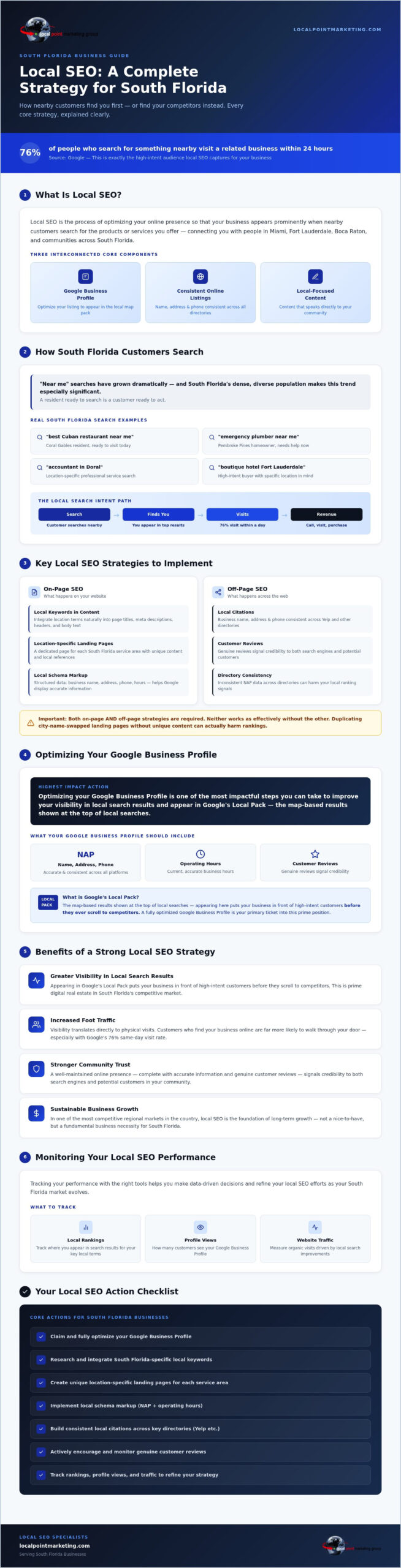
At its core, local SEO involves three interconnected components: optimizing your Google Business Profile, building consistent business listings across the web, and creating content that speaks directly to your local audience. Together, these elements signal to search engines that your business is relevant, trustworthy, and worth showing to nearby searchers.

Understanding Local Search Behavior

South Florida customers search differently than a general online audience. They’re looking for immediate solutions close to home. According to Google, 76% of people who search for something nearby on their smartphone visit a related business within a day. That kind of intent is powerful, and it’s exactly the audience local SEO is designed to capture.

“Near me” searches have grown dramatically over the past several years, and South Florida’s dense, diverse population makes this trend especially significant here. A resident in Coral Gables searching for “best Cuban restaurant near me” or a homeowner in Pembroke Pines looking for “emergency plumber near me” is ready to act. The businesses that appear first in those results earn the call, the visit, and the revenue.

Identifying the right local keywords for your business means thinking like your customers. Consider terms that combine your service with a neighborhood, city, or regional identifier. Phrases like “accountant in Doral” or “boutique hotel Fort Lauderdale” reflect how real South Florida customers search, and targeting them strategically puts your business directly in their path.

Benefits of Local SEO for Your Business

The advantages of a strong local SEO strategy extend well beyond search rankings. Here’s what consistent local optimization delivers:

  • Greater visibility in local search results: Appearing in Google’s local pack, the map-based results shown at the top of local searches, puts your business in front of high-intent customers before they ever scroll to competitors.
  • Increased foot traffic: Visibility translates directly to physical visits. Customers who find you online are far more likely to walk through your door.
  • Stronger community trust: A well-maintained online presence, complete with accurate information and genuine customer reviews, signals credibility to both search engines and potential customers.

For South Florida businesses operating in one of the most competitive regional markets in the country, local SEO isn’t a nice-to-have. It’s the foundation of sustainable growth.

How Local SEO Works: Key Strategies to Implement

Understanding why local SEO matters is only the first step. The real work lies in knowing exactly what to do about it. A strong local SEO strategy operates on two fronts: what happens on your website and what happens across the broader web. Both matter, and neither works as well without the other.

On-Page SEO for Local Optimization

Your website needs to communicate your location clearly and consistently to search engines. That starts with integrating local keywords naturally into your page titles, meta descriptions, headers, and body content. A law firm in Fort Lauderdale, for example, benefits from pages that specifically reference the communities it serves rather than using generic language that could apply anywhere.

Location-specific landing pages take this further. If your business serves multiple South Florida communities, a dedicated page for each service area helps search engines match your content to the right local queries. Each page should include unique content, local references, and relevant service details rather than duplicating the same text with a different city name swapped in.

Local schema markup is another layer worth implementing. This structured data tells search engines precisely what your business is, where it’s located, and what it offers. Adding schema for your business name, address, phone number, and operating hours makes it easier for Google to display accurate information about your business in search results. If you want to go deeper on the technical and content fundamentals that drive search visibility, this comprehensive guide on how to rank higher on Google covers the full spectrum of strategies that support stronger rankings.

Off-Page SEO Techniques

Off-page signals carry significant weight in local rankings. Local citations, which are mentions of your business name, address, and phone number across directories like Yelp, the Better Business Bureau, and local Chamber of Commerce listings, help establish credibility and consistency in the eyes of search engines. Inconsistent information across these sources can quietly undermine your rankings, so accuracy is non-negotiable.

Backlinks from locally relevant, authoritative sources strengthen your domain’s trustworthiness. Earning links from South Florida news outlets, local business associations, or community organizations sends a clear signal that your business is a legitimate, established presence in the region. Focus on building genuine relationships rather than chasing volume.

Social media plays a supporting role that’s easy to underestimate. Active engagement on platforms like Facebook and Instagram, particularly with South Florida community groups and local events, reinforces your geographic relevance and drives traffic back to your website. Consistent posting that references your service areas and local community keeps your brand visible between searches. If you want to turn that social presence into a structured lead-generation engine, a dedicated social media marketing strategy for local business can help you move beyond basic posting toward measurable growth.

  • Audit your citations regularly to ensure your business information is accurate across all directories.
  • Prioritize quality over quantity when pursuing backlinks; one link from a respected local publication outweighs dozens from low-authority sources.
  • Engage authentically on social media by participating in local conversations, not just broadcasting promotional content.

Putting these strategies into practice consistently is what separates businesses that rank from those that don’t. If you’d like expert guidance on building a local SEO foundation tailored to the South Florida market, explore how Local Point Marketing approaches local search optimization.

Optimizing Your Google Business Profile for Local SEO

Your Google Business Profile is often the first thing a potential customer sees when they search for your business. It appears in Google Maps, the local pack, and knowledge panels, making it one of the most visible assets you control. Getting it right isn’t complicated, but it does require attention to detail and consistent maintenance.

Setting Up Your Google Business Profile

Start by claiming your listing at Google Business Profile Manager. If your business already exists in Google’s database, you’ll need to verify ownership, typically through a postcard mailed to your business address, a phone call, or email verification. Once verified, you have full control over how your business appears in search results.

Choosing the right primary category is one of the most consequential decisions you’ll make during setup. Google uses your category to determine which searches trigger your listing. Be specific: a business in Coral Gables offering family dental care should select “Dentist” rather than “Health Care Provider.” You can add secondary categories to capture related searches, but your primary category should reflect your core offering as precisely as possible.

Fill out every available field completely. That means your business name, address, phone number, website URL, service areas, hours of operation, and a thorough business description. Consistency with the information on your website and across other directories reinforces the credibility signals that search engines rely on.

Maximizing Your Profile’s Potential

Customer reviews carry real weight in local rankings and in the trust decisions of prospective customers. The most effective way to earn reviews is simply to ask. After a positive interaction, invite your customers to share their experience on Google. A direct link to your review page removes friction and increases follow-through. When reviews come in, respond to every one of them. Thank customers for positive feedback and address concerns professionally in negative ones. Thoughtful responses signal to both Google and future customers that your business is engaged and accountable.

Photos and videos give your profile substance. Businesses with strong visual content consistently attract more clicks and direction requests than those without. Upload high-quality images of your storefront, team, products, and services. Refresh your photo library regularly so the profile feels current.

Google Posts let you share updates, promotions, and announcements directly on your profile. Use them to highlight seasonal offers, community involvement, or new services. Posts expire after seven days, so a consistent posting cadence keeps your profile active and signals ongoing relevance to Google.

  • Review your profile insights monthly to understand how customers are finding you and what actions they’re taking.
  • Track search queries that surface your profile to identify new keyword opportunities for your broader local SEO strategy.
  • Monitor your photo views to gauge which visual content resonates most with your audience.

A fully optimized, actively maintained Google Business Profile doesn’t just improve your rankings. It builds the kind of first impression that converts a search into a customer.

Local SEO Guide for South Florida Businesses: Boost Your Online Presence

Tools and Resources for Monitoring Local SEO Performance

Implementing a local SEO strategy is only half the equation. Knowing whether it’s working, and where to adjust, is what separates businesses that improve steadily from those that stall. The right tools give you visibility into your performance, your customers’ behavior, and the competitive landscape around you.

Essential Local SEO Tools

Google Search Console is the logical starting point. It shows you exactly which search queries are driving impressions and clicks to your website, how your pages rank for specific terms, and whether Google is encountering any technical issues that could suppress your visibility. For local SEO, pay close attention to queries that include city names, neighborhood references, or “near me” language. These tell you which local searches are already connecting customers to your site and which opportunities you haven’t yet captured.

For rank tracking across specific geographic areas, tools like Moz Local and Ahrefs provide more granular data than Search Console alone. Moz Local is particularly useful for managing citation consistency across directories, alerting you when your business information appears incorrectly somewhere online. Ahrefs helps you analyze your backlink profile and benchmark your domain authority against local competitors. Used together, they give you a clear picture of both your content performance and your off-page credibility.

Review management deserves its own dedicated attention. Platforms like BirdEye aggregate your reviews from Google, Yelp, and other sources into a single dashboard, making it easier to monitor sentiment, respond promptly, and identify patterns in customer feedback. Yelp’s own business tools also offer useful analytics on profile views and customer actions, particularly for businesses in South Florida’s hospitality and service sectors.

Analyzing Performance and Making Adjustments

Raw data only creates value when you interpret it correctly. Google Analytics, connected to your Search Console account, reveals how local visitors behave after they reach your site: which pages they visit, how long they stay, and whether they convert into leads or customers. A high volume of local traffic paired with low engagement often signals a mismatch between what searchers expect and what your pages deliver.

Set a regular review cadence, monthly at minimum, to assess your key metrics and identify trends. Declining impressions for a specific service area might indicate a competitor has strengthened their presence there. A drop in review volume might mean your request process needs attention. These signals are actionable when you catch them early.

  • Track ranking changes by location to understand how your visibility shifts across different South Florida communities.
  • Monitor your Google Business Profile insights separately from website analytics; they measure different customer touchpoints.
  • Review citation accuracy quarterly using Moz Local or a similar tool to catch inconsistencies before they affect rankings.

Staying current with local SEO trends matters too. Google updates its local search algorithms regularly, and what works today may need refinement tomorrow. As AI-generated results now appear at the top of more than half of all Google searches, understanding AI search optimization and how it affects your business visibility in 2026 is becoming just as important as traditional ranking tactics. Following sources like Google’s Search Central Blog and reputable industry publications keeps your strategy grounded in current best practices rather than outdated assumptions.

If interpreting this data feels overwhelming or time-consuming, working with an experienced partner makes the process more efficient. Learn how Local Point Marketing uses data-driven strategies to monitor and improve local SEO performance for businesses across South Florida.

Conclusion: Taking Your South Florida Business to the Next Level with Local SEO

The path to stronger local visibility is clearer than most business owners realize. Throughout this guide, you’ve seen how local SEO operates across multiple layers: your website, your Google Business Profile, your citation footprint, and the data tools that help you measure progress. Each layer reinforces the others, and together they build the kind of online presence that consistently puts your business in front of the right customers at the right moment.

South Florida is a market that rewards businesses willing to invest in their local presence. The competition is real, but so is the opportunity. Customers across Miami, Fort Lauderdale, Boca Raton, and every community in between are actively searching for the services you offer. The businesses that appear first in those results aren’t there by accident. They’ve made deliberate, consistent efforts to earn that visibility, and you can do the same.

The strategies covered here are actionable starting points, not abstract theory. Optimizing your on-page content for local keywords, maintaining accurate citations, building your Google Business Profile, and tracking your performance with the right tools are all steps you can begin taking today. Progress compounds over time. Small, consistent improvements lead to meaningful ranking gains, and those gains translate directly into more calls, more visits, and more revenue.

That said, managing a comprehensive local SEO strategy alongside running a business is a significant undertaking. Knowing what to do and having the bandwidth to do it consistently are two different things.

That’s where Local Point Marketing comes in. With a decade of experience helping South Florida businesses grow their digital presence, Local Point Marketing brings data-driven SEO strategies and genuine local market expertise to every client relationship. The approach is built around your outcomes, not generic templates. Whether you’re starting from scratch or looking to strengthen an existing foundation, the team works alongside you as a reliable partner focused on measurable results.

  • SEO strategies tailored to your specific South Florida market and the communities you serve.
  • Content creation and social media marketing that reinforces your local presence across channels.
  • Ongoing performance monitoring to ensure your strategy evolves as your market does.

Taking the next step doesn’t require a complete overhaul overnight. It starts with a conversation. Reach out to Local Point Marketing today to discuss how a focused local SEO strategy can help your South Florida business grow.

Start Growing Your Local Presence Today

Local SEO isn’t a one-time fix; it’s an ongoing investment that builds momentum over time. The strategies covered in this guide, from optimizing your Google Business Profile to tracking performance with the right tools, give you a proven framework for attracting more customers across South Florida’s competitive market.

Three things matter most as you move forward: consistency, accuracy, and patience. Businesses that commit to these principles don’t just rank higher; they build lasting credibility with the communities they serve.

If you’re ready to put these strategies into practice but want an experienced partner alongside you, Local Point Marketing brings over 10 years of digital marketing expertise and a data-driven approach tailored to local businesses like yours. The focus is always on your outcomes, not generic solutions.

Your next customer is already searching. Make sure they find you first. Contact Local Point Marketing today to boost your local SEO and take a confident step toward sustainable growth.

Frequently Asked Questions About Local SEO

What is local SEO and how does it differ from traditional SEO?

Local SEO focuses specifically on improving your visibility for searches tied to a geographic area, such as “plumber in Miami” or “dentist near me.” Traditional SEO targets broader audiences without a location component, aiming to rank for terms that could apply anywhere. The strategies overlap in some areas, but local SEO adds layers like Google Business Profile optimization, citation building, and location-specific content that general SEO doesn’t prioritize.

For South Florida businesses serving customers in specific cities or neighborhoods, local SEO is the more relevant discipline. It connects you with people who are nearby, searching with immediate intent, and ready to make a decision.

How can I improve my Google Business Profile for better visibility?

Complete every field in your profile accurately, starting with your business name, address, phone number, hours, and primary category. Choose your category carefully; it directly influences which searches trigger your listing. Add high-quality photos, respond to every review, and use Google Posts to share updates regularly. Profiles that are fully filled out and actively maintained consistently outperform neglected ones in local search results.

Review your profile insights monthly to understand how customers are finding you and which actions they’re taking. That data tells you where to focus your attention next.

What are the key components of a successful local SEO strategy?

A successful local SEO strategy rests on four pillars: on-page optimization with location-specific keywords and content, a fully maintained Google Business Profile, consistent business citations across directories, and a steady stream of genuine customer reviews. Each element supports the others. Strong on-page content without accurate citations, for example, sends mixed signals to search engines that can suppress your rankings.

Consistency is what ties everything together. Businesses that apply these components regularly and accurately build cumulative authority in their local market over time.

How do online reviews affect my local SEO rankings?

Reviews influence local rankings in two direct ways: the volume of reviews signals to Google that your business is active and trusted, while the content of those reviews introduces natural keyword language that reinforces your relevance. A dental practice in Boca Raton that consistently receives reviews mentioning specific services will strengthen its visibility for those related searches over time.

Beyond rankings, reviews shape the trust decisions of potential customers before they ever contact you. Responding to every review, positive or negative, demonstrates accountability and signals that your business is engaged with the community it serves.

What tools can I use to monitor my local SEO performance?

Google Search Console is the essential starting point, showing you which queries drive traffic to your site and flagging technical issues. Moz Local helps you manage citation consistency across directories, while Ahrefs provides backlink analysis and competitive benchmarking. For review monitoring, platforms like BirdEye aggregate feedback from multiple sources into one dashboard, making it easier to track sentiment and respond promptly.

Use Google Analytics alongside Search Console to understand how local visitors behave once they reach your site. Together, these tools give you a complete picture of your performance across search, citations, and customer engagement.

What are the common mistakes to avoid in local SEO?

The most damaging mistakes are inconsistent business information across directories, neglecting your Google Business Profile after the initial setup, and targeting keywords that are too broad to attract local intent. Duplicate listings on Google Maps are another common issue; they split your authority and confuse search engines about which listing to surface. Thin or duplicated location pages that swap a city name without adding unique, relevant content also undermine rankings rather than supporting them.

Ignoring reviews entirely is a costly oversight. Businesses that don’t actively request or respond to reviews miss one of the most accessible opportunities to build trust and improve their local search visibility simultaneously.

How long does it take to see results from local SEO efforts?

Most businesses begin to see measurable improvements in local rankings within three to six months of consistent effort, though this varies based on your market’s competitiveness, your starting point, and how comprehensively you implement each strategy. Quick wins like completing your Google Business Profile or correcting citation errors can produce visible changes faster. Building domain authority through backlinks and content takes longer but delivers more durable results.

Patience is part of the process. Local SEO compounds over time; the businesses that commit to it consistently are the ones that hold strong rankings and attract steady customer growth across their South Florida communities. If your business isn’t appearing in search results at all, understanding why your business is not showing on Google is an important first step before investing further in optimization.