
2026 Local SEO Citation Guide for Florida Businesses

96% of people now discover nearby businesses through online searches. For Florida business owners, this digital visibility is the primary driver of growth. It’s frustrating to watch a competitor down the street claim the top spot in the local Map Pack while your own listing struggles to gain traction. Managing dozens of directory listings is an exhausting process, and inconsistent business information often leads to customer confusion rather than new leads.

We understand that your time is best spent running your business, not chasing down data errors across the web. This guide will show you how to master local SEO citation building to secure a trusted digital footprint that dominates South Florida search results. By aligning your brand data, you’ll establish the authority needed to outrank the competition and drive more phone calls to your office. We’ll walk through the essential steps to clean up your listings, satisfy modern AI search agents, and ensure your business is the first one customers see when they search in your neighborhood.

Key Takeaways

  • Learn how local citations have evolved into a critical layer of entity validation for both Google Maps and modern AI search agents.
  • Discover the “NAP+” strategy that goes beyond basic contact details to include social handles and website URLs for maximum impact.
  • Understand the strategic differences between automated data aggregators and manual submissions to build a more permanent and high-quality digital footprint.
  • Master a proven local SEO citation building process that starts with identifying “ghost listings” and cleaning up inconsistent data to restore search engine trust.
  • See how maintaining consistent brand data serves as the foundation for achieving a top 3 placement in the local Map Pack and increasing walk-in traffic.

What is Local SEO Citation Building and Why Does It Matter in 2026?

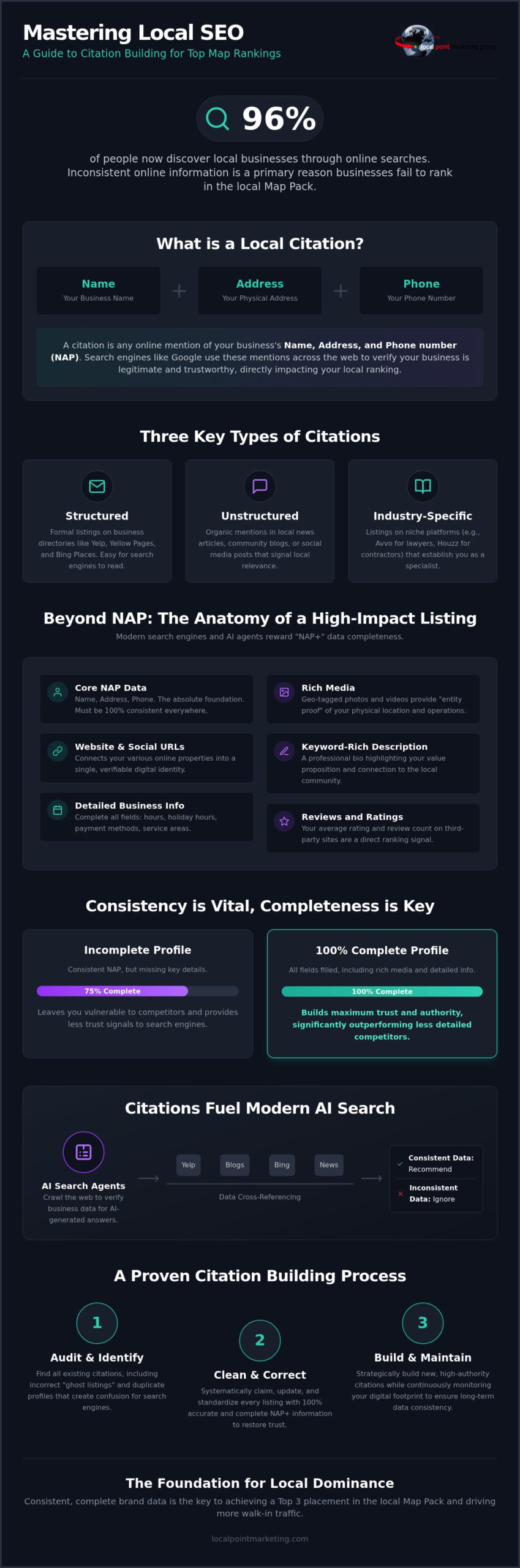
A local citation is any online mention of your business name, address, and phone number (NAP). While this sounds simple, local SEO citation building has evolved into a sophisticated method of entity validation. Google uses these mentions to cross-reference data and confirm that your business is a legitimate, active physical entity. In 2026, search engines don’t just rely on what you say on your website. They look for consensus across the digital ecosystem to build trust and authority.

When your NAP data is consistent across multiple high-authority platforms, Google is more likely to reward you with a top placement in the local Map Pack. This visibility is vital because local searches often lead to immediate action from customers in your neighborhood. To understand the broader context of these strategies, it’s helpful to review What is Local SEO? and how it prioritizes proximity and relevance for users.

The Different Types of Citations

Mastering local SEO citation building involves three distinct categories of mentions. Structured citations are the most common. These are formal listings on business directories like Yelp, Yellow Pages, or Bing Places. They follow a specific format that makes it easy for search engines to parse your contact details. Unstructured citations occur when your business is mentioned in local news articles, community blogs, or social media posts. These signal local relevance. Finally, industry-specific citations target niche platforms like Avvo for lawyers or Houzz for contractors, establishing you as a credible specialist.

The Link Between Citations and AI Search Visibility

The rise of AI search has changed the stakes for data consistency. Large Language Models (LLMs) and AI search agents crawl directory data to verify facts before presenting them to users. If an AI agent finds conflicting addresses or disconnected phone numbers, it’s less likely to recommend your business in an AI-generated answer. Your digital footprint is the primary trust signal for 2026 search. By maintaining a clean and expansive network of mentions, you ensure that AI tools see your business as a reliable answer to local queries.

Beyond NAP: The Anatomy of a High-Impact Business Listing

Basic contact information is the foundation of any digital presence, but local SEO citation building in 2026 requires a “NAP+” mindset. While your name, address, and phone number are the bare minimum, modern search engines look for much more. You should include your website URL, email address, and social media handles to create a fully connected digital identity. These extra data points help search engines verify that your business is a legitimate entity with a broad, active presence across the web.

Rich media is another critical component of a high-impact listing. High-quality, geo-tagged photos and videos provide undeniable proof of your physical location. When you upload a video of your Miami storefront or photos of your team helping customers in Vero Beach, you’re providing “entity proof” that search engines value. These visuals also increase engagement, as potential customers are more likely to trust a business they can see.

Your business description should be keyword-rich without looking like spam. Avoid the temptation to just list your services. Instead, craft a professional bio that highlights your unique value proposition and your connection to the South Florida community. Use natural language that reflects your brand’s voice while naturally incorporating the terms your customers actually use when they search for your services.

Data Consistency vs. Data Completeness

Consistency is vital, but completeness is often what sets market leaders apart. A profile that’s 100% complete frequently performs better than one that’s just consistent but lacks detail. Don’t skip fields like holiday hours, accepted payment methods, or specific service areas. Many businesses overlook these details, which gives you an easy opportunity to stand out. To keep your listings secure and resilient against external threats, it’s wise to consult the SBA guide to SEO security as you build your footprint.

The Role of Reviews and Ratings in Citations

Reviews are more than just social proof; they’re a ranking signal. Your review counts and average ratings on third-party sites like Yelp or industry-specific directories directly influence your visibility in Google’s local results. It’s essential to respond to mentions and feedback across the web, not just on your main profile. This activity signals that your business is active and cares about customer experience. For a broader look at how these elements fit into your overall strategy, read our Local SEO Guide for South Florida Businesses.

AI search engines thrive on this “enhanced data.” They look for specific attributes to answer complex user questions, such as “which law firm near me is open on Saturdays?” By providing a complete and rich set of data, you’re feeding AI engines exactly what they need to recommend your business. If you’re ready to build a more dominant presence, our team can help you implement a managed SEO strategy that covers every detail.

Manual Submissions vs. Data Aggregators: Which is Better?

Choosing the right method for local SEO citation building often feels like a trade-off between speed and control. On one side, you have automated data aggregators. On the other, you have manual, direct-to-site submissions. Understanding how these two paths impact your long-term visibility is essential for any Florida business looking to secure its place in the market. Each method serves a specific purpose in creating a comprehensive digital footprint.

Data aggregators like Data Axle, Foursquare, and Neustar Localeze serve as the central hubs of the local search world. They collect business information and distribute it to a massive network of secondary directories, GPS systems, and mobile apps. This method is efficient for broad coverage, but it comes with a significant time delay. It often takes months for a change in an aggregator’s database to filter down to the smaller sites that rely on them. While aggregators are a powerful foundation, they lack the surgical precision required for high-competition markets like Miami or Fort Lauderdale.

Manual submissions involve claiming and verifying your business listing directly on each platform. While this is more time-consuming, it provides a level of precision that automation can’t match. You can tailor your descriptions, upload specific rich media, and ensure every field is filled correctly. Manual submissions offer permanent ownership of your digital assets. Unlike software-based solutions, these listings don’t disappear or revert to old data if you decide to cancel a subscription. This “listing hijack” risk is a common pitfall for business owners who rely solely on automated tools. When the monthly payment stops, the software often releases control of the listing, which can lead to your data being overwritten by incorrect information from inferior sources.

Understanding the Data Ecosystem

The local data ecosystem is a complex web of interconnected sources. Information flows from the major aggregators to the navigation systems in cars and the niche apps on smartphones. Because of this interconnectedness, a single error at the aggregator level can ripple across hundreds of sites. To effectively Improve Your Local Citations, you must address both the primary hubs and the specific directories that matter most in your industry. A hybrid approach is often the most cost-effective strategy for Florida SMBs. It combines the broad reach of aggregators with the surgical precision of manual work for your most important profiles.

Managed Services: The Local Point Marketing Difference

Many business owners fall into the DIY software trap, thinking a single tool will solve their visibility issues. In reality, managing 50 or more listings requires constant oversight and a deep understanding of how data is verified. Our team acts as your steady partner, auditing your existing footprint to find and “clean” bad data that might be holding you back. We ensure your local SEO citation building efforts are integrated into a broader strategy of ROI-driven digital marketing. By handling the technical heavy lifting, we allow you to focus on serving your customers while we build a trusted, permanent foundation for your growth.
2026 Local SEO Citation Guide for Florida Businesses

Step-by-Step Citation Building Strategy for South Florida SMBs

A successful local SEO citation building strategy begins with a methodical plan. It’s not enough to simply submit your data to a few websites and hope for the best. You need a structured approach that prioritizes high-authority platforms and addresses the specific geographic nuances of the Florida market. Following these steps will help you build a resilient digital foundation that search engines and customers can rely on.

  • Step 1: Conduct a thorough citation audit. Search for “ghost listings” which are outdated records containing old addresses, former business names, or disconnected phone numbers. These remnants of the past often confuse search engines and dilute your authority.
  • Step 2: Execute the Cleanup Phase. Before adding new listings, correct every inconsistency found during your audit. Ensuring your NAP data is identical across all existing platforms is the highest priority during this stage.
  • Step 3: Claim the Big Three. Prioritize your profiles on Google Business Profile, Bing Places, and Apple Maps. These platforms act as the primary data sources for the vast majority of local searches.
  • Step 4: Target regional and industry-niche directories. Once the foundations are set, expand your reach to platforms that specifically serve your industry or the South Florida region.
  • Step 5: Ongoing monitoring and duplicate suppression. Digital data is fluid. New, incorrect listings can appear at any time due to aggregator updates, so you must monitor your footprint regularly to suppress duplicates.

Local Florida Citation Targets

Businesses from Miami to Vero Beach have access to powerful regional signals that generic national directories can’t provide. Joining the Better Business Bureau of Southeast Florida is a strong trust signal for both consumers and search engines. Additionally, securing a listing through the Miami, Fort Lauderdale, or Boca Raton Chambers of Commerce provides a high-authority backlink and confirms your active participation in the local economy. Regional news mentions and local Florida business directories further solidify your geographic relevance.

Competitor Citation Gap Analysis

To dominate the Map Pack, you must understand where your top-ranking rivals are listed. Use specialized tools to identify the specific directories and local blogs that are powering your competitors’ visibility. Your goal is to “steal” these mentions by securing your own listings on those same platforms. We recommend maintaining a “10% rule” to stay ahead. Aim to have at least 10% more high-quality citations than your closest rival to ensure your authority remains undisputed. This proactive stance is a core part of our local SEO citation building approach. If you want to accelerate this process, our team is ready to conduct a professional audit and build your custom roadmap to the top of the search results.

Scaling Your Visibility with Local Point Marketing

Local Point Marketing views local SEO citation building as a foundational element of our managed SEO retainers. We don’t treat your business data as a set-and-forget task. Instead, we approach it as a continuous process of verification and growth. Our team acts as a steady partner, ensuring that your digital presence remains accurate and authoritative as your business evolves. By managing these details on your behalf, we provide the reassurance that your brand is always represented correctly to both search engines and potential customers.

Our methodology follows a clear, data-driven path. We begin with a comprehensive audit to identify every existing mention of your brand. This phase allows us to uncover ghost listings and incorrect data that may be hindering your performance. Once identified, we move into the cleanup phase, systematically correcting inconsistencies to restore your search engine trust. Finally, we expand your reach by securing high-impact placements in regional and industry-specific directories. This structured approach ensures your local SEO citation building efforts produce measurable results and a clean footprint.

We recognize that the search landscape is shifting toward agentic and AI-driven results. That’s why we integrate our citation work with AI search optimization. By providing structured, verified data, we help AI search agents understand and recommend your business with confidence. Our reporting is built on transparency. We track your local ranking improvements and Map Pack placements, providing you with clear metrics that show the impact of our work on your bottom line.

The Long-Term Value of Managed Citations

Managed citations offer protection against the accidental or malicious data changes that can occur in the complex local ecosystem. Consistent data also strengthens the ROI of your other marketing efforts. When your NAP is accurate, your PPC landing pages and social media profiles work in harmony to build a unified brand identity. For businesses growing from a single location in Miami to multiple sites across the Treasure Coast and Vero Beach, this consistency is the key to scaling without losing local authority.

Ready to Clean Up Your Local Presence?

The danger of setting and forgetting your business information is real. Outdated data leads to lost calls, customer frustration, and missed opportunities. We invite you to take the first step toward a more dominant local presence and a trusted digital footprint. Get your free Local SEO audit from Local Point Marketing today. Let us show you how a steady, expert partner can transform your visibility and drive measurable growth.

Securing Your Competitive Edge in the South Florida Market

Maintaining a dominant online presence requires more than just a basic directory listing. It demands a strategic approach to local SEO citation building that treats your business data as a verifiable asset for both human customers and AI search agents. By cleaning up ghost listings and adopting a NAP+ strategy, you establish the trust needed to secure a top spot in the local Map Pack. Consistency isn’t just about accuracy; it’s about building a foundation for long-term growth.

As the digital landscape evolves, having a steady partner to manage these complexities becomes a significant competitive advantage. We focus on transforming your business data into an engine for measurable ROI and increased foot traffic. With 10 years of South Florida SEO experience, our team specializes in data-driven lead generation and AI visibility. We understand the regional market from Miami to Vero Beach and are ready to help you scale. Partner with Local Point Marketing for Expert Local SEO to future-proof your growth and outshine the competition. Your path to a more trusted digital footprint starts with a single, expert step.

Frequently Asked Questions

How long does it take for new citations to affect my Google rankings?

It usually takes 4 to 12 weeks for search engines to crawl and index new directory listings. The impact on your rankings isn’t immediate because Google needs time to verify the consistency of the data across multiple sources. Businesses in competitive markets like Boca Raton may see gradual improvements in their Map Pack placement as their digital footprint becomes more established and trusted.

Do I need to build citations if I only have an online business without a physical office?

Local citations are primarily designed for businesses with a physical location or those that serve specific geographic areas. If you run a purely online store without a service area in cities like Palm Beach or Stuart, standard local citations might not be your primary growth lever. However, building a trusted digital footprint still helps establish brand authority and entity validation for search engines across the web.

What is the most common mistake in local SEO citation building?

The most frequent error in local SEO citation building is allowing inconsistent NAP data to persist across different platforms. Even minor differences in your business name or phone number can confuse search algorithms and lower your authority. Forgetting to audit “ghost listings” from previous addresses in Fort Lauderdale or Miami is a common oversight that dilutes the effectiveness of your overall strategy.

Can I use a P.O. Box or virtual office address for my citations?

You should avoid using P.O. Boxes or virtual offices for your primary local citations. Google and other major directories prefer a legitimate physical street address where your business operates. Using a P.O. Box in Port St Lucie or a virtual suite in Miami can lead to your listing being suspended or filtered out of the local results entirely because it lacks physical entity proof.

How many citations does a typical South Florida business need to rank?

Most successful businesses in South Florida maintain between 50 and 80 high-quality citations. However, the exact number depends on your specific industry and the strength of your competitors in cities like Jupiter or Vero Beach. We recommend performing a gap analysis to ensure you have at least 10% more verified mentions than your closest rival to maintain a competitive edge in the Map Pack.

What happens to my listings if I move my business to a new location in Miami or Fort Lauderdale?

Moving your office requires a comprehensive cleanup phase to update every existing listing. If you move from a location in Fort Lauderdale to a new space in Miami or Fort Pierce, you must ensure your old NAP data is suppressed or updated. Leaving old addresses active creates data fragmentation, which can cause your rankings to drop as search engines lose trust in which location is currently active.

Is it better to build citations manually or use a service like Yext or BrightLocal?

Manual submissions are generally better for long-term ownership and data accuracy. Services like Yext offer speed but often use an API overlay that can revert to old data if you stop paying. For a permanent digital footprint, we recommend a hybrid approach to local SEO citation building that combines manual work for your core profiles with aggregators for broader reach across the local Florida market.

How do citations help my business appear in AI search results like ChatGPT or Google Gemini?

Citations provide the structured data that Large Language Models (LLMs) use to verify facts. When a user asks an AI agent for a top-rated law firm in Palm City, the AI crawls directory data to confirm your expertise and location. Consistent mentions across the web act as trust signals, making it more likely that AI tools will recommend your business in their generated answers.

The Ultimate 2026 Local SEO Audit Checklist for Growing Businesses

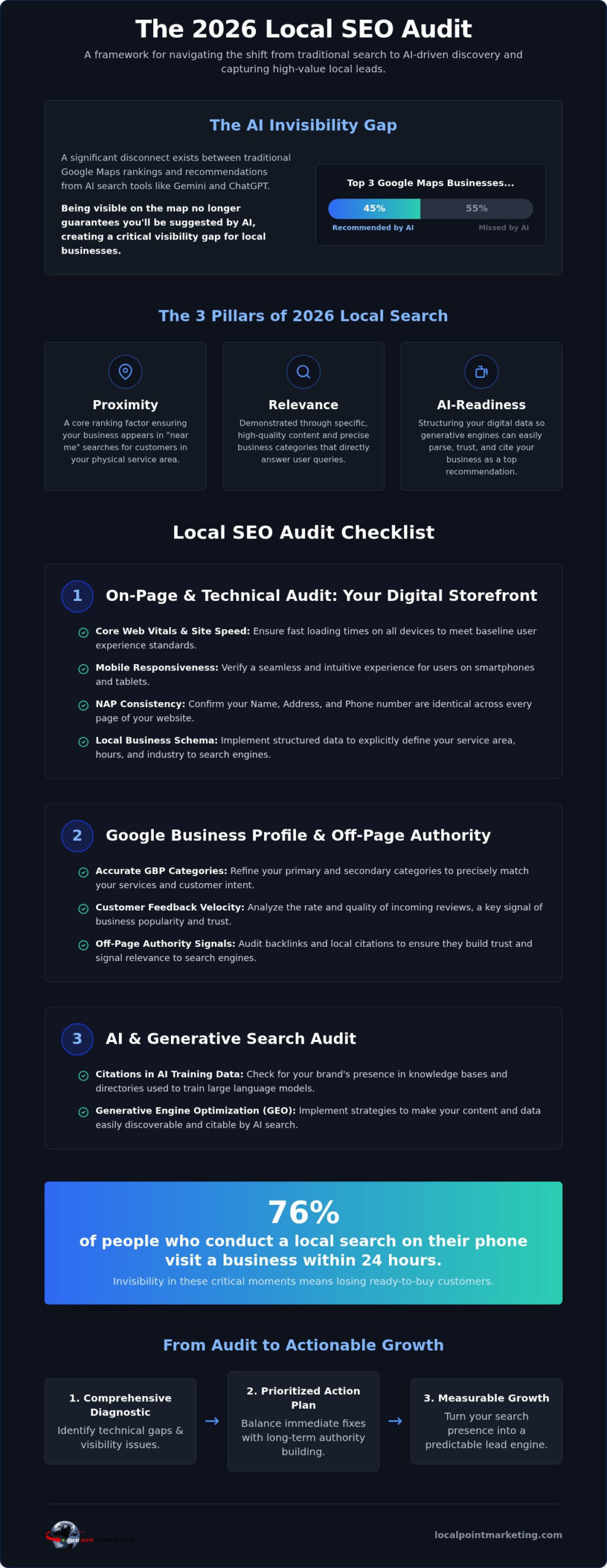
Only 45% of businesses that rank in the top three of Google Maps are actually recommended by AI search tools. This significant gap means your business might be visible on a map but invisible to the growing number of customers using Gemini or ChatGPT to find local services. If you feel like your marketing spend isn’t showing a clear ROI, it’s likely because your strategy hasn’t adapted to these shifting search behaviors. This local SEO audit checklist provides the methodical framework you need to identify visibility gaps and turn your profile into a high-impact lead-generation engine.

It’s natural to feel concerned when traditional tactics stop delivering the same growth they once did. You want a steady partner who understands how 2026 updates, like the shift from prominence to popularity, affect your bottom line. This guide offers a comprehensive look at the actionable fixes required to increase your ranking in the Google Map Pack and earn measurable inquiries. We’ll preview the latest Google Business Profile standards and show you how to optimize for AI-driven discovery across South Florida, from Miami to Stuart.

Key Takeaways

  • Conduct a comprehensive diagnostic of your digital footprint to identify the technical gaps that prevent your business from appearing in front of qualified local leads.
  • Ensure your website meets 2026 technical standards by auditing Core Web Vitals and verifying Name, Address, and Phone (NAP) consistency across all domain pages.
  • Use our data-driven local SEO audit checklist to refine your Google Business Profile categories and increase the velocity of high-quality customer feedback.
  • Position your brand for the future of search by auditing for citations within AI training data and implementing Generative Engine Optimization (GEO) strategies.
  • Transform audit findings into a prioritized action plan that balances immediate technical fixes with long-term authority-building efforts for sustainable growth.

Why Your Local SEO Audit Is the Foundation of 2026 Growth

A local SEO audit is a comprehensive diagnostic of your digital footprint, acting as a clear-eyed assessment of how search engines and AI models view your brand. It’s the essential first step in understanding why your business might be underperforming despite your best efforts. By evaluating every touchpoint of your online presence, you can identify the exact friction points that prevent potential customers from finding your services. Our local SEO audit checklist provides the clarity needed to bridge this gap and align your digital identity with the way people search today.

Many growing businesses suffer from digital invisibility due to technical debt, outdated content, or weak authority. Technical debt often manifests as slow page speeds or broken links that frustrate both users and search crawlers. Outdated content signals to algorithms that your business may no longer be relevant, while weak authority indicates a lack of trust from the broader web. At Local Point Marketing, we connect these audit findings directly to our mission of measurable lead generation. We don’t just find errors; we uncover opportunities to turn your search presence into a predictable engine for growth.

The 2026 local search environment rests on three pillars: proximity, relevance, and AI-readiness. Proximity remains a core factor in traditional local search engine optimization (local SEO), but relevance now requires deeper, more specific content that answers user questions. AI-readiness is the newest requirement, ensuring that your data is structured so that generative engines like Gemini can easily cite your business as a top recommendation.

The Cost of Invisibility for South Florida Businesses

The Invisibility Gap represents the lost revenue that occurs when qualified customers search for your services in South Florida but find a competitor instead. Missing out on “near me” search intent leads to competitor dominance in high-value markets like Miami, Jupiter, and Stuart. Recent data shows that 76% of people who conduct a local search on mobile visit a business within 24 hours. If you aren’t visible in those critical moments, you aren’t just losing a click; you’re losing a customer. This shift is accelerating as users transition from traditional search results to AI-assisted discovery, where only the most authoritative and well-optimized businesses are featured.

Audit vs. Strategy: Why You Need the Diagnostic First

There is a fundamental difference between a one-time audit and a long-term managed SEO retainer. An audit identifies the current state of your visibility, while a strategy outlines the path toward your future goals. Guessing at SEO fixes without a diagnostic leads to wasted marketing budgets and inconsistent results. Using a local SEO audit checklist ensures that every technical and content-based factor is measured against current performance data. Expert partners use this methodology to build a foundation of methodical trustworthiness, ensuring that every subsequent marketing action is backed by evidence rather than intuition.

The On-Page & Technical Checklist: Your Digital Storefront

Your website serves as the primary touchpoint for local leads. A comprehensive local SEO audit checklist must prioritize the technical health of this digital storefront to ensure a seamless user experience. In 2026, Core Web Vitals are no longer just a recommendation; they’re a baseline requirement. Audit your site speed and mobile responsiveness to confirm that your pages load quickly on every device. A slow site creates friction that turns away potential customers before they even see your value proposition.

Consistency is the next critical pillar. Verify that your Name, Address, and Phone (NAP) details are identical across your domain footer and contact pages. Even minor discrepancies can confuse search algorithms and erode trust. Beyond simple text, you must implement Local Business Schema markup. This structured data explicitly tells search engines about your service area, business hours, and industry. Finally, evaluate your internal linking structure. Ensure that local authority flows naturally from your homepage to your high-value service pages, creating a clear path for both crawlers and users.

Optimizing Local Landing Pages for Miami to Palm Beach

Serving the South Florida market from Miami to Vero Beach requires a granular approach to content. Audit your site to ensure that each city you serve has a dedicated, unique landing page. These pages shouldn’t be carbon copies of one another. Instead, check for “Local Signals” such as mentions of specific neighborhoods, local landmarks, or reviews from customers in that specific area. Integrating strategic blog content creation helps support these geographic pages by building topical authority. This alignment with broader local marketing strategies ensures your technical foundation supports your overall business goals. If you find your landing pages are underperforming, a reliable expert can help refine your messaging for the South Florida market.

Technical SEO Health Check

Security and clarity are paramount for maintaining a professional online presence. Verify your SSL certificates to ensure all traffic uses HTTPS security protocols, which is a standard expectation for modern businesses. Audit your URL structures for clarity and descriptive keywords. A URL like /miami-seo-services/ is far more effective than a generic /service1/ string because it immediately communicates relevance. You should also identify and fix duplicate content issues. Having identical text across multiple location pages confuses search engine crawlers and can lead to penalties that diminish your visibility. Fixing these technical errors creates a stable foundation for all your future marketing efforts.

Google Business Profile & Off-Page Authority Audit

Your Google Business Profile (GBP) is the most influential factor in your local search rankings, accounting for approximately 32% of the weight in local pack results. A thorough local SEO audit checklist must begin with a deep dive into your profile’s completeness. Verify that your business name exactly matches your legal trading name to satisfy Google’s 2026 verification standards. Audit your categories, business hours, and high-resolution photos to ensure they provide a professional image of your operations. Profiles that remain inactive for more than 30 days often see a decline in visibility, so consistent activity is mandatory for maintaining your position.

Authority extends beyond your own profile. Check your citation accuracy across Tier 1 directories such as Apple Maps, Bing, and Yelp. Inconsistent data across these platforms signals unreliability to search engines and can confuse potential customers. You should also evaluate your local backlink profile. Seek mentions and links from South Florida community sites, news outlets, or local business associations. These geographic signals confirm your physical presence in markets like Jupiter and Miami, strengthening your overall popularity score in the eyes of search algorithms.

Mastering the Google Map Pack

Success in the Map Pack now depends on the “popularity” signal, which tracks real-time user interactions like click-through rates and profile views. Audit the “Services” and “Products” sections of your GBP to ensure they include keyword-relevant descriptions of your core offerings. Use the “Google Updates” feature at least once a week to signal that your business is active and engaged. Your primary category should align perfectly with your highest-value search intent. Choosing an incorrect primary category is a common error that leads to your business appearing for irrelevant queries or missing out on qualified leads entirely.

Review Management & Reputation Audit

Reviews are no longer just about the star rating; they are a source of data for AI-powered search. Analyze your review velocity and sentiment to see how often customers provide 5-star feedback. Identify keyword-rich reviews where customers mention specific services, as these help Google’s “Ask Maps” feature recommend you for specific user questions. Your response rate is equally critical. Unanswered reviews hurt your reputation and your visibility score. Aligning your review management with a cohesive social media strategy ensures brand consistency across all digital platforms. This methodical approach builds the trust necessary to turn searchers into long-term clients.

The Ultimate 2026 Local SEO Audit Checklist for Growing Businesses

Beyond the Map: Auditing for AI Search & Generative Visibility

Local search is evolving beyond the traditional list of links. While the Map Pack remains vital, 2026 requires looking at how AI models recommend businesses. Generative Engine Optimization (GEO) is the discipline of making your business information easily extractable for AI. Recent studies show only a 45% overlap between businesses in the top three of Google Maps and those recommended by AI tools. Your local SEO audit checklist must evaluate whether your brand appears in AI Overviews and LLM responses. AI tools like ChatGPT and Google Gemini rely on specific brand citations within their training data to make recommendations. If your business isn’t mentioned across authoritative local directories and news sites, these models may skip you entirely.

Evaluating your use of structured data is the next logical step. AI models use these technical signals to build knowledge graphs that define who you are and what you do. If your data is disorganized, AI crawlers cannot verify your authority. This lack of verification leads to your business being excluded from direct “Who is the best…” or “How do I…” queries. A methodical audit ensures your technical foundation is ready for a multi-modal search era where visibility is earned through clarity and consistency.

Generative Engine Optimization (GEO) Essentials

AI visibility depends on your commitment to E-E-A-T. Models prioritize content that demonstrates Experience, Expertise, Authoritativeness, and Trustworthiness. Audit your existing content to see if you are cited as a recommended source in local summaries. This isn’t just about keywords; it’s about being a recognized authority in the South Florida market. For a deeper look at these strategies, consult our AI search optimization guide. Establishing this level of trust ensures your business remains visible as search habits shift from clicking links to receiving direct answers. To secure your place in these generative summaries, partner with an agency that understands AI visibility.

Conversational Keyword Audit

Voice search and AI queries are inherently conversational. Audit your current keyword list for natural language phrases used in modern search. These long-tail queries are the foundation of how customers find services today. Check your website for FAQ sections that provide crisp, citation-ready answers for LLMs. These snippets are easily consumed by AI and used in generative summaries. Your “About Us” page should also clearly establish your local identity. Mentioning specific service areas like Jupiter, Stuart, or Miami helps AI crawlers map your business to the correct geographic knowledge graph. This clarity turns your “About Us” page into a powerful signal for local discovery.

Implementing Your Audit: Prioritizing for South Florida Leads

Completing your local SEO audit checklist is only the beginning of your growth journey. To see a measurable impact on your bottom line, you must categorize your findings into quick wins and long-term strategic plays. Quick wins typically involve technical corrections that remove immediate friction for search engines. Long-term plays, such as building local authority through community engagement, require a sustained effort but offer the highest compounding returns over time. By organizing your tasks this way, you ensure your marketing resources are used efficiently.

Prioritizing Google Business Profile and NAP (Name, Address, Phone) fixes should be your first step for immediate Map Pack impact. These core signals are the bedrock of local trust. Once these are secured, develop a 90-day roadmap focused on the highest ROI-driven digital marketing activities. This structured approach prevents you from feeling overwhelmed by the technical requirements of modern search. Your success depends on establishing KPIs that reflect actual business health. Instead of obsessing over keyword rankings, prioritize tracking phone calls, direction requests, and form fills. These metrics represent real customers entering your sales funnel.

Setting Measurable Local SEO Goals

Success for a business in Stuart or Boca Raton looks different than a national campaign. It means dominating the specific neighborhoods where your customers live and work. Detailed analytics and reporting are essential to prove the value of your SEO efforts and justify your marketing spend. Use this data to adjust your strategy every month. If direction requests are up but phone calls are down, you might need to audit your profile’s call-to-action buttons. This methodical refinement turns a static audit into a living strategy for growth.

When to DIY vs. When to Hire a Reliable Partner

Identifying the complexity threshold is vital for growing businesses. Manual auditing and implementation become inefficient when you manage multiple locations or face aggressive competition in dense South Florida markets like Miami. A professional local SEO guide provides the expertise needed to navigate shifting AI trends and technical updates that often confuse business owners. Local Point Marketing stands as a steady, dependable partner for businesses ready for a long-term managed SEO retainer. We work alongside you to ensure your audit findings translate into measurable inquiries and sustainable success.

Securing Your Local Dominance in 2026

Transitioning from digital invisibility to market leadership requires a methodical approach to your online presence. By following a structured local SEO audit checklist, you align your business with the technical standards of 2026 while preparing for the rapid growth of generative search. Success in the South Florida market involves more than just a complete profile; it requires a blend of technical precision, geographic relevance, and active reputation management.

Implementing these fixes turns your search visibility into a reliable lead-generation engine. Local Point Marketing provides 10 years of South Florida marketing expertise to help you navigate these changes. We deliver data-driven strategies that increase lead generation and provide comprehensive reporting on your ROI and visibility growth. Our team acts as a steady, dependable partner, ensuring your business remains ahead of the curve as search behaviors evolve.

Get Your Professional Local SEO Audit from Local Point Marketing and start your journey toward measurable growth. We’re ready to help your business reach its full potential in a competitive landscape.

Frequently Asked Questions

How often should I perform a local SEO audit?

Perform a comprehensive audit at least every six months. In highly competitive South Florida markets such as Miami or Jupiter, quarterly reviews are more effective. Search algorithms and AI discovery trends shift rapidly. Regular audits ensure your Google Business Profile remains active and your technical foundation stays secure against 2026 updates. This frequency helps you identify visibility gaps before they impact your monthly lead generation and sales growth.

What is the most important part of a local SEO checklist?

Your Google Business Profile (GBP) is the most critical element. It accounts for roughly 32% of your local pack ranking weight. A successful local SEO audit checklist must prioritize GBP completeness, including exact category matching and high-resolution photos. Without a verified and optimized profile, your business remains invisible to customers in Boca Raton or Stuart who use “near me” search intent to find local services.

Do I need a separate audit for each business location?

Yes, you must audit each location individually. A business in Fort Lauderdale faces different competitors and search trends than one in Vero Beach. Each physical site requires its own unique landing page with specific local signals like neighborhood mentions and community landmarks. Auditing separately ensures that your Name, Address, and Phone (NAP) data is perfectly consistent for every specific branch, which builds essential algorithmic trust.

How long does it take to see results after fixing audit issues?

You typically see initial ranking shifts within four to six weeks. Technical fixes like site speed improvements often show impact faster than authority-building tasks. For businesses in Palm Beach or Jupiter, sustained lead growth usually manifests after 90 days of consistent optimization. Measurable results depend on how quickly search engines crawl your updates and how your popularity score improves through real-time user interactions and clicks.

Can I do a local SEO audit myself without technical skills?

You can handle basic tasks like checking NAP consistency or updating business hours. However, auditing for Core Web Vitals or implementing Local Business Schema requires technical expertise. Many owners find that a DIY local SEO audit checklist reaches a complexity threshold where professional help becomes necessary. Expert partners ensure that your technical foundation is robust enough to feed modern AI knowledge graphs and generative engines effectively.

Why is my business ranking in one city but not the neighboring one?

This often happens due to a lack of proximity or specific local signals. If you rank in Stuart but not Palm City, your website might lack dedicated content for that neighboring area. Search engines prioritize the most relevant and popular business for a specific coordinate. To bridge this gap, you need unique landing pages and local backlinks from community organizations within that specific neighboring city.

How does AI search change the way I should audit my website?

AI search shifts the focus toward Generative Engine Optimization (GEO). You must audit your content to see if it provides crisp, conversational answers to direct user questions. LLMs like Gemini look for structured data and authoritative citations to recommend your business in AI Overviews. It’s no longer just about keywords; it’s about being a verifiable source of information that AI models can trust, extract, and cite.

What are the most common local SEO mistakes found during audits?

The most frequent errors include inconsistent NAP data and keyword-stuffed business names. Many South Florida businesses also fail to respond to reviews or use generic, duplicate content across multiple location pages. These mistakes confuse search crawlers and lower your prominence score. Another common oversight is neglecting the “Updates” feature on Google Business Profiles, which signals to the algorithm that your business is active and engaged.