

Digital Marketing for Startups in Berlin: The 2026 Growth Playbook

With over 2,513 startups currently competing for attention in Berlin’s Silicon Allee, simply having a great product is no longer enough to guarantee visibility. As digital ad spend in Germany approaches $40 billion this year, many founders find themselves trapped by rising customer acquisition costs and the complexities of the latest GDPR and Digital Services Act requirements. It is a challenging environment where even the most innovative brands can get lost in the noise. Mastering digital marketing for startups in Berlin requires a shift from aggressive spending to a lean-to-scale framework that prioritizes long-term efficiency.

We know that you want to build a sustainable growth engine without draining your capital on experimental tactics. This playbook offers a clear path to dominating search results and generating high-quality leads in 2026. You’ll learn how to optimize for AI-driven search results, maintain strict German data compliance, and implement a scalable SEO strategy that turns visibility into measurable revenue. We’ve designed this approach to help your startup transition from a local contender to a market leader with confidence and clarity.

Key Takeaways

  • Identify the specific competitive shifts in the 2026 Berlin ecosystem to move beyond ineffective “spray and pray” marketing tactics.
  • Master a lean-to-scale framework for digital marketing for startups in Berlin that uses AI integration to secure visibility in modern search results.
  • Balance immediate lead generation through PPC with the sustainable, long-term growth provided by a robust organic SEO strategy.
  • Develop a multilingual content engine that addresses the unique linguistic dynamics of the German capital to build trust with diverse audiences.
  • Recognize the critical importance of data transparency and local market expertise when selecting a collaborative marketing partner.

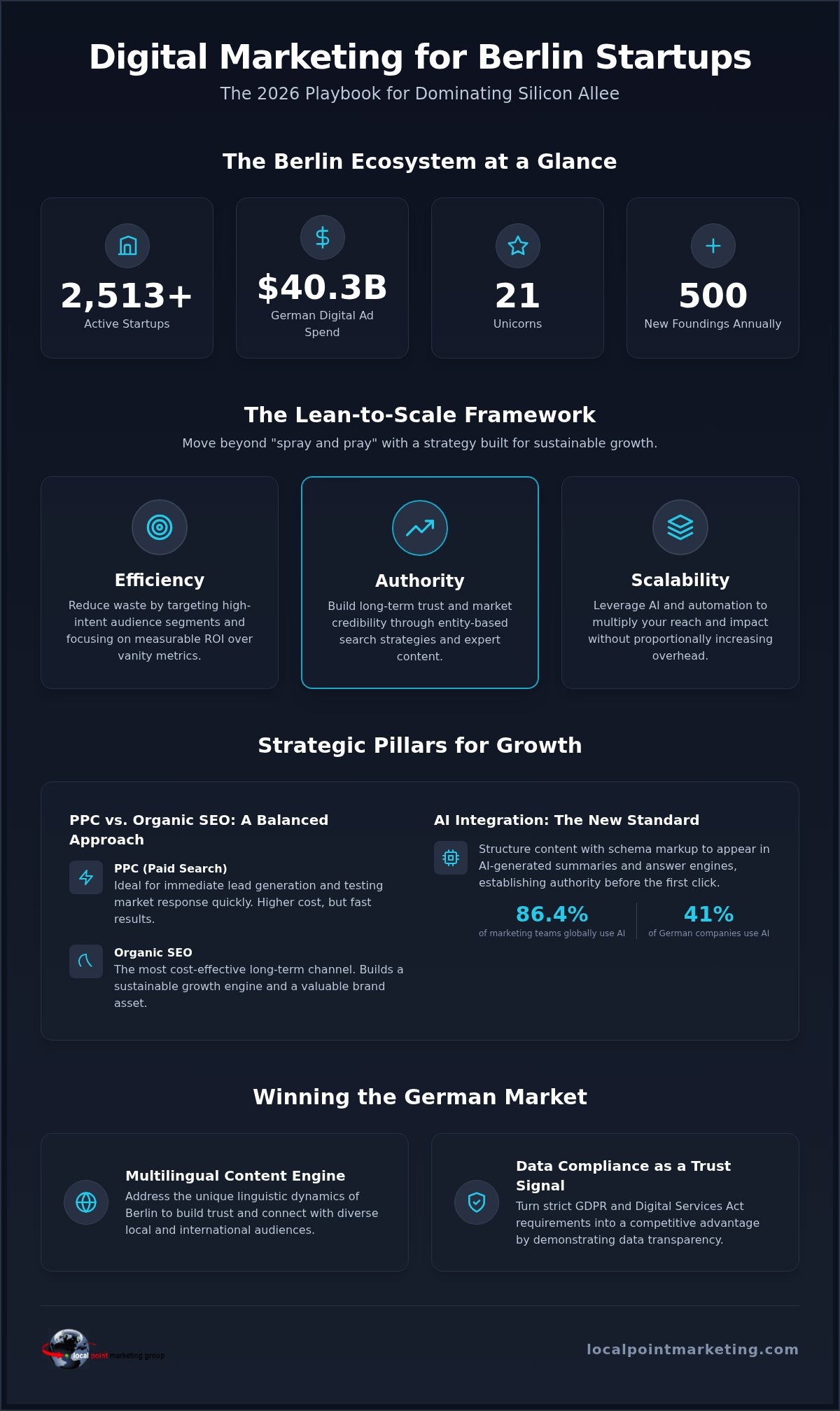
Berlin’s “Silicon Allee” has matured into a global powerhouse. As of 2026, the city hosts over 2,513 startups and 21 unicorns. This density creates a significant challenge for new entrants. Competition for digital attention is at an all-time high. The old “spray and pray” approach, where founders spent broad budgets hoping for a lead, no longer works in the German capital. With digital ad spend in Germany projected to reach $40.32 billion this year, high customer acquisition costs demand a more surgical approach to digital marketing for startups in Berlin. Success now requires shifting from growth-at-all-costs to a sustainable, ROI-driven strategy that prioritizes measurable impact over vanity metrics.

The Berlin Tech Landscape: Beyond the Hype

Effective marketing begins by identifying your specific niche. Berlin’s ecosystem is defined by distinct clusters in Fintech, SaaS, and AI. Each sector has unique audience behaviors. While startups focus on rapid scaling, they must also interface with the German “Mittelstand,” or medium-sized businesses. These established companies value stability and local presence. According to the German Startups Association, building B2B trust in this market requires demonstrating a deep understanding of local business culture. The city sees approximately 500 new startup foundings annually. Standing out in this volume means you can’t rely on generic messaging. You need a strategy that reflects the specific dynamics of the Berlin market.

Regulatory Hurdles as a Competitive Advantage

Privacy is a core value in the German market. As of June 15, 2026, GDPR enforcement includes stricter national additions. For instance, any company with 20 or more employees must appoint a Data Protection Officer if they handle personal data. Instead of viewing these rules as obstacles, successful founders use them as a brand trust signal. Data sovereignty is now a critical component of your marketing stack. Clients and users are more likely to engage with brands that demonstrate clear compliance. At Local Point Marketing, we integrate these compliance requirements into your strategy from the start. We ensure that your lead generation processes are both effective and fully aligned with the latest German Digital Services Act standards. This methodical approach protects your brand while building long-term credibility with your target audience.

The Lean-to-Scale Framework: SEO and AI Integration for Early Growth

Scaling a new venture requires a strategy that balances immediate impact with long-term efficiency. The Lean-to-Scale framework is designed to meet this need by prioritizing high-impact, low-waste digital channels. Research shows that 86.4% of marketing teams globally now use AI to streamline their workflows. For those managing digital marketing for startups in Berlin, this means moving beyond traditional tactics. You must transition from simple keyword stuffing to entity-based search visibility. This approach helps search engines understand the context and authority of your brand, rather than just matching a phrase to a page. By integrating AI tools, you can automate your content distribution without losing the unique voice that defines your startup.

The Lean-to-Scale framework focuses on three core pillars:

  • Efficiency: Reducing waste by targeting high-intent segments.
  • Authority: Building trust through entity-based search strategies.
  • Scalability: Using AI to multiply your reach without increasing overhead.

Optimizing for Generative AI Search Results

AI search optimization for B2B startups is the process of structuring data and content to ensure high-visibility placement within generative search summaries and answer engine responses. In early 2026, 41% of German companies with 20 or more employees were already actively using AI. To appear in these AI-generated summaries, your website needs a robust technical foundation. Structured data and schema markup are no longer optional extras; they are the essential maps that guide AI crawlers. When these systems can easily parse your data, your brand is more likely to be featured as a primary source in “answer engine” results. This visibility positions your startup as a trusted authority before a user even clicks a link.

Sustainable SEO: The Foundation of Startup Growth

Organic search remains the most cost-effective long-term channel for sustainable growth. While paid ads offer speed, SEO builds an asset that delivers value for years. A successful strategy focuses on “pain-point” queries. These are the specific questions and challenges your potential customers face daily. By addressing these needs, you attract high-intent leads who are ready for a solution. For deeper technical insights into this shift, you can explore our guide on AI search optimization. Building this foundation early ensures that your growth is both scalable and resilient. If you’re ready to refine your approach, our team at Local Point Marketing can help you implement these data-driven strategies effectively.

Strategic Spending: PPC vs. Organic SEO for Berlin Startups

Founders in the German capital often face the “Startup Dilemma.” You need immediate leads to satisfy investors; however, you also need long-term authority to ensure the business survives beyond the next funding round. Over-reliance on paid advertising creates a “VC burn” trap. In this scenario, your growth stops the moment the ad budget runs out. A balanced approach to digital marketing for startups in Berlin involves using Pay-Per-Click (PPC) as a testing probe while building organic Search Engine Optimization (SEO) as your foundation. This strategy allows you to capture quick wins without sacrificing future profitability.

PPC for Startups: Testing and Validating

PPC is an essential tool for validating your value proposition in a crowded market. You can launch small-budget campaigns to identify which specific keywords actually result in conversions. This data is invaluable. It prevents you from wasting months on content that doesn’t resonate with your audience. In Berlin, targeting must be precise to reach decision-makers in hubs like Silicon Allee or the various tech parks. While the average cost-per-click for search advertising in Germany is approximately $0.97, competitive B2B terms on LinkedIn or Google Ads can be significantly higher. Use these paid channels to find your highest-converting queries. Once you’ve identified what works, you can transition that spending into long-term organic equity.

Organic SEO: The Compound Interest of Marketing

SEO is the primary service for startups that prioritize ROI-driven digital marketing. It functions much like compound interest; the work you perform today builds a “moat” around your brand that competitors cannot easily replicate. While PPC results disappear the moment you stop paying, organic visibility persists and grows over time. For startups in 2026, setting realistic expectations is vital. You should expect a timeline of four to six months before seeing significant organic traction. During this period, you focus on three core goals:

  • Authority: Establishing your brand as a thought leader in your specific niche.
  • Relevance: Creating high-quality content that addresses user pain points directly.
  • Sustainability: Reducing your long-term customer acquisition costs (CAC) through free search traffic.

Building this organic foundation ensures that your digital marketing for startups in Berlin remains resilient. By creating non-replicable content and optimizing for the latest search trends, you secure a competitive advantage that lasts for years. This methodical shift from paid to organic allows you to scale with confidence and fiscal responsibility.
Digital Marketing for Startups in Berlin: The 2026 Growth Playbook

Content That Converts: Building a Multilingual Engine in Berlin

Berlin is a unique intersection of global ambition and local precision. With over 2,500 startups calling the city home, your message must cut through a diverse, multilingual environment. Building an effective content engine is not just about producing words; it’s about creating a bridge between international investors and the local German market. To succeed in digital marketing for startups in Berlin, you need a structured approach that prioritizes relevance and trust over mere volume. This process ensures your brand remains visible while building the credibility necessary for long-term growth.

Your content strategy should follow a logical, five-step progression:

  • Step 1: Identify your primary and secondary languages. While English is the standard for the tech scene, German remains vital for local B2B partnerships.
  • Step 2: Create “Seed Content” that addresses specific startup pain points. Focus on challenges like customer acquisition costs, scaling hurdles, and data privacy.
  • Step 3: Localize, don’t just translate. Your content must reflect the cultural context and business etiquette of the German market.
  • Step 4: Distribute across relevant channels. Use LinkedIn for professional reach, Twitter (X) for tech updates, and local Berlin forums for community engagement.
  • Step 5: Measure conversion rates. High traffic is a vanity metric; focus on the high-quality leads that drive revenue.

The English-First Approach in Berlin Tech

Most ventures in the city lead with English to attract international talent and secure venture capital. Berlin startups attract roughly 32% of all venture capital invested in Germany, much of which comes from global firms. Maintaining a global brand voice allows you to stay competitive on the world stage while remaining accessible to the local ecosystem. If you need help executing this vision, our blog content creation services provide the framework for consistent, high-impact messaging. This approach ensures your brand resonates with both the Silicon Allee community and your future stakeholders.

Localizing for the German “Mittelstand”

While English drives the startup world, German-language content is often the key to unlocking B2B sales with established medium-sized businesses. These partners value detailed information, formal professionalism, and clear data. Direct translation often fails in the Berlin B2B market because it misses the specific technical vocabulary and formal tone required to establish credibility with German decision-makers. You must adapt your copy to meet these high standards of precision. By respecting these cultural nuances, you turn compliance and professionalism into a competitive advantage. If you’re ready to build a content engine that delivers results, consider a content strategy consultation with our team.

Scaling with Confidence: Choosing Your Digital Marketing Partner

Selecting a partner for digital marketing for startups in Berlin is a decision that impacts your long-term trajectory. In a city where approximately 500 new startups are founded every year, you need an ally that matches your pace. A startup-focused agency prioritizes agility and data transparency over flashy presentations. Choosing an agency that specializes in digital marketing for startups in Berlin ensures that your brand remains resilient in a crowded market. You should look for a partner that understands the specific nuances of “Silicon Allee,” including the local regulatory environment and the competitive tech clusters.

Many founders fall into the trap of “Big Agency” culture. These larger firms often come with high overhead and slow decision-making processes. Your account might be handed to junior staff who lack the experience to navigate complex growth phases. This disconnect can kill your momentum. At Local Point Marketing, we bridge the gap between high-touch boutique service and enterprise-level results. We provide the steady, methodical expertise required to scale without the friction of a traditional vendor relationship.

The “Partner” vs. “Vendor” Distinction

A true partner acts as an extension of your team. You don’t need a vendor who simply checks boxes; you need a collaborator who understands your funding cycles. We offer monthly retainers that adapt as you move from seed funding to Series A and beyond. This flexibility ensures your marketing spend remains efficient and impactful. We use advanced analytics to refine a 90-day roadmap, focusing on transparency and measurable ROI. You’ll always have access to the metrics that matter, from conversion rates to organic traffic growth. This clarity builds the trust necessary for a long-term, successful relationship.

Your 2026 Growth Starts Here

Dominating search results in 2026 is a journey that requires both technical precision and local insight. We’ve spent 10 years helping businesses navigate the digital space with confidence. For international startups, having a local Berlin partner is a significant advantage. We understand the specific dynamics of the German market and the cultural expectations of local B2B partners. This knowledge allows us to deliver results that are both measurable and sustainable. Our goal is to help you transition from a local contender to a market leader.

Ready to scale your visibility and lead generation? Contact Local Point Marketing today to begin your journey toward market leadership.

Securing Your Growth in the Berlin Market

Success in Silicon Allee requires a strategic shift from short-term tactics to a sustainable foundation. By implementing a lean-to-scale framework, you move beyond the high-burn trap and build a brand that thrives on organic equity. You’ve explored how AI integration and multilingual content can transform your visibility in a competitive landscape. Now is the time to turn these insights into a measurable 90-day roadmap. Mastering the nuances of digital marketing for startups in Berlin is easier with a steady, experienced collaborator at your side.

Local Point Marketing brings over 10 years of experience and deep local market expertise to every partnership. Our Berlin-based team uses data-driven strategies to ensure your growth is both compliant and scalable. We focus on the metrics that drive real revenue, allowing you to lead with confidence. Your future in the capital’s tech ecosystem is bright, and we’re ready to help you reach it. Partner with a Berlin Digital Marketing Expert today to start building your engine for long-term success. We look forward to scaling alongside you.

Frequently Asked Questions

Is SEO or PPC better for an early-stage startup in Berlin?

Both channels serve distinct roles in your growth strategy. PPC provides immediate validation by testing your value proposition and identifying high-converting keywords. SEO builds the long-term authority needed to reduce your customer acquisition costs over time. Most successful ventures use paid ads to capture quick wins while simultaneously investing in organic search to create a sustainable, scalable growth engine that doesn’t rely solely on ad spend.

How much should a Berlin startup spend on digital marketing per month?

Your marketing budget should align with your funding stage and specific growth targets. Early-stage companies often allocate a percentage of their total capital toward customer acquisition to prove their market fit. It’s more important to focus on the return on investment rather than a fixed total. We recommend scaling your budget as you identify which channels deliver the highest quality leads for your specific niche.

Does my startup need a German-language website to rank in Berlin?

While Berlin is a global city, having German-language content is a significant advantage for domestic search visibility. Many local B2B decision-makers and the “Mittelstand” prefer professional communication in their native language. Localizing your site helps you capture specific local search intent and builds trust with partners who value precision. A multilingual approach ensures you reach both the international tech community and the broader German market effectively.

How long does it take to see results from SEO in the competitive Berlin market?

Most startups see measurable improvements in organic visibility within four to six months. This timeline depends on the competitiveness of your sector and the current state of your technical foundation. Effective digital marketing for startups in Berlin requires consistent effort in content creation and authority building. While organic growth takes longer than paid advertising, the resulting traffic is far more cost-effective and resilient against future market shifts.

What is AI search optimization and do I need it in 2026?

AI search optimization involves structuring your content and data so generative “answer engines” can easily parse and recommend your brand. In 2026, this is essential because many users now rely on AI summaries rather than traditional lists of links. By using structured data and addressing specific user pain points, you ensure your startup appears as a primary source in these AI-generated responses, positioning you as a trusted market authority.

How can I ensure my digital marketing is GDPR compliant in Germany?

Compliance requires a methodical approach to data sovereignty and user privacy. You must implement clear consent management and ensure your website “Impressum” is accurate. As of 2026, German law requires a Data Protection Officer for companies with 20 or more employees handling personal data. Prioritizing these privacy standards from the start turns regulatory requirements into a brand trust signal that reassures your partners and customers.

What are the most effective digital marketing channels for B2B startups in Berlin?

LinkedIn and organic SEO are the most effective channels for B2B lead generation in the capital. LinkedIn allows for precise targeting of decision-makers in tech hubs like Silicon Allee. Organic search captures high-intent traffic from users actively seeking solutions to their challenges. Combining these with personalized email marketing creates a robust engine for digital marketing for startups in Berlin that drives consistent, measurable growth over the long term.

Can I manage my startup’s SEO in-house or should I hire an agency?

Managing SEO in-house is possible but often distracts founders from core product innovation. Hiring an agency provides immediate access to a full team of specialists and advanced analytics tools without the overhead of multiple full-time hires. A reliable partner offers the agility and local market knowledge needed to scale quickly. This allows your team to focus on your product while experts handle your long-term search dominance and visibility.

How to Choose a Digital Marketing Agency: The 2026 Business Growth Guide

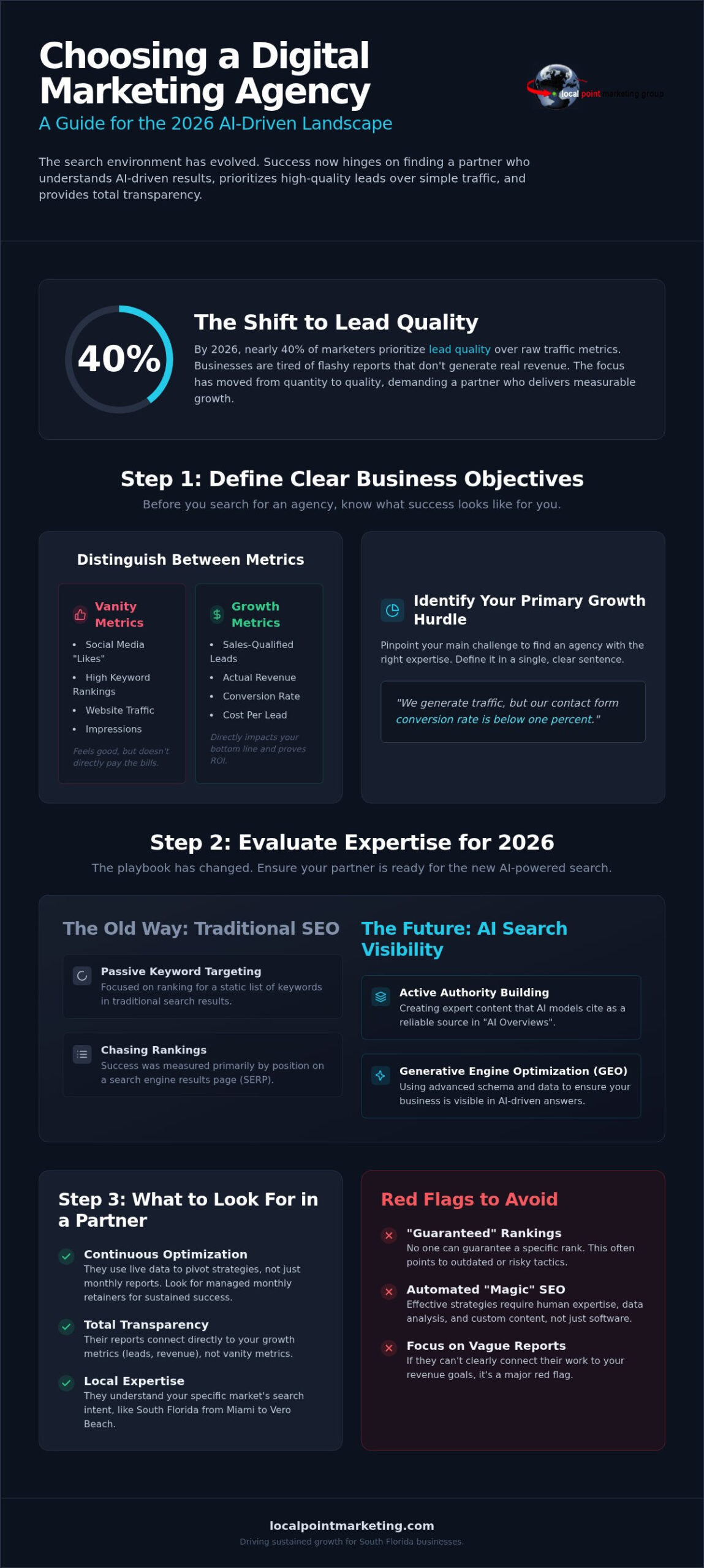
Nearly 40 percent of marketers in 2026 now prioritize lead quality over simple traffic metrics. This shift reflects a growing frustration among business owners who have watched budgets vanish into flashy reports that fail to produce actual revenue. If you feel uncertain about how your current marketing spend converts to growth, you aren’t alone. Understanding how to choose a digital marketing agency has become more complex as AI-driven search and strict data privacy laws redefine what success looks like. You need a partner who views your success as their own and provides total transparency in every report.

We understand that you want a reliable collaborator rather than just another vendor. This guide provides a clear framework for vetting partners who can master the 2026 AI search environment while delivering a measurable increase in high-quality local leads. We’ll examine the essential criteria for selection, from technical AI integration skills to the importance of first-party data strategies. By the end of this article, you’ll have the clarity needed to select a partner that acts as a true extension of your team and drives sustained growth across South Florida markets from Miami to Vero Beach.

Key Takeaways

  • Define clear business objectives and establish baseline metrics to ensure your marketing partner targets measurable lead generation and revenue growth.
  • Learn how to choose a digital marketing agency that understands the 2026 search landscape, including Generative Engine Optimization and visibility in AI-driven results.
  • Evaluate the benefits of managed monthly retainers, which offer the continuous optimization and transparency required for sustainable organic success.
  • Prioritize local expertise to ensure your campaigns resonate with specific search intent throughout South Florida, from Miami to Vero Beach.
  • Identify common red flags, such as guaranteed rankings or automated SEO, to avoid wasting budget on agencies that don’t deliver quality leads.

Defining Your Business Objectives and ROI Goals

Success in the digital space doesn’t happen by accident. Clear internal goals must come before any external search. Many business owners start by asking for “more traffic,” but traffic alone doesn’t sustain a business. You must decide if your current priority is broad brand awareness or direct lead generation. While Digital marketing offers tools for both, an agency focused on high-level visibility operates differently than one built for immediate sales conversions.

Evaluate your current baseline metrics before interviewing any firms. Look at your monthly website visitors, conversion rates, and the cost per lead you currently pay. Establishing a realistic marketing budget is also essential. We recommend basing your spend on your customer lifetime value (CLV). If a single client brings in significant revenue over several years, your acquisition budget can be more robust. This data-driven approach ensures you aren’t just spending money; you’re investing it for a specific return.

Distinguishing between vanity metrics and growth metrics is critical when learning how to choose a digital marketing agency. Social media “likes” or high keyword rankings feel good, but they are often vanity metrics. Growth metrics, such as sales-qualified leads and actual revenue from organic search, are what truly move the needle. A reliable partner will focus on these bottom-line results rather than flashy, surface-level reports.

Identifying Growth Gaps in Your Current Strategy

Every business has leaks in its sales funnel. Perhaps you’re driving traffic, but visitors aren’t converting. Or maybe your website isn’t technically ready to handle more volume. To get the most out of your search, write a single sentence that defines your primary growth hurdle. For example: “We generate traffic, but our contact form conversion rate is below one percent.” Sharing this clarity helps you identify which agency has the specific expertise to fix your unique problem. For a deeper look at these frameworks, explore our ROI-Driven Digital Marketing: The Definitive Guide for 2026.

Setting Measurable ROI Expectations

Understanding how to choose a digital marketing agency requires clarity on what constitutes a “qualified lead.” In industries like real estate or legal services throughout South Florida, a lead might be a completed consultation request rather than a newsletter signup. Set clear 30, 60, and 90-day benchmarks during initial conversations. While PPC can deliver immediate results, organic SEO and AI visibility strategies often take longer to show full impact. A trustworthy agency will be honest about these timelines and provide a roadmap that balances short-term wins with long-term stability.

Evaluating Expertise in the 2026 Search Landscape

The search environment in 2026 is fundamentally different from a few years ago. Users now interact with AI agents like ChatGPT and Gemini as much as they use traditional search bars. When learning how to choose a digital marketing agency, you must verify their proficiency in Generative Engine Optimization (GEO). This involves optimizing your brand’s presence so AI models cite your business as a reliable source. A modern partner doesn’t just chase keywords. They ensure your expertise is visible across the entire digital ecosystem. This shift requires a move from passive keyword targeting to active authority building.

High-quality content remains the foundation of success, but it needs a technical edge to thrive in 2026. Your agency should demonstrate a clear Digital Marketing Strategy: The Ultimate Guide that balances human-centric storytelling with machine-readable data. Ask prospects how they use data-driven analytics to refine strategies in real-time. If they only look at last month’s performance, they’re already behind. You want a team that uses live data to pivot as search algorithms evolve. This reactive capability is what separates a steady partner from a stagnant one.

Traditional SEO vs. AI Search Visibility

Traditional rankings still matter, but AI discovery is the new frontier. Effective agencies use advanced schema markup to help AI crawlers understand the context of your services. They also focus on creating deeply authoritative content that wins “AI Overviews.” This ensures your business appears as the recommended solution when a user asks a complex question. For specific questions to ask during your interview process, review our AI Search Optimization Guide. Winning in this space requires a blend of technical precision and creative insight.

The Importance of Data-Driven Strategy

The best agencies in 2026 have moved beyond historical reporting. Ask if they utilize predictive analytics to anticipate market shifts before they happen. A high-performing partner should provide an example of a 2026 performance report that tracks the entire customer journey with precision. This means seeing how a user first discovered you through an AI prompt, engaged with your social media, and eventually converted through an email campaign. Verifying they can track these multi-touch attributions is a vital step in how to choose a digital marketing agency. If you’re ready to see how a data-driven partner can elevate your brand, focus on agencies that prioritize these transparent, full-funnel metrics.

Vetting the Agency Partnership and Process

A digital marketing agency should function as a seamless extension of your own team. When you’re deciding how to choose a digital marketing agency, the internal processes they use are just as important as the results they promise. You need a partner who understands your internal workflow and can integrate with your existing sales team to ensure leads are handled effectively. This alignment prevents high-quality leads from falling through the cracks. Before you sign any contracts, it’s helpful to review the SBA’s guide to creating a marketing plan to ensure your foundational strategy is sound. This preparation allows you to enter the partnership with clear expectations for both execution and communication.

Managed Retainers vs. One-Off Projects

Success in 2026 requires consistency. One-off projects or “set it and forget it” setups often fail because search algorithms and AI models evolve weekly. A managed monthly retainer provides the flexibility needed for continuous optimization. It allows your agency to perform ongoing A/B testing on your landing pages and adjust strategies based on real-time performance data. Project-based SEO is risky; it leaves your business vulnerable to sudden ranking drops without a team ready to pivot. Working with a dedicated digital marketing retainer agency ensures your brand stays ahead of competitors by constantly refining your digital presence. It fosters a long-term relationship where the agency is invested in your sustained growth rather than just a quick delivery.

Assessing Communication and Transparency

Transparency builds trust. You should always know exactly where your marketing spend is going and how it’s performing. Ask potential agencies about the project management tools they use and how often they provide reports. You deserve real-time access to your campaign data rather than waiting for a monthly PDF that only highlights positive numbers. It’s also vital to confirm your primary point of contact. Some agencies use general account managers, while others give you direct access to specialists. Understanding who is responsible for your results is a key part of how to choose a digital marketing agency. To understand what a high-quality report looks like, refer to our Measuring SEO Success Guide. Clear reporting ensures you can track every dollar spent back to revenue generated.

How to Choose a Digital Marketing Agency: The 2026 Business Growth Guide

Local Expertise: Why Geographic Context Matters

Geography plays a critical role in the effectiveness of your digital presence. While SEO principles are universal, the application of those principles depends heavily on local market dynamics. A firm based in Miami or Fort Lauderdale understands the local search intent that a global agency often misses. When you consider how to choose a digital marketing agency, look for a partner that knows your specific neighborhood. They understand the nuances of “near me” search queries and how to capture high-intent local traffic effectively. This requires more than just adding a city name to a page. It involves understanding local landmarks, community events, and the specific way residents in Fort Pierce or Vero Beach search for services. Local link building and community-specific content are the keys to standing out in a crowded digital space. The same principles that drive results for SEO services Berlin CT businesses rely on — deep local authority and AI-driven visibility — apply equally to competitive South Florida markets.

Winning the South Florida Market

Marketing to diverse populations requires a tailored approach. The strategy for a business in Boca Raton often focuses on high-end service expectations, while a campaign in Port St. Lucie might prioritize family-oriented value and rapid residential growth. Similarly, local SEO for Palm Beach and Jupiter requires a different competitive lens than Stuart or Palm City. A local partner recognizes these patterns and adjusts your content accordingly. They understand that a customer in Miami has different expectations and search behaviors than one in a quieter coastal town. For a deeper look at these strategies, refer to our Local SEO Guide for South Florida. This geographic context ensures your marketing spend resonates with the people most likely to become customers.

Questioning Local Case Studies

When vetting prospects, ask for specific examples of businesses they have supported along the Treasure Coast or the Gold Coast. It’s not enough to see a list of logos; you need to verify if the growth was sustained or just a temporary spike. A reliable partner will show you how they maintained lead quality over time in competitive markets like Fort Lauderdale or Miami. Ask about their experience navigating the high competition levels in these specific areas. Check for reviews from other local business owners to gauge their reputation and reliability. You can find detailed insights and common questions in our Palm Beach FAQ article. Choosing a partner with a proven track record in your backyard provides a level of reassurance that a distant firm simply cannot match. If you are ready to work with an expert South Florida agency that prioritizes your local growth, focus on partners who value evidence over hype.

Final Decision: Red Flags and Onboarding

Making the final selection is the most critical step in how to choose a digital marketing agency. It requires a balance of logical vetting and professional intuition. You want to ensure the agency operates with the same integrity and focus on results that you do. A partner should feel like a collaborator who shares your vision for growth across the South Florida market. This final stage is about moving past the sales pitch and verifying the agency’s ability to act as a steady, dependable extension of your team.

Red Flags to Watch For

Watch out for agencies that promise “guaranteed” rankings. In the 2026 AI-driven search landscape, no one can guarantee a specific spot because algorithms shift in real-time. Another warning sign is a lack of transparency regarding account access. You should always own your data and your ad accounts. Understanding these warning signs is a vital part of how to choose a digital marketing agency. If an agency refuses to share their specific link-building tactics or focuses on traffic rather than your specific ROI, it’s a signal to look elsewhere. To help you identify these issues before they become expensive mistakes, review our When to Switch SEO Agencies Checklist. Avoid low-cost “automated” SEO services that lack the human expertise needed for modern authority building.

The Onboarding Experience

The first 30 days of a partnership set the tone for your future success. A professional agency will have a structured onboarding process designed to align their team with your business objectives. This phase usually begins with a deep technical audit and comprehensive competitive research. They should analyze how your competitors in Miami, Boca Raton, or Jupiter are currently winning in AI search results. Strategy alignment meetings are essential during this time to ensure everyone understands the 30, 60, and 90-day benchmarks. Establishing a consistent cadence for monthly performance reviews ensures you stay informed about how your marketing spend converts to revenue.

Review your contract for flexibility rather than just length. A reliable expert partner will offer performance-based milestones that hold them accountable for high-quality lead generation. Trust your instincts during the final interview. If the agency feels like a transactional vendor rather than a strategic partner, they likely won’t provide the level of care your business deserves. Choosing a firm that values evidence over hype will provide the steady, managed growth needed to thrive in the years ahead.

Building a Foundation for Sustained Growth

Selecting the right partner is about more than just checking boxes. It’s about finding a team that integrates with your vision and understands the nuances of the 2026 search landscape. Success requires a shift from chasing rankings to capturing measurable revenue through AI visibility and local authority. When you understand how to choose a digital marketing agency, you move from being a client to becoming a collaborator in a high-performing partnership. This transition ensures your marketing spend is no longer a cost, but a strategic investment in your future.

Local Point Marketing brings over 10 years of South Florida expertise to every engagement. We provide data-backed reporting focused on lead generation and specialize in the technical demands of AI search visibility and local SEO. If you’re ready to move beyond the hype and focus on evidence, partner with Local Point Marketing for ROI-driven growth. Our managed SEO retainers provide the continuous optimization required to stay ahead in competitive markets from Miami to Vero Beach. Your business deserves a reliable expert partner dedicated to your long-term success.

Frequently Asked Questions

What is the average cost of a digital marketing agency in 2026?

Most digital marketing engagements in 2026 are structured as monthly retainers that vary based on the scope of work. When researching how to choose a digital marketing agency, you’ll find that your specific investment depends on your growth goals and the competitive landscape of your industry. A reliable partner will provide a transparent breakdown of how your budget supports specific lead generation targets and technical requirements for your business.

How long does it take to see results from a new marketing agency?

Initial indicators of success often appear within the first 90 days of a partnership. While PPC campaigns can generate traffic almost immediately, organic strategies like SEO and AI visibility typically require four to six months to reach full momentum. This timeline allows for technical audits, content creation, and the accumulation of authority signals that search engines and AI models require to recommend your business to local users.

Should I hire a local agency or a remote one for my South Florida business?

Hiring a local agency offers significant advantages for businesses targeting the South Florida market. A firm with local expertise understands the specific search behaviors of residents from Miami to Vero Beach and can build community-specific authority that remote firms often overlook. This geographic context is essential for capturing high-intent “near me” queries and navigating the competitive landscape of the Gold Coast and Treasure Coast markets effectively.

What questions should I ask during a digital marketing agency interview?

Focus your interview on transparency and data-driven methodology. Ask how they optimize for AI search results like ChatGPT and what specific metrics they use to track lead quality. You should also inquire about their reporting frequency and who your primary point of contact will be. Understanding their approach to first-party data and regulatory compliance is also vital when learning how to choose a digital marketing agency that aligns with your objectives.

Is it better to hire a full-service agency or a specialized SEO firm?

A full-service agency is often the better choice for businesses looking for a cohesive strategy across multiple channels. While specialized firms excel in one area, a full-service partner ensures your SEO, content creation, and email marketing work together to drive a single ROI goal. This integrated approach prevents data silos and ensures a consistent brand voice across the entire customer journey, from initial AI discovery to the final conversion.

What are the signs that I need to switch my current marketing agency?

Stagnant lead quality and a lack of transparency in reporting are the primary indicators that it’s time to find a new partner. If your current agency provides reports filled with vanity metrics like impressions rather than actual revenue growth, they aren’t focused on your bottom line. A lack of communication regarding AI search updates or a failure to adapt to shifting South Florida market trends are also clear signs of a misalignment.

How do agencies stay ahead of AI search engine updates?

Agencies stay ahead of AI updates by prioritizing technical schema markup and high-quality, authoritative content. In 2026, this involves moving beyond traditional keywords to focus on Generative Engine Optimization (GEO). A proactive partner utilizes predictive analytics to anticipate algorithm shifts and ensures your content is machine-readable for AI agents. This methodical approach ensures your business remains a cited source in AI overviews and traditional search results alike.

What is the difference between a project fee and a monthly retainer?

A project fee covers a one-time deliverable like a technical audit, while a monthly retainer supports continuous optimization and managed growth. Retainers are the preferred model for long-term success because they allow for ongoing A/B testing and rapid responses to search algorithm changes. To understand the full strategic advantages of this model, explore our guide to partnering with a digital marketing retainer agency for long-term growth. This structure ensures your agency is a consistent collaborator that evolves with your business, providing the steady oversight needed to maintain visibility in a dynamic digital environment.