
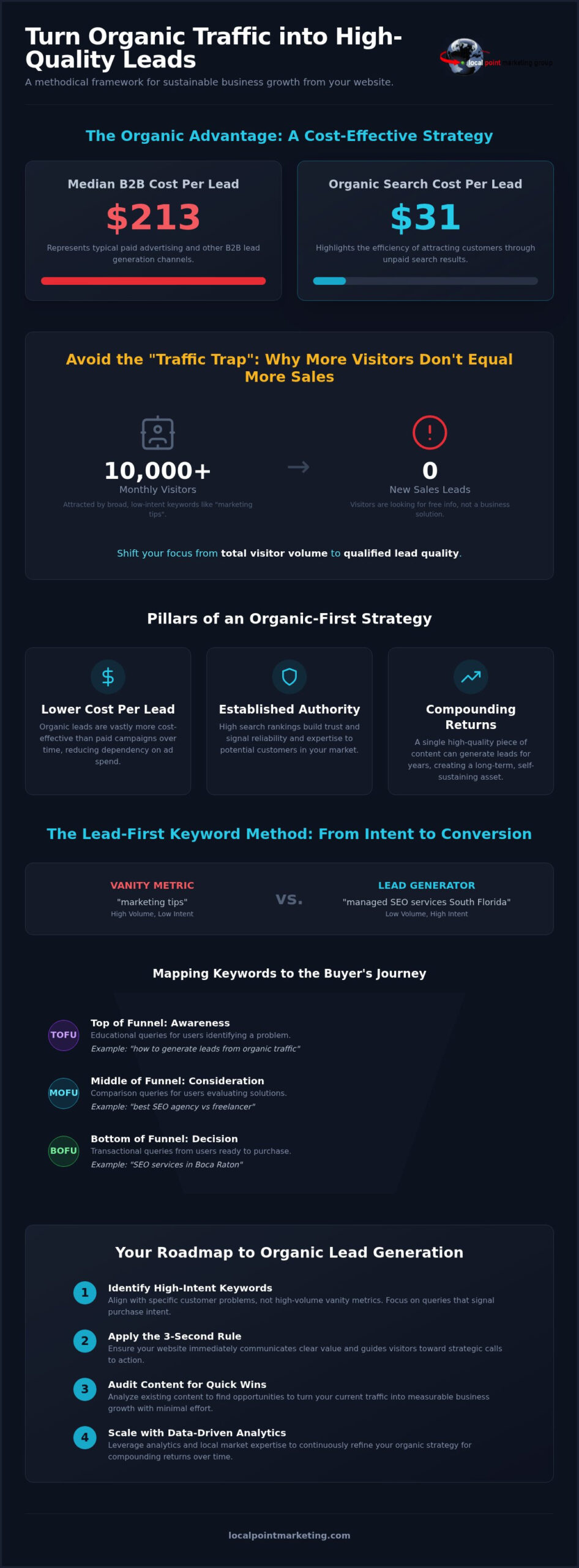
While the median B2B cost per lead has climbed to $213 this year, the average cost per lead for organic search remains significantly lower at approximately $31. This data highlights a clear opportunity for businesses to grow sustainably. You’ve likely felt the frustration of watching your website traffic increase while your actual sales numbers stay flat. It’s easy to feel overwhelmed by technical jargon or discouraged when you’re unsure how to generate leads from organic traffic effectively. These common challenges often lead to wasted time on content that fails to produce measurable results.
We’ve developed a methodical framework to help you turn passive website visitors into high-quality business leads without the need for a larger advertising budget. This article provides a clear roadmap to help you increase your lead volume and achieve a better ROI from your existing content. We’ll show you how to identify keywords that drive revenue and create a user experience that empowers your visitors to take the next step. By the end of this guide, you’ll have the tools to transform your digital presence into a reliable engine for growth.
Key Takeaways
- Identify high-intent keywords that align with your customers’ specific problems rather than chasing high-volume vanity metrics.
- Learn the methodical framework for how to generate leads from organic traffic by shifting your focus from total visitor volume to lead quality.
- Implement the 3-second rule to ensure your website communicates clear value and guides visitors toward strategic calls to action immediately.
- Audit your existing content to uncover quick win opportunities that turn current traffic into measurable business growth.
- Scale your success by leveraging data-driven analytics and local market expertise to refine your organic strategy over time.
Understanding Organic Lead Generation: Why Traffic Is Only the Start
Organic lead generation is the methodical process of attracting potential customers through unpaid search engine results. Unlike paid advertising, which stops the moment your budget runs out, organic strategies build a permanent foundation for your digital presence. Understanding how to generate leads from organic traffic requires a shift in perspective. You must move past vanity metrics and focus on the actual business outcomes that drive growth. This approach transforms your website from a simple digital brochure into a sustainable, long-term asset.
Many business owners fall into the “Traffic Trap.” They celebrate when monthly visitors reach 10,000, yet they see zero growth in their sales pipeline. This disconnect happens when content attracts people who are looking for free information rather than specific solutions. In 2026, the definition of a “visit” is also evolving. AI-powered search engines now provide direct answers, which means every click to your site carries higher intent. Research indicates that traffic from AI search referrals converts at a rate of 3.49 percent. This is 22 percent higher than traditional organic search, making high-quality content more valuable than ever.
Traffic vs. Qualified Leads
There is a fundamental difference between a visitor who is browsing and one who is ready to buy. Broad keywords often fail to generate ROI for local businesses because they lack specific intent. For example, ranking for a generic term like “marketing tips” provides little value to a firm serving the Miami market compared to ranking for “managed SEO services South Florida.” Prioritizing lead quality over click quantity ensures that your team spends time on prospects who are genuinely interested in your offerings. This focus on qualified leads reduces wasted effort and improves your overall conversion rates.
The Benefits of an Organic-First Strategy
Focusing on organic growth creates a sustainable asset that reduces your dependency on fluctuating ad prices. The median cost per lead for organic search is approximately $31. This is significantly lower than the $110 average cost for PPC or search ads. Beyond the financial savings, organic rankings build higher levels of trust with your audience. People often view top organic results as more credible than sponsored placements. This credibility is vital in competitive markets like Miami and Palm Beach.
- Lower CPL: Organic leads are more cost-effective than aggressive paid campaigns over time.
- Established Authority: High rankings signal reliability and expertise to local searchers.
- Compounding Returns: A single piece of high-quality content can generate leads for years without additional investment.
Targeting High-Intent Keywords: The Lead-First Research Method
High search volume is often a vanity metric that distracts from actual growth. While it’s tempting to chase keywords with tens of thousands of monthly searches, these broad terms usually attract people who are merely browsing. To master how to generate leads from organic traffic, you must prioritize intent over volume. High-intent keywords are specific queries that indicate a user is ready to solve a problem or make a purchase. These often have lower search volumes but significantly higher conversion rates because they align with a prospect’s immediate needs.
The “Problem-Solution” framework is an effective way to uncover these opportunities. Start by identifying the specific pain points your customers face daily. Instead of targeting generic terms, look for queries that describe a struggle. For businesses in the Miami and Fort Lauderdale markets, this means analyzing competitor gaps. Many local firms focus on broad industry terms while neglecting the specific questions their customers ask. By leveraging long-tail queries, you can capture users at the exact moment they’re looking for an expert partner to provide a solution.
Mapping Keywords to the Buyer’s Journey
Successful lead generation requires content for every stage of the decision-making process. Top of Funnel (TOFU) queries are educational, such as “how to generate leads from organic traffic.” Middle of Funnel (MOFU) searches involve comparisons, like “best SEO agency vs freelancer.” Finally, Bottom of Funnel (BOFU) queries are transactional and highly localized, such as “SEO services in Boca Raton.” Providing the right information at each stage builds the trust necessary to move a visitor toward a phone call or contact form submission.
Local Intent and Geographic Modifiers
South Florida is a diverse and competitive landscape where “near me” modifiers are no longer sufficient. To stand out, your strategy should incorporate neighborhood-specific terms naturally. A business serving Palm Beach needs to speak directly to that community while also appearing for searches in Jupiter or Stuart. Integrating these geographic modifiers into your content signals relevance to both search engines and local users. Our team at Local Point Marketing uses this methodical approach to ensure your brand remains visible where your customers actually live and work. Balancing broad educational pieces with hyper-local service pages creates a comprehensive web of visibility that captures high-quality leads consistently.
Optimizing Your Website for Conversion: Turning Clicks into Calls
Attracting visitors through search engines is a significant achievement, but your growth depends on what happens after the click. You must master how to generate leads from organic traffic by creating a seamless transition from reader to prospect. This process begins with the 3-second rule. Visitors from Miami to Vero Beach often decide whether to stay on your site within moments of landing. Your page must communicate clear value immediately. If a visitor cannot identify how you solve their specific problem within three seconds, they will likely return to the search results.
Mobile-first optimization is no longer optional for South Florida businesses. Google’s 2026 algorithm updates place a heavy emphasis on user experience signals like page load speed and intuitive navigation. A slow mobile site acts as a barrier to your lead flow. Most local searches happen on the move, and a frustrating mobile experience will cause potential clients to abandon their journey. Ensuring your site is responsive and fast protects your ranking and keeps your conversion funnel open.
Crafting High-Conversion Calls to Action (CTAs)
Strategic CTA placement is about more than just having a “Contact Us” page. You should use low-friction offers to encourage engagement without overwhelming the visitor. Free audits, local industry guides, or checklists are excellent ways to capture contact information early in the buyer’s journey. Use action-oriented language that tells the user exactly what to expect. Instead of a generic “Submit” button, try “Get My Free SEO Audit” or “Download the Miami Growth Guide.” Matching the intensity of your CTA to the content’s funnel stage ensures you aren’t asking for a sale before you’ve established value.
Trust Signals for South Florida Businesses
Building authority requires consistent trust signals that resonate with a local audience. Highlighting local awards, certifications, and community involvement shows that you’re an established part of the regional economy. Authentic testimonials from recognizable local clients provide the social proof necessary to reassure new visitors. Professional blog content creation services play a vital role here by demonstrating your expertise through helpful, data-driven articles. Finally, ensure your Name, Address, and Phone number (NAP) are consistent across every page. This technical detail builds trust with both users and search engines, confirming your business is a reliable local partner.
A 5-Step Roadmap to Increase Website Traffic Organically
Building a reliable engine for growth requires more than just publishing occasional updates. You need a structured execution plan that prioritizes high-impact activities. This 5-step roadmap outlines how to generate leads from organic traffic by focusing on data-driven improvements and local relevance. By following a methodical sequence, you transform your website into a high-performing business asset that works for you around the clock.
Step 1 & 2: Auditing and Content Strategy
Start by auditing your existing assets to identify “Quick Win” opportunities. Many businesses have older blog posts that attract steady traffic but fail to convert visitors into leads. Refreshing these pages with updated data, modern insights, and clearer calls to action can produce immediate results. Your plan should mirror the Local SEO Guide for South Florida Businesses to ensure you’re targeting the right regional intent. A content strategy is a structured roadmap for building authority and guiding prospects toward a solution. For Fort Lauderdale businesses specifically, a dedicated content marketing strategy for Fort Lauderdale can provide the structured growth template needed to turn local searchers into loyal customers.
Step 3: Optimizing for the AI Era
In 2026, capturing visibility in AI-generated answers is essential for maintaining a competitive edge. You must structure your content for easy extraction by using clear headings and providing concise, direct answers to common customer questions. Google’s continued focus on Experience, Expertise, Authoritativeness, and Trust (E-E-A-T) means that generic content will no longer rank well. Authenticity and first-hand experience are your greatest defenses against algorithm shifts. Investing in professional SEO content writing services ensures your content is structured to earn authority and appear in AI-generated answers. For deep technical tactics on appearing in generative search results, refer to our AI Search Optimization Guide.
Step 4 involves building local authority through strategic link-building. Focus on securing mentions from reputable South Florida organizations, local news outlets, and industry-specific directories. These signals tell search engines that your business is a trusted partner within the Miami and Palm Beach communities. This local relevance is a powerful ranking factor that broad, national competitors cannot easily replicate.
Finally, implement rigorous lead tracking and analytics. You cannot improve what you don’t measure. Use advanced tracking tools to connect specific content pieces to actual revenue and phone calls. This transparency allows you to refine your strategy based on evidence rather than guesswork. If you’re ready to implement this roadmap and see measurable results, partner with Local Point Marketing to develop a managed SEO strategy tailored to your business goals.
Scaling Your Results with a Managed SEO Partner
Implementing a strategy for how to generate leads from organic traffic is a significant first step toward digital independence. However, maintaining that momentum requires consistent attention and specialized expertise that many busy owners simply cannot spare. Many local business owners find that their initial results plateau because they lack the resources to monitor shifting algorithm trends or refine their content daily. Scaling your results involves moving beyond basic implementation toward a sophisticated, data-driven approach that maximizes every visitor’s potential.
A professional partnership provides the high-level strategy needed to turn search data into actual sales growth in the Miami and Fort Lauderdale markets. We focus on measurable outcomes rather than just ranking positions. By integrating your search efforts with a comprehensive social media marketing strategy, you create a holistic lead engine. This multi-channel approach ensures your brand remains visible across the entire digital landscape, reinforcing your authority and making your business the obvious choice for local customers.
The Managed SEO Advantage
Managed SEO offers a continuous optimization cycle that one-time projects or DIY efforts cannot match. You gain access to professional-grade tools and high-level strategy that clarify your specific path to success. This shift allows you to move from guesswork to measurable growth with complete confidence. Instead of wondering which tactics are working, you receive clear reports that link your organic visibility directly to your bottom line. This methodical approach is why we have spent 10 years helping businesses from Miami to Vero Beach achieve sustainable, predictable ROI.
Your Next Steps for Organic Growth
Taking the next step toward a more profitable digital presence doesn’t have to be overwhelming. You can begin improving your lead volume by focusing on these immediate actions:
- Identify your top 3 high-intent keywords this week to focus your content efforts on revenue-generating terms.
- Analyze your lead capture forms for friction points that might be discouraging visitors from completing their inquiry.
- Schedule a consultation with a reliable expert partner to evaluate your current strategy and identify growth opportunities.
We are here to help you navigate the complexities of the 2026 search landscape. Our team provides the steady, capable support you need to reach your growth goals with confidence. By choosing a partner who understands the South Florida market, you ensure your business remains a leader in your industry for years to come.
Building Your Sustainable Path to Growth
Sustainable business growth in the South Florida market requires a shift from chasing vanity metrics to capturing genuine intent. By prioritizing high-quality content and optimizing for conversion, you build a digital asset that works for you every day. Mastering how to generate leads from organic traffic isn’t just about ranking. It’s about creating a reliable, trustworthy path for your customers to find the solutions they need. This methodical approach ensures your brand remains a leader in the Miami and Palm Beach communities as search behaviors continue to evolve.
Our team brings 10+ years of South Florida marketing expertise to every partnership. We provide data-driven analytics and customized local SEO strategies that turn complex search data into measurable success. If you’re ready to move past the traffic trap and start seeing a higher ROI from your digital presence, we invite you to Request a Free SEO and Lead Generation Audit. Your path to a more profitable and predictable future starts with a single methodical step. We’re ready to help you reach your goals with confidence.
Frequently Asked Questions
How long does it take to generate leads from organic traffic?
It typically takes six to twelve months to see measurable traffic gains from a new campaign. Full ROI is often realized between twelve and eighteen months. While this timeline is longer than paid ads, the results are more sustainable. You can accelerate this by auditing existing content for quick wins. This approach allows you to understand how to generate leads from organic traffic by improving assets you already own.
Is organic lead generation actually free?
Organic lead generation is unpaid in terms of media spend, but it isn’t strictly free. Success requires a consistent investment in high-quality content creation and technical optimization. You may choose to handle this internally or partner with a managed service provider. While there are no per-click costs, the resources required to build authority and trust are significant. It’s a long-term investment that reduces your dependency on expensive advertising platforms over time.
Why is my website getting traffic but no leads?
This disconnect usually happens when your content attracts informational seekers rather than buyers. If you rank for broad terms, you might get visitors who aren’t ready to purchase. Another common reason is high friction on your website. Slow page speeds or confusing contact forms can stop a prospect before they reach out. You must align your content with high-intent queries and ensure your user experience is seamless for South Florida visitors.
What is the best type of content for generating leads?
Case studies and problem-solution guides are among the most effective formats for driving conversions. These pieces demonstrate your expertise while addressing specific pain points your customers face. For local businesses, hyper-local service pages that include neighborhood-specific details also perform exceptionally well. This content builds trust by showing you understand the local market. Providing clear, actionable value helps move a visitor from the educational phase into the decision-making stage of their buyer journey.
Do I need a big budget to start organic lead generation?
You don’t need a massive budget to begin improving your organic results. Many businesses start by refreshing existing blog posts or optimizing their core service pages for local search. As your traffic increases and you see a return on investment, you can scale your efforts with more comprehensive strategies. The key is to focus on methodical growth rather than trying to compete for every keyword at once. Small, data-driven improvements lead to significant long-term gains.
How do I track where my organic leads are coming from?
Tracking your leads requires a combination of analytics tools and CRM integration. You should use Google Analytics 4 to monitor which specific pages are driving the most conversions. Call tracking software is also essential for local businesses to identify which search terms lead to phone inquiries. By connecting these data points, you gain a clear understanding of how to generate leads from organic traffic effectively. This transparency allows you to allocate resources toward the most profitable content.
Can AI search replace traditional organic lead generation in 2026?
AI search won’t replace organic lead generation; instead, it’s becoming a critical layer of the search landscape. While AI tools provide quick answers, users still visit websites for detailed expertise and to establish trust. Appearing in AI-generated summaries is a new way to capture high-intent traffic. Your goal should be to create authoritative content that AI engines want to cite. This strategy ensures you remain visible regardless of how search interfaces change for your audience.