
You’ve done everything right: built a website, set up your business, and waited for customers to find you online. But when you search for your own business, it’s nowhere to be found. If you’re asking yourself why is my business not showing on Google, you’re not alone, and more importantly, there’s a clear path forward.
That frustration is real. Poor visibility doesn’t just hurt your pride; it directly limits the number of customers who can discover what you offer. And when you’re unsure whether your marketing efforts are even working, every dollar spent feels like a gamble.
The good news is that Google’s ranking factors are not a mystery. They follow consistent patterns, and once you understand what’s working against your visibility, you can take targeted steps to correct it. In this guide, you’ll learn the most common reasons businesses disappear from Google search results, along with practical, proven strategies to improve your online presence and start attracting the customers you deserve.
Key Takeaways
- Understanding why is my business not showing on Google starts with identifying the root cause – from technical indexing errors to incomplete local listings, each issue has a targeted fix.
- Technical problems like broken links, crawl errors, and improper redirects can silently suppress your visibility, even when your content is strong.
- High-quality, relevant content is one of Google’s most consistent ranking signals – businesses that align their content with what their audience is actively searching for gain a measurable edge.
- A fully optimized Google Business Profile, supported by accurate local citations, is one of the most impactful steps a local business can take to improve search visibility.
- Improving your Google presence is not a one-time fix – a structured action plan with clear, measurable goals is what separates businesses that see lasting results from those that don’t.
Understanding Google Visibility: Why Your Business Might Not Be Showing
Google visibility refers to how easily your business appears in search results when potential customers look for the products or services you offer. It’s not a single metric but a combination of signals that Google evaluates to decide which businesses deserve a place on the first page. For most businesses serving markets like Miami, Fort Lauderdale, and Boca Raton, that first page is where growth happens. If your business isn’t there, you’re effectively invisible to a large portion of your potential market across South Florida and beyond.
Google’s ranking process involves automated systems called crawlers that scan websites, evaluate their content and technical structure, and determine relevance against specific search queries. The algorithm weighs hundreds of factors, from the quality of your content and the strength of your backlink profile to how your site performs on mobile devices. No single factor guarantees visibility, but several common issues consistently suppress rankings across industries and regions throughout the United States.
Common Reasons Businesses Don’t Show Up on Google
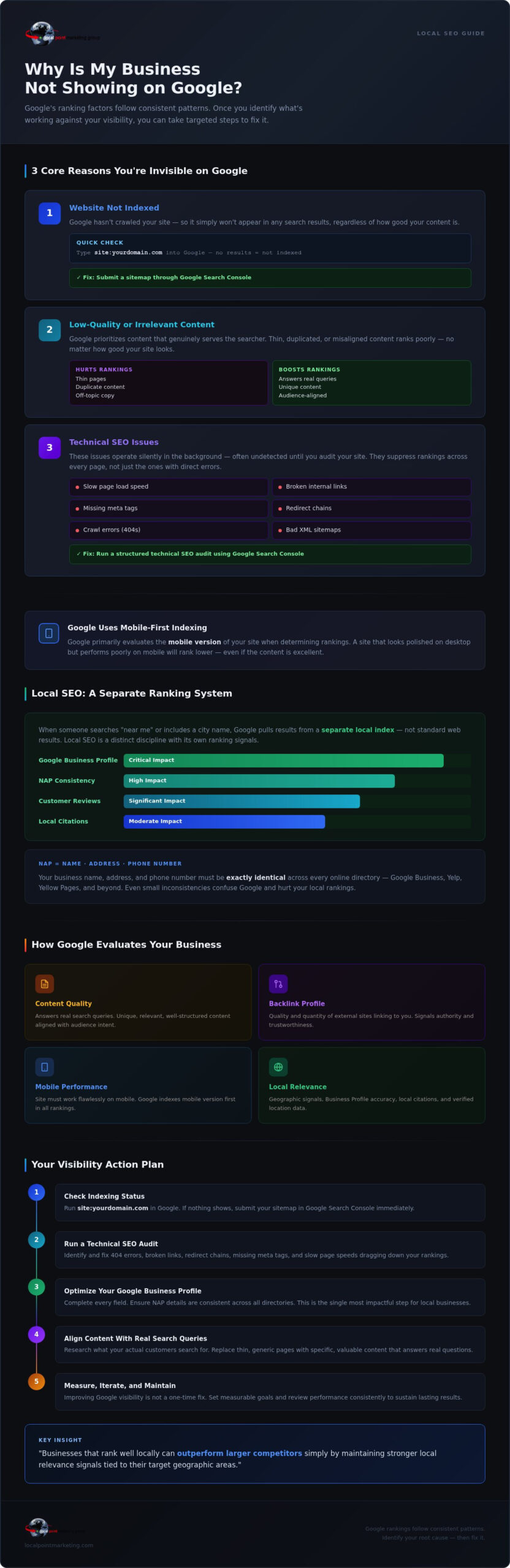
Understanding why is my business not showing on Google often comes down to three core problem areas:
- Website not indexed: If Google hasn’t crawled and indexed your site, it simply won’t appear in search results. You can check this by entering site:yourdomain.com into Google’s search bar. No results means no index. Submitting a sitemap through Google Search Console is the fastest way to address this.
- Low-quality or irrelevant content: Google prioritizes content that genuinely serves the searcher. Pages that are thin, duplicated, or misaligned with what your audience is actually searching for will consistently rank poorly, regardless of how well-designed your site looks.
- Technical SEO issues: Slow page load speeds, broken links, missing meta tags, improper redirects, and crawl errors can all prevent Google from accurately reading and ranking your site. These issues often go undetected without a structured audit.
The Role of Local SEO
Local SEO operates differently from general search rankings. When someone in Boca Raton, Miami, or Fort Lauderdale searches for a service “near me” or includes a city name in their query, Google pulls results from a separate local index, prioritizing businesses with strong geographic relevance signals. This makes local SEO a distinct discipline, not just a subset of standard SEO, and it is especially critical for businesses competing across South Florida’s densely populated markets.
Key factors that influence local search visibility include the accuracy of your Google Business Profile, the consistency of your name, address, and phone number across online directories, and the volume and quality of your customer reviews. For businesses serving specific regions of the United States — from Fort Lauderdale and Miami to communities throughout Broward and Palm Beach counties — these signals carry significant weight. At Local Point Marketing, we’ve seen businesses that rank well locally outperform larger competitors simply by maintaining stronger local relevance signals tied to their target geographic areas.
Recognizing which of these factors is working against you in your specific market is the essential first step toward reclaiming your visibility online.
Technical Issues That May Affect Your Business’s Visibility
Even a well-designed website can be completely invisible to Google if technical problems are preventing it from being properly crawled and indexed. These issues often operate silently in the background, and many business owners don’t realize they exist until they start asking why is my business not showing on Google. Identifying them early saves significant time and prevents months of wasted effort on content that Google simply can’t access.
Technical SEO covers the structural and performance-related factors that determine how effectively Google can read your site. Common culprits include 404 error pages, broken internal links, redirect chains, duplicate content, and missing or misconfigured XML sitemaps. Each one signals to Google that your site may not be reliable or well-maintained, which can suppress your rankings across every page, not just the ones with direct errors.
Mobile-friendliness is another factor that carries real weight. Google uses mobile-first indexing, meaning it primarily evaluates the mobile version of your site when determining rankings. A site that looks polished on a desktop but performs poorly on a smartphone is at a structural disadvantage, regardless of its content quality.
Site speed compounds the problem further. Slow-loading pages increase bounce rates, reduce engagement, and directly affect how Google scores your site’s overall user experience. Core Web Vitals, Google’s framework for measuring real-world page performance, now factor into rankings. Pages that load slowly, shift unexpectedly during load, or delay interaction are scored lower as a result.
How to Check for Technical Issues
A structured audit is the most reliable starting point. These tools give you a clear picture of what’s working against your visibility:
- Google Search Console: Reveals crawl errors, indexing problems, mobile usability issues, and Core Web Vitals scores. The Coverage report shows exactly which pages Google has indexed and which have been excluded.
- Google PageSpeed Insights: Diagnoses speed and performance issues on both mobile and desktop, with specific recommendations for improvement.
- Screaming Frog SEO Spider: Crawls your site the way Google does, flagging broken links, redirect chains, missing meta tags, and duplicate content at scale.
Once you’ve identified errors in Search Console, prioritize fixing 404 pages first by either restoring the missing content or implementing a proper 301 redirect to a relevant live page. Redirect chains, where one redirect points to another, should be collapsed into a single direct redirect to preserve link equity and improve crawl efficiency.
Improving Your Website’s Technical Health
Sustainable technical health requires more than a one-time fix. Compressing images, enabling browser caching, and minimizing render-blocking JavaScript are practical steps that meaningfully improve load times. For mobile responsiveness, use Google’s Mobile-Friendly Test to identify layout issues, and ensure tap targets and font sizes meet usability standards across device types.
Structured data, implemented through Schema markup, helps Google understand the context of your content. It can enable rich results in search, such as star ratings, business hours, and FAQ snippets, which increase both visibility and click-through rates. It’s a technical investment that pays dividends in how prominently your business appears in results.
If auditing and resolving these issues feels overwhelming, working with an experienced SEO partner can accelerate the process considerably. Local Point Marketing’s SEO services are built around identifying exactly these kinds of technical barriers and resolving them with a structured, data-driven approach.
Content Quality and Relevance: Key Factors in SEO
Technical health gets your site in front of Google. Content is what convinces Google to rank it. If you’re still wondering why is my business not showing on Google despite having a functional website, the answer often lives in your content strategy. Google’s core mission is to surface the most relevant, helpful result for every search query. Pages that don’t clearly serve that purpose get pushed down, regardless of how polished the design looks.
Quality content isn’t just well-written copy. It’s content that matches what your audience is actively searching for, answers their questions with depth, and signals to Google that your business is a credible source. Thin pages, duplicated text, and generic descriptions all work against you. Google’s systems are sophisticated enough to distinguish between content that genuinely helps a reader and content that simply fills space.
Creating SEO-Friendly Content
Effective content starts with keyword research. Before writing a single word, you need to understand what terms your potential customers are actually typing into search engines. Tools like Google Keyword Planner, Ahrefs, and Semrush reveal search volume, competition levels, and related queries that can shape your content structure. The goal isn’t to target the most popular keywords; it’s to identify terms where your business can realistically compete and where searcher intent aligns with what you offer.
Once you’ve identified your target keywords, on-page implementation matters. Best practices include:
- Title tags: Include your primary keyword naturally within the first 60 characters.
- Meta descriptions: Write compelling summaries of 150 to 160 characters that describe the page’s value and encourage clicks.
- Header structure: Use H2 and H3 tags to organize content logically, incorporating secondary keywords where they fit naturally.
- Body content: Distribute keywords throughout the page without forcing them. Readability always takes priority over keyword density.
- Internal links: Connect related pages on your site to help Google understand your content structure and keep visitors engaged longer.
Existing content deserves as much attention as new pages. A blog post written two years ago may contain outdated information, missing keywords, or a structure that no longer reflects how your audience searches. Refreshing that content, updating statistics, expanding thin sections, and realigning it with current search intent can produce meaningful ranking improvements without starting from scratch. For a deeper look at the full range of strategies involved, our comprehensive guide on how to rank higher on Google walks through each layer of effective SEO from technical foundations to content and link building.
Evaluating Content Effectiveness
Publishing content without tracking its performance is a common mistake. Google Search Console shows which queries are driving impressions and clicks to each page, revealing gaps between what you think you’re ranking for and what’s actually bringing visitors in. Google Analytics complements this by showing how users behave once they arrive: how long they stay, which pages they visit next, and where they exit.
Key metrics to monitor include organic click-through rate, average time on page, and bounce rate. A page with strong impressions but a low click-through rate likely needs a stronger title tag or meta description. A page where visitors leave quickly may not be delivering on the promise its title makes. These signals guide refinement, turning content strategy into an ongoing, evidence-based process rather than a one-time effort.
Businesses that treat content as a living asset, rather than a static publication, consistently outperform those that don’t. It’s a discipline that compounds over time.
Local SEO Strategies to Boost Your Online Presence
If you’ve addressed your technical issues and refined your content strategy but you’re still asking why is my business not showing on Google, the missing piece is often local SEO. General search rankings and local search rankings operate through different signals, and for businesses serving specific communities, local visibility is frequently where the most immediate growth happens.
Optimizing Your Google Business Profile
Your Google Business Profile (formerly Google My Business) is the single most influential asset for local search visibility. An incomplete or unverified profile is one of the most common reasons local businesses fail to appear in the Map Pack, the prominent three-listing block that appears above organic results for location-based searches.
Completing your profile fully means going beyond the basics. Include every relevant element:
- Business name, address, and phone number: These must match exactly what appears across every other online directory. Inconsistencies confuse Google and erode your local authority.
- Business categories: Choose your primary category carefully. It carries more weight than secondary categories and directly affects which searches trigger your listing.
- Business hours: Keep these current, including holiday adjustments. Outdated hours damage trust with both customers and Google.
- Photos: Listings with photos consistently attract more engagement. Add images of your location, team, and work regularly.
- Services and products: Use the dedicated sections to describe what you offer in detail. This content is indexed and influences relevance matching.
Customer reviews deserve dedicated attention. Respond to every review, positive or negative, with a professional, specific reply. Acknowledging feedback signals to Google that your business is active and engaged. It also influences prospective customers who read those exchanges before deciding to contact you. Encourage satisfied customers to leave reviews by making the process simple: a direct link to your review page removes friction and increases follow-through.
Google Posts are an underused feature that many businesses overlook. Regular posts about offers, events, or updates keep your profile fresh and give Google additional signals about your business activity. Treat your profile as a living channel, not a static directory listing.
Building Local Citations and Backlinks
Citations are online mentions of your business name, address, and phone number across directories and platforms. Consistent citations across authoritative sources, such as Yelp, Apple Maps, Bing Places, and industry-specific directories, reinforce your geographic relevance to Google’s local algorithm.
Start by auditing your existing citations using a tool like BrightLocal or Moz Local. Identify inconsistencies and correct them systematically. A single address discrepancy across dozens of listings can suppress your local rankings in ways that are difficult to trace without a structured audit.
Local backlinks carry a different kind of weight. A link from a regional news outlet, a local chamber of commerce, or a community organization tells Google that your business is genuinely embedded in its area. These links are harder to earn than directory citations, but they’re also harder for competitors to replicate. Practical approaches include sponsoring local events, contributing guest content to local publications, and building reciprocal relationships with complementary businesses in your area. Community involvement isn’t just good for brand awareness; it generates the kind of organic, locally relevant links that strengthen your search presence in ways that paid tactics simply can’t replicate.
Local content marketing ties these efforts together. Creating content that speaks directly to your community, covering local events, addressing region-specific questions, or highlighting your involvement in the area, builds topical relevance and attracts locally sourced links naturally over time. It’s a strategy that compounds, and it’s one that why is my business not showing on Google searches rarely uncover as a root cause, even though it’s often part of the answer.
Building and sustaining local SEO visibility takes consistent effort across multiple channels. Local Point Marketing’s SEO services are designed to manage exactly this kind of structured, ongoing local optimization so your business earns the visibility it deserves in the communities you serve.
Taking Action: Steps to Improve Your Business Visibility on Google
Understanding the problem is only half the work. The businesses that move from invisible to consistently visible on Google are the ones that translate that understanding into a structured, prioritized plan and follow through with discipline. If you’ve worked through the previous sections and identified your core issues, this is where you turn those insights into results.
Creating Your Action Plan
Start by documenting where you currently stand. Use Google Search Console to record your current impressions, clicks, and average position for your most important keywords. Note which pages are indexed, which have errors, and which are simply underperforming. This baseline gives you a reference point that makes future progress measurable rather than anecdotal.
With your baseline established, prioritize your fixes by impact and feasibility. A practical framework looks like this:
- Immediate fixes (weeks one to two): Resolve critical indexing errors, correct your Google Business Profile, and address any broken links or redirect issues flagged in Search Console.
- Short-term improvements (weeks three to eight): Refresh underperforming content, build out missing on-page elements like title tags and meta descriptions, and audit your local citations for consistency.
- Ongoing development (month three and beyond): Publish new content aligned with keyword research, pursue local backlinks, and maintain your Google Business Profile with regular posts and review responses.
Timelines matter. Without them, action plans become wishlists. Assign each task an owner and a deadline, even if you’re working alone. If you want a structured month-by-month roadmap to follow, our small business SEO strategy 90-day checklist breaks down exactly what to prioritize each month to build lasting local visibility.
Measuring Success and Adjusting Strategies
Tracking performance consistently is what separates businesses that sustain visibility from those that plateau. Google Search Console and Google Analytics remain your primary tools. Search Console shows ranking movement and impressions over time; Analytics reveals whether that traffic is converting into real business outcomes.
Review your data monthly at minimum. Look for pages climbing in impressions but not clicks – those need stronger titles. Watch for pages where traffic grows but bounce rates stay high – those need content improvements. SEO rarely delivers overnight results, but the trend lines over three to six months tell a clear story about whether your strategy is working.
Knowing when to pivot is equally important. If a content approach isn’t generating traction after consistent effort, revisit the keyword targeting and search intent alignment before adding more volume. Strategy adjustments grounded in data outperform guesswork every time.
For businesses still asking why is my business not showing on Google after working through these steps independently, the gap is often execution consistency rather than knowledge. Local Point Marketing brings a decade of SEO experience and a proven, data-driven approach to exactly this challenge. From technical audits to ongoing local optimization, the team works as a structured partner focused on delivering the measurable visibility growth your business deserves.
Your Path to Google Visibility Starts Now
Getting your business in front of the right customers on Google isn’t about luck. It’s about addressing the right problems in the right order. If you’ve been asking why is my business not showing on Google, the answer almost always traces back to a combination of technical gaps, content misalignment, and incomplete local signals, each one fixable with a structured approach.
The key is consistency. Businesses that earn lasting visibility treat SEO as an ongoing discipline, not a one-time project. Small, deliberate improvements compound over time into measurable growth.
If you’re ready to stop guessing and start seeing real results, contact Local Point Marketing today to enhance your Google visibility. With 10 years of experience, data-driven strategies, and a proven track record of helping businesses climb search rankings, the team brings the structure and expertise your business deserves.
Your customers are already searching. Let’s make sure they find you.
Frequently Asked Questions
Why isn’t my business showing on Google Maps?
Your business most likely isn’t appearing on Google Maps because your Google Business Profile is either unverified, incomplete, or contains information that doesn’t match what’s listed across other online directories. Google needs consistent signals to confirm your business is legitimate and geographically relevant before placing it in map results.
Start by claiming and verifying your profile through Google’s verification process, then ensure your business name, address, and phone number are identical across every directory where your business appears. An unverified profile won’t show in the Map Pack regardless of how strong your website is.
What can I do if my website isn’t indexed by Google?
If your site isn’t indexed, submit an XML sitemap through Google Search Console and use the URL Inspection tool to request indexing for your most important pages. Also check that your robots.txt file isn’t accidentally blocking Google’s crawlers, and confirm there’s no “noindex” tag applied to pages you want ranked.
New websites can take several weeks to appear in search results after indexing. Building a few quality backlinks from established sites can help Google discover and prioritize your site faster.
How often should I update my Google Business Profile?
Your Google Business Profile should be reviewed and updated at minimum once a month. Business hours, service descriptions, and photos should reflect your current operations at all times. Outdated information, particularly incorrect hours, damages trust with potential customers and signals to Google that your listing may be neglected.
Beyond routine maintenance, use Google Posts weekly or bi-weekly to share offers, updates, or news. Active profiles consistently receive more engagement than static ones, and that activity is a positive signal to Google’s local ranking algorithm.
What are local citations and why do they matter?
Local citations are online mentions of your business name, address, and phone number across directories like Yelp, Bing Places, Apple Maps, and industry-specific platforms. Google cross-references these listings to verify that your business is real and correctly located. Consistent citations across authoritative sources strengthen your geographic relevance in local search results.
Inconsistencies across citations, even minor variations like “St.” versus “Street” in your address, can confuse Google and suppress your local rankings. Auditing and correcting these discrepancies is one of the more impactful, and often overlooked, steps in local SEO.
How long does it take to see results from SEO efforts?
Most businesses begin seeing measurable movement in rankings and organic traffic within three to six months of consistent SEO work. Technical fixes tend to produce faster results than content or link-building efforts, which compound over time. The timeline depends on your starting point, your industry’s competitiveness, and how consistently improvements are implemented.
If you’re asking why is my business not showing on Google and you’ve only recently started addressing it, patience paired with consistent execution is the right approach. SEO isn’t a one-time project; it’s a discipline that rewards sustained effort with durable, compounding visibility.
Can I improve my Google rankings without hiring an SEO expert?
Yes, many foundational improvements are achievable independently. Verifying your Google Business Profile, fixing obvious technical errors in Search Console, refreshing thin content, and building local citations are all tasks a motivated business owner can handle with the right tools and a structured approach.
That said, the complexity increases quickly as you move into competitive markets or address more advanced technical issues. Many businesses find that DIY efforts plateau without the strategic depth and execution consistency that an experienced SEO partner provides. The decision often comes down to how much time you can realistically invest versus how quickly you need results. If you want to go deeper on the full range of tactics available to you, our guide on how to rank higher on Google covers everything from foundational fixes to advanced strategies for competitive markets.